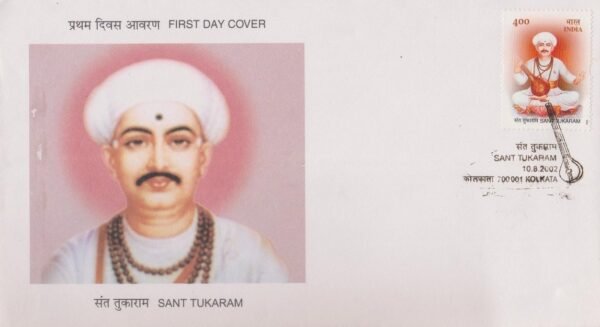
Sant Tukaram (1608-1650)

Technical Data
| Date of Issue | August 10, 2002 |
|---|---|
| Denomination | Rs. 4 |
| Quantity | 400,000 |
| Perforation | Syncopated 13 |
| Printer | Calcutta Security Printers Ltd |
| Printing Process | Offset Lithography |
| Watermark | No Watermark |
| Colors | Multicolor |
| Credit (Designed By) | Smt. Alka Sharma |
| Catalog Codes |
Michel IN 1912 Stamp Number IN 1965 Yvert et Tellier IN 1678 Stanley Gibbons IN 2080 WADP Numbering System - WNS IN024.02 |
| Themes | Authors | Commemoration | Famous people | Headgear | Literary People (Poets and Writers) | Literature | Men |
Mystic Poet of the Bhakti Movement
Tukaram (1608–1650), also known as Bhakta Tukobaraya, was one of the greatest saint-poets of Maharashtra and a leading figure of the Bhakti movement. Through his poetry and teachings, he brought religion closer to the common people and played a vital role in shaping the cultural and spiritual identity of the Marathas. A contemporary of Shivaji, Tukaram preached values of compassion, forgiveness, peace, and equality.
Early Life and Hardships
Tukaram was born in Dehu, a village on the banks of the Indrayani River, into a family of traders. His early life was marked by immense personal tragedy:
- Loss of his parents, first wife, and children at a young age
- The devastating famine of 1629, which also claimed his wife
- Financial ruin leading to poverty and bankruptcy
These hardships deeply affected him, turning him away from worldly life and toward spirituality.
Spiritual Awakening
In his search for meaning, Tukaram became devoted to Vithoba (Vitthal), the family deity worshipped widely in Maharashtra. Inspired by a divine vision of Namdev, a 13th-century saint-poet, Tukaram began composing abhangs—devotional poems written in simple Marathi.
Conflict with Orthodoxy
Tukaram’s teachings and writings challenged established religious norms:
- He wrote in Marathi, making spirituality accessible to common people instead of using Sanskrit
- His ideas questioned the monopoly of priests over religious interpretation
According to legend, offended priests forced him to throw his manuscripts into the Indrayani River. Miraculously, the writings are said to have reappeared unharmed after thirteen days, reinforcing his divine inspiration among followers.
Literary Contributions
Though no complete original manuscript survives, scholars estimate that Tukaram composed around 5,000 abhangs. His poetry is known for:
- Simple language and structure
- Deep philosophical insights
- Strong emphasis on devotion, morality, and social equality
Tukaram is often regarded as the first truly modern poet in Marathi, influencing both the language and its literary tradition profoundly. His works have been translated into several languages, including English, French, and German.
Final Years and Legacy
In 1650, Tukaram is believed to have mysteriously disappeared. Devotees hold that Lord Vithoba himself carried him away, marking a divine end to his earthly life.
Enduring Influence
Tukaram’s legacy continues to inspire:
- The Bhakti tradition in Maharashtra
- The development of the Marathi language and literature
- Social ideals of equality and devotion beyond caste barriers
To honour his immense contribution, India Post issued a commemorative postage stamp, celebrating Sant Tukaram as a spiritual icon and literary pioneer of India.
First Day Cover