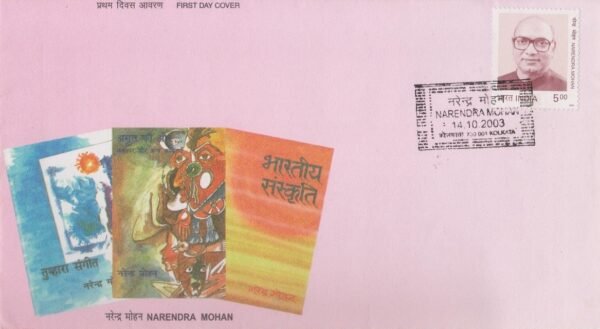
Narendra Mohan (1934-2002)

Technical Data
| Date of Issue | October 14, 2003 |
|---|---|
| Denomination | Rs. 5 |
| Quantity | 400,000 |
| Perforation | comb 13 |
| Printer | Calcutta Security Printers Ltd |
| Printing Process | Offset Lithography |
| Watermark | No Watermark |
| Colors | Multicolor |
| Credit (Designed By) | Smt. Alka Sharma |
| Catalog Codes |
Michel IN 1984 Stamp Number IN 2027 Yvert et Tellier IN 1749 Stanley Gibbons IN 2158 WADP Numbering System - WNS IN041.03 |
| Themes | Anniversaries and Jubilees | Famous people | Literary People (Poets and Writers) | Men | Newspapers | Optical Instruments | Publishers |
Introduction
The press is often referred to as the “Fourth Estate”, highlighting its importance alongside the three pillars of democracy—Legislature, Executive and Judiciary. In India, journalism has a proud tradition of defending truth, safeguarding public rights and promoting democratic values. One of the prominent figures who carried forward this legacy was Narendra Mohan, an eminent journalist and champion of Hindi media.
Role of the Press in India
During the early years of the Indian Independence Movement, newspapers played a vital role in spreading nationalist ideas and mobilizing public opinion. Through fearless writing and strong criticism of colonial policies, they contributed significantly to the repeal of repressive laws such as the Vernacular Press Act.
This rich tradition of fearless journalism inspired later generations of journalists, including Narendra Mohan.
Early Life
Narendra Mohan was born on 10 October 1934 in Kalpi, located in Jalaun District. Later, his family moved to Kanpur.
His father, Puran Chandra Gupta, established the Hindi newspaper Dainik Jagran in 1947. This publication would later become one of the most widely read newspapers in India.
Career in Journalism
In 1965, Narendra Mohan became the editor of Dainik Jagran, at a time when English-language newspapers dominated Indian journalism. He strongly believed that newspapers should represent the voice of ordinary people and that communication should occur in a language easily understood by the masses.
With his determination, impartial approach and dedication, Dainik Jagran grew to become one of the leading Hindi newspapers in the country. His efforts significantly strengthened the role and status of Hindi journalism in India.
Literary and Cultural Contributions
Apart from journalism, Narendra Mohan was also a poet and a passionate supporter of Indian culture. He introduced the weekly column “Vichar Pravaah”, which reflected his deep patriotism and admiration for India’s cultural heritage.
His speeches on Indian culture gained recognition internationally. One of his notable addresses was delivered at the Vishwa Shanti Sammelan, where he spoke about the richness of Indian traditions.
He also authored several literary and political works, including:
- Amrit ki Oar
- Kholo Dwaar
- Tumhara Sangeet
- Daasatva Se Ubaro
- Satya ki Dhoop
- Dharma Aur Saampradaayikta
- Pratiraksha Aur Saamrik Neeti
- Aaj ki Rajneeti Aur Bhrashtachaar
These writings reflected his thoughts on culture, politics and social issues.
Public Service and Recognition
In recognition of his contributions, Narendra Mohan was nominated to the Rajya Sabha in 1996. He also received prestigious honours such as the Matrushree Award and the Sita Award for excellence in journalism.
Inspired by the principle of “social service through journalism”, which he inherited from his father, Narendra Mohan actively supported relief efforts during national crises such as the Kargil War and the 2001 Gujarat Earthquake. He helped raise funds through the Jagran Rahat Kosh, contributing to the Prime Minister’s Relief Fund and Sainik Sahayata Kosh.
Legacy
Narendra Mohan passed away on 20 September 2002, leaving behind a lasting legacy in Indian journalism. To honour his immense contribution to media and society, India Post issued a commemorative postage stamp in his memory.
Conclusion
Narendra Mohan remains a towering figure in Hindi journalism. Through his dedication, vision and commitment to truth, he strengthened the role of regional-language media and ensured that the voice of the common citizen found a powerful platform in the press.
First Day Cover