
Tripuraneni Gopichand
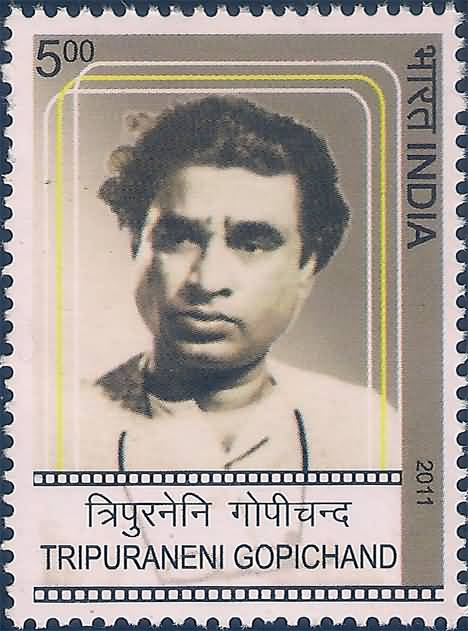
Technical Data
| Date of Issue | September 8, 2011 |
|---|---|
| Denomination | Rs. 5 |
| Quantity | 300,000 |
| Perforation | 13½ |
| Printer | Security Printing Press, Hyderabad |
| Printing Process | Wet Offset |
| Watermark | No Watermark |
| Colors | Multicolor |
| Credit (Designed By) | Smt. Alka Sharma |
| Catalog Codes |
Michel IN 2617 Stanley Gibbons IN 2834 WADP Numbering System - WNS IN041.2011 |
| Themes | Anniversaries and Jubilees | Authors | Commemoration | Famous people | Literary People (Poets and Writers) | Literature | Men |
A Luminary of Modern Telugu Literature
Early Life and Literary Lineage
Tripuraneni Gopichand was born on 8 September 1910 into a family deeply rooted in Telugu literary and cultural traditions. His father, Shri Tripuraneni Ramaswamy Chowdhry, popularly known as Kaviraju, was a renowned poet, nationalist, and freedom fighter. His mother, Smt. Punnamamba, nurtured an environment that encouraged intellectual curiosity and creative expression.
Growing up in such an atmosphere, Gopichand naturally evolved into one of the most powerful literary voices in Telugu literature.
Versatile Literary Career
Gopichand’s contribution to Telugu letters was vast and multifaceted. He distinguished himself as a writer, novelist, dramatist, essayist, and cine script writer. Over a literary career spanning nearly 35 years, he produced an impressive body of work, including:
- Ten novels
- Twelve plays
- Numerous essays and sketches
- Personal letters
- Over one hundred short stories
His writings are marked by depth, originality, and a strong social conscience.
Themes and Literary Style
Gopichand’s short stories broadly fall into four major categories—political, social, domestic, and autobiographical. Social issues and gender conflict remained his most favored themes. One of his most acclaimed stories, “Apadbandhavyam”, brilliantly portrays the psychological turmoil of a woman during an air journey, reflecting his keen insight into the human mind.
A distinctive feature of his storytelling was the innovative technique of narrating stories through non-human entities, presented as soliloquies with human emotions and reflections. His works are infused with satire, subtle humor, and sharp social critique.
Purposeful and Reformist Writing
Though well-read in European literature, Gopichand was never a blind imitator. His writings were purposeful, meant to educate, awaken, and challenge society. He boldly questioned age-old traditions, exposed self-deception, and condemned social injustice and tyranny in all forms.
Every piece of his writing reflects deep thought, moral inquiry, and a reformist spirit.
Awards and Recognition
In recognition of his literary excellence, Tripuraneni Gopichand was awarded the Sahitya Akademi Award in 1963 for his outstanding work “Panditha Parameshwara Sastry Veelunama”. This honor affirmed his enduring contribution to modern Telugu literature.
Legacy
Gopichand passed away on 2 November 1962, but his writings continue to inspire readers, scholars, and writers across generations. His fearless voice, intellectual honesty, and commitment to social reform secure his place among the greatest modern Telugu literary figures.
Commemorative Postage Stamp
Honouring his remarkable contribution to Telugu literature and cultural thought, the Department of Posts is pleased to issue a Commemorative Postage Stamp on Tripuraneni Gopichand, celebrating the life and legacy of this distinguished writer.
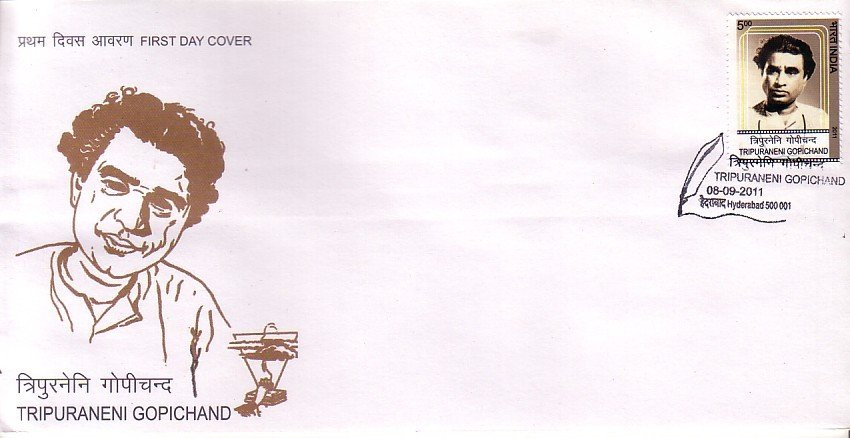
First Day Cover
Leave a Comment
You must be logged in to post a comment.