
100 Years of Mahatma Gandhi’s Return
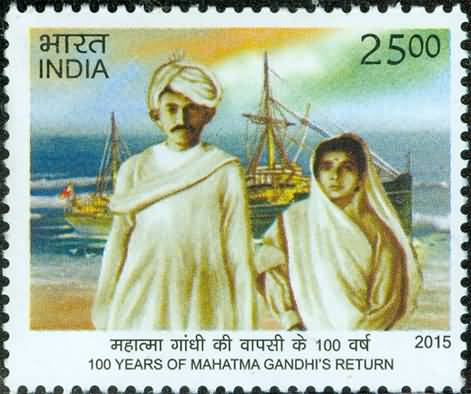
Technical Data
| Date of Issue | January 8, 2015 |
|---|---|
| Denomination | Rs. 25 |
| Quantity | 900,000 |
| Perforation | 13 |
| Printer | Security Printing Press, Hyderabad |
| Printing Process | Wet Offset |
| Watermark | No Watermark |
| Colors | Multicolor |
| Credit (Designed By) | Sh. Sankha Samanta Smt. Alka Sharma |
| Catalog Codes |
Michel IN 2862 Stamp Number IN 2714 Yvert et Tellier IN 2604 Stanley Gibbons IN 3033 |
| Themes | Anniversaries and Jubilees | Famous people | Freedom Fighters | Men | Teachers | Women |
The South African Journey That Shaped a Global Leader
A Visionary with Extraordinary Courage
Mahatma Gandhi is remembered as a visionary leader whose moral and physical courage shaped India’s freedom struggle and inspired movements for justice across the world. His early identity as a political activist formed the foundation for the pivotal role he later played in securing India’s independence from British rule. Gandhi not only led India’s freedom movement but also pioneered a unique form of civil disobedience that would become a guiding force for global non-violent movements.
Arrival in South Africa: The Beginning of a Transformation
In 1893, Gandhi travelled to South Africa as a newly qualified lawyer to assist an Indian trader in a commercial dispute. What was intended to be a brief assignment became a transformative chapter of his life. By the time he left South Africa in 1914, he had already earned the honorific “Mahatma”, or Great Soul, for his remarkable work in advocating the rights of the Indian community.
For more than a decade, Gandhi immersed himself in the struggle for justice. He:
- Prepared petitions and legal memoranda
- Led delegations to authorities
- Wrote extensively to newspapers
- Mobilized public opinion in South Africa, India, and Britain
His legal practice gradually evolved into a mission dedicated to defending the dignity and equality of Indians living under discriminatory laws.
Birth of Satyagraha: A New Path to Justice
It was in South Africa that Gandhi developed Satyagraha, the powerful philosophy of truth-force. This strategy encouraged peaceful marches, voluntary arrests, and moral resistance to unjust laws. Rooted in courage and non-violence, Satyagraha became one of the most influential political tools of the 20th century.
The principles born in South Africa later shaped India’s independence movement and inspired civil rights struggles across the globe.
South Africa: The Crucible of a Leader
Gandhi’s years in South Africa were crucial in shaping his political thinking, ethical values, and leadership style. It was here that he transformed from a young lawyer into a global figure who stood for justice, equality, and non-violence.
Return to India and Leadership in the Freedom Movement
Gandhi returned to India on 9 January 1915, a date now commemorated as Pravasi Bharatiya Divas. Soon after, he supported the Home Rule Movement and rose to leadership in the Indian National Congress. He championed non-violent non-cooperation as the path to independence and worked tirelessly to support farmers, laborers, and marginalized communities suffering under oppressive taxation and discrimination.
His unique ability to connect with the masses and transform ordinary people into participants in the national struggle made him the soul of India’s fight for freedom.
Commemorative Stamp: 100 Years of Gandhi’s Return
To honor this historic moment, India issued a commemorative postage stamp marking 100 Years of Mahatma Gandhi’s Return to India.
The stamp pays tribute to the journey that shaped the Mahatma and celebrates the values of truth, courage, and non-violence that he gifted to the world.