
400 Years of Guru Granth Sahib
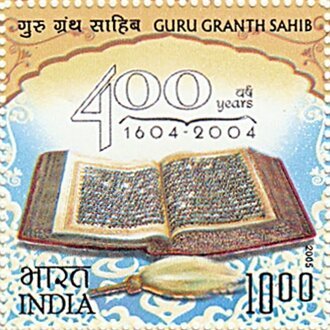
Technical Data
| Date of Issue | June 16, 2005 |
|---|---|
| Denomination | Rs. 10 |
| Quantity | 800,000 |
| Perforation | 13 |
| Watermark | No Watermark |
| Colors | Multicolor |
| Catalog Codes |
Michel IN III Stamp Number IN 2109 Stanley Gibbons IN Unlisted |
| Themes | Anniversaries and Jubilees | Books | Religion |
The Eternal Spiritual Guide of Sikhism
The Guru Granth Sahib stands as one of the most sacred and revered scriptures in the world. It represents the essence of India’s composite culture and carries a deeply unifying spiritual message. Through its hymns and teachings, the scripture presents a rich panorama of Indian spiritual thought, languages, and cultural traditions. Its verses, set to musical measures, create a melodious flow that elevates listeners beyond the limitations of region, religion, or social identity.
Compilation and Significance
The Guru Granth Sahib was compiled in 1604 by Guru Arjan Dev, the fifth Sikh Guru. The scripture contains 1430 pages filled with sacred hymns known as banis. These hymns reflect profound spiritual experiences and divine insights. Because it embodies the teachings of Sikh Gurus and saints, it is regarded as the eternal Guru of Sikhism.
The text includes the teachings of the first six Sikh Gurus, beginning with Guru Nanak, as well as the spiritual wisdom of several revered saints from different regions of India. Among them are Namdev from Maharashtra, Ravidas and Ramananda from Banaras, Jayadeva from Bengal, Pipa from Rajasthan, and Fariduddin Ganjshakar from the north-western region of the Indian subcontinent. This diversity highlights the inclusive and universal character of the scripture.
Teachings and Philosophy
The Guru Granth Sahib emphasizes equality among all human beings and firmly rejects the caste system. Inspired by the teachings of Guru Nanak, it established important institutions that promote community harmony and spiritual unity.
Two such institutions are Sangat (holy congregation) and Pangat (community kitchen or langar). These traditions encourage people from all backgrounds to gather, worship, and share meals together, reinforcing the idea of social equality and brotherhood.
The scripture also prescribes three simple yet profound principles for daily life:
- Kirat Karna – earning a livelihood through honest work
- Nam Japna – remembering and meditating on the Divine
- Vand Chhakna – sharing one’s earnings with those in need
These principles guide both the elite and the common people toward a balanced life rooted in spirituality, compassion, and social responsibility.
Message of Unity and Humanity
The Guru Granth Sahib goes beyond the conventional definition of a religious scripture. Its teachings encourage reflection and understanding rather than blind acceptance. It upholds the dignity and honour of every individual and promotes universal human values.
The message of the Holy Granth can be summarized in a powerful idea: humanity is one, and divisions based on religion, region, or culture are meaningless. It teaches that there is no fundamental difference between Hindu, Muslim, Sikh, or Christian—every human being belongs to the same universal family.
Legacy and Commemoration
With its profound spiritual wisdom and ethical guidance, the Guru Granth Sahib has stood the test of time and continues to inspire millions around the world. Recognizing its immense spiritual and cultural significance, India Post issued a commemorative postage stamp in honour of the Guru Granth Sahib, celebrating its timeless message of unity, equality, and universal brotherhood.
Leave a Comment
You must be logged in to post a comment.