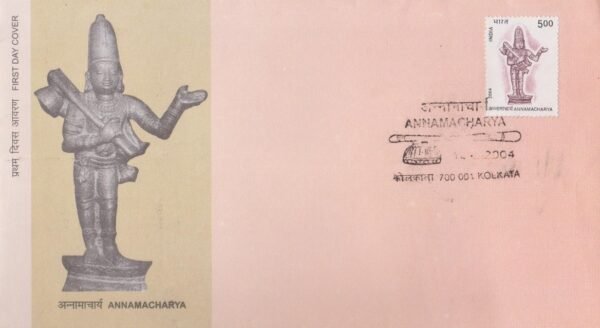
Annamacharya (1408-1503)

Technical Data
| Date of Issue | March 18, 2004 |
|---|---|
| Denomination | Rs. 5 |
| Quantity | 400,000 |
| Perforation | comb 14 |
| Printer | Security Printing Press, Nashik |
| Printing Process | Photogravure |
| Watermark | No Watermark |
| Colors | Multicolor |
| Credit (Designed By) | Sh. Brahm Prakash Smt. Alka Sharma |
| Catalog Codes |
Michel IN 2018 Stamp Number IN 2054 Yvert et Tellier IN 1783 Stanley Gibbons IN 2195 WADP Numbering System - WNS IN004.04 |
| Themes | Commemoration | Composers | Famous people | Men | Saints |
The Mystic Poet of Devotion
Annamacharya, also known as Annamayya, was a renowned 15th-century mystic saint, social reformer, and devotional poet. Revered as a “Sahaja Vaggeyakara”—a composer who both writes and sings his own compositions—he is remembered as one of the earliest and most influential composers of devotional music dedicated to Lord Venkateswara. His spiritual songs, known as Sankirtanams, conveyed deep philosophical truths and promoted equality among all people.
Early Life
Annamacharya was born in 1408 in Rajampet, in the present-day Andhra Pradesh, to Lakkamamba and Narayana Suri. According to tradition, he was named Annamayya because he was believed to have been born through the divine grace of Nandaka, the sacred sword of Lord Vishnu.
From a young age, Annamayya displayed deep spiritual inclination. At a tender age he left home carrying a tanpura, determined to reach Tirumala Venkateswara Temple, the sacred abode of Lord Venkateswara. During his journey to Tirumala, he spontaneously composed and sang a hundred verses praising Alamelu Manga.
Spiritual Initiation and Family Life
At Tirumala, Annamayya was initiated into Sri Vaishnavism by the sage Ghana Vishnu, after which he came to be known as Annamacharya. At the age of sixteen, he married and entered the life of a Grihastha (householder) while continuing his devotional pursuits.
A popular legend narrates that in 1424, Lord Venkateswara appeared before Annamacharya while he was in deep meditation. The deity expressed a wish to hear a new devotional song from him every day. From that moment, Annamacharya devoted his life to composing and singing devotional hymns in praise of the Lord.
Immense Literary and Musical Contribution
According to Chinna Tirumalacharya, Annamacharya composed about 32,000 Sankirtanams. These compositions were written in simple language enriched with native idioms, spiritual philosophy, and profound devotion. His songs emphasized equality and urged people to transcend varna and social differences in the pursuit of God.
His Sankirtanams are broadly classified into two categories:
- Sringara Sankirtanams – expressing Madhura Bhakti, the pure and divine love between the soul and God.
- Adhyatma Sankirtanams – focusing on spiritual surrender, devotion, and philosophical reflection.
These devotional compositions became an integral part of the rituals at the Tirumala temple, where the Lord is awakened with the Melukolupu (morning song) and lulled to sleep with the Jola Pata (lullaby) composed by Annamacharya.
Other Literary Works
Apart from Sankirtanams, Annamacharya authored several important literary works, including:
- Sringara Manjari
- Dwipada Ramayanam
- Venkatachala Mahatyam
- Sankirtana Lakshanam
In Telugu literature, he earned titles such as “Sankirtanacharya,” “Pada Kavita Pitamaha,” and “Dravidagana Sarvabhouma.”
Many of his compositions were engraved on copper plates, though unfortunately a large number were lost over time. Today, only about 14,400 Sankirtanams and one Sataka survive.
Influence on Carnatic Music
Annamacharya is widely regarded as a pioneer of Carnatic music. He systematized the structure of devotional compositions by establishing the format of Pallavi and Charanams, achieving a harmonious unity between Raga, Bhava, and Tala.
The renowned Carnatic composer Purandara Dasa, who is believed to have met Annamacharya, praised his compositions as sacred hymns possessing spiritual and even healing power.
Encounter with the Vijayanagara Ruler
An interesting episode from his life involves Saluva Narasimha Raya, a chieftain of the Vijayanagara Empire. Impressed by Annamacharya’s music, the king once invited him to court and requested a song in his praise.
Annamacharya declined respectfully, saying that his soul was devoted only to God (Narahari) and could not praise man (Nara). Offended, the king imprisoned him. According to tradition, when Annamacharya prayed to Lord Venkateswara, the chains binding him miraculously broke. Realizing his mistake, the king sought forgiveness from the saint.
Final Years and Legacy
Annamacharya lived a long and devoted life and passed away in 1503 at the age of 95. Before his departure, he entrusted his tanpura to his son Peda Tirumalaiah, urging him to continue the spiritual and musical mission he had begun.
Though centuries have passed since his death, the divine compositions of Annamacharya still resonate across the sacred hills of Tirumala, inspiring devotees and musicians alike.
In recognition of his immense spiritual and cultural contribution, India Post issued a commemorative postage stamp to honour the life and legacy of this great saint-poet.
First Day Cover