Bade Ghulam Ali Khan (1902-1968)
Technical Data
| Date of Issue | June 30, 2003 |
|---|---|
| Denomination | Rs. 5 |
| Quantity | 400,000 |
| Perforation | comb 13 x 13¼ |
| Printer | Calcutta Security Printers Ltd |
| Printing Process | Offset Lithography |
| Watermark | No Watermark |
| Colors | Multicolor |
| Credit (Designed By) | Sh. Bharati Mirchandani |
| Catalog Codes |
Michel IN 1969 Stamp Number IN 2014 Yvert et Tellier IN 1734 Stanley Gibbons IN 2142 WADP Numbering System - WNS IN026.03 |
| Themes | Commemoration | Famous people | Headgear | Men | Musical Instruments | Musicians | Singers |
Bade Ghulam Ali Khan was an unquestioned genius and one of the greatest vocalists of the twentieth century. His extraordinary talent and powerful voice left an indelible mark on Hindustani classical music, particularly within the renowned Patiala Gharana.
Early Life and Training
Bade Ghulam Ali Khan received his early musical training within his family. His father, Ali Baksh Khan, a respected Dilruba player from Kasur, and his uncle Kale Khan, a distinguished musician of the Patiala Gharana, played an important role in shaping his musical foundation. From a young age, he displayed exceptional musical qualities such as vitality, concentration, stamina and remarkable strength of character.
Rise to Fame
Although he made his formal debut in 1939 at the All India Music Conference in Kolkata, his first major public concert in Mumbai a few years later proved to be the turning point of his career. From that moment, his fame spread rapidly and he captivated audiences throughout the Indian subcontinent. In 1958, he moved from Lahore and settled permanently in Mumbai.
Musical Style and Contributions
Ustad Bade Ghulam Ali Khan was primarily an exponent of Khayal singing. However, he also rendered Thumri and Bhajan with equal brilliance.
One of his notable innovations was refining a worn harp-like instrument he had found in a junk shop into a musical accompaniment known as the Surmandal, which later became an integral part of his performances.
Compositions and Recordings
Bade Ghulam Ali Khan composed more than a hundred khayals and thumris, setting them to music and popularising them through performances at music conferences and through recordings. His works were widely distributed through records and later cassettes, gaining immense popularity across the world. His flawless command over sargam patterns further demonstrated the depth of his musical genius.
Personality and Legacy
Khan Sahib was known not only for his musical brilliance but also for his warm and charming personality. Admirers believed that the harmony in his music reflected the harmony within his character. His wit, wisdom and unforgettable smile endeared him to all who knew him.
Honours and Recognition
His remarkable contributions to music brought him many prestigious honours. He was elected a Fellow of the Sangeet Natak Akademi and was awarded the Padma Bhushan by the President of India. He was also conferred the honorary degree of Doctor of Literature by Visva-Bharati University.
Commemoration
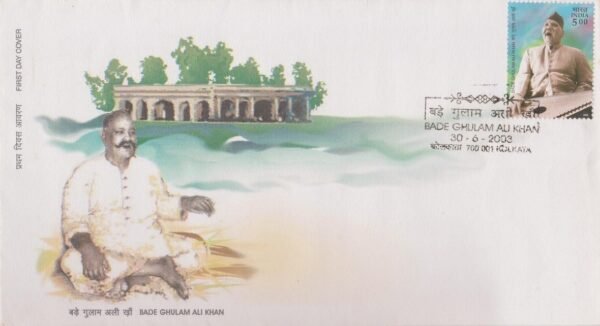
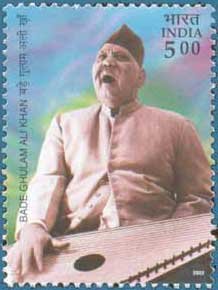
To honour this legendary musician, India Post issued a commemorative postage stamp portraying him in concert with the Surmandal in his hand. The First Day Cover features Kamran’s Baradari, recalling the days when he practised his riyaz on the banks of the Ravi River.
Through his unparalleled artistry and devotion to music, Ustad Bade Ghulam Ali Khan continues to inspire generations of musicians and music lovers around the world.
First Day Cover