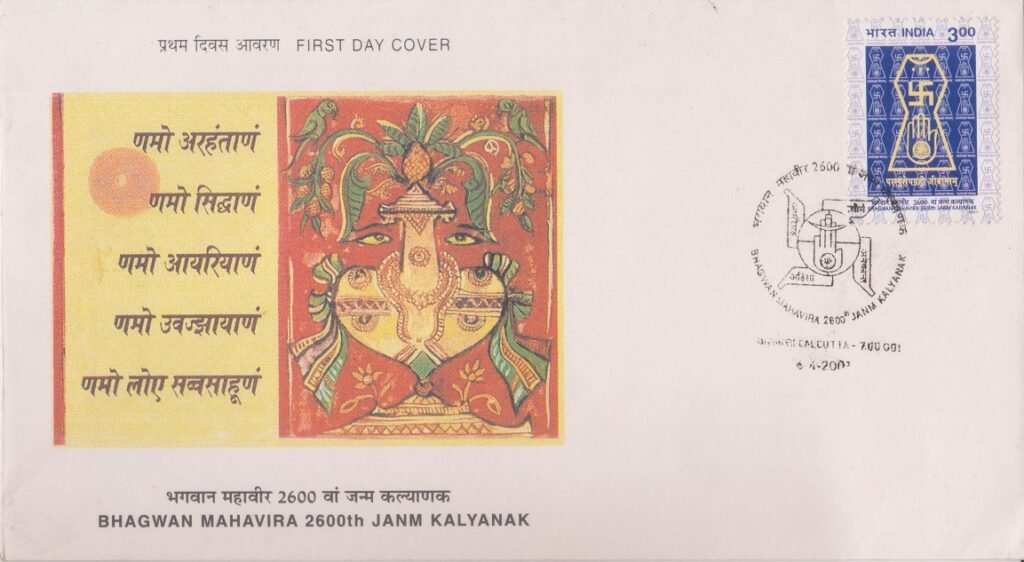
Bhagwan Mahavira 2600Th Janm Kalyanak

Technical Data
| Date of Issue | April 6, 2001 |
|---|---|
| Denomination | Rs. 3 |
| Quantity | 300,000 |
| Perforation | comb 13 |
| Printer | Calcutta Security Printers Ltd |
| Printing Process | Offset Lithography |
| Watermark | No Watermark |
| Colors | Multicolor |
| Credit (Designed By) | Sh. Sankha Samanta |
| Catalog Codes |
Michel IN 1828 Stamp Number IN 1888 Yvert et Tellier IN 1594 Stanley Gibbons IN 1995 |
| Themes | Anniversaries and Jubilees | Religion | Symbols |
Life, Teachings, and Legacy of the 24th Tirthankara
Bhagwan Mahavira, the 24th Tirthankara of the Jain tradition, was born into a royal family in Vaishali, Bihar. His father, King Siddhartha, ruled the region, and his mother, Trishala, was the daughter of King Cetaka.
Early Life and Spiritual Inclination
Bhagwan Mahavira was known as Vardhamana during his childhood. Even at a young age, he displayed deep compassion and a strong inclination toward spirituality. His thoughtful and introspective nature led him to reflect on the suffering and challenges faced by society.
At the age of thirty, after living as a householder, he renounced worldly life in search of truth and higher knowledge.
Path to Enlightenment
Mahavira spent twelve years as an ascetic, practicing intense penance, self-discipline, and meditation. He wandered from place to place, focusing on self-purification and spiritual growth.
At the age of forty-two, he attained Kevala Jnana (absolute knowledge). Through this enlightenment, he gained a complete understanding of life and the universe. Having conquered both joy and suffering, he came to be known as Mahavira, meaning “the great hero.”
Core Teachings of Bhagwan Mahavira
Bhagwan Mahavira emphasized five fundamental principles that form the foundation of Jain philosophy:
- Ahimsa (Non-violence)
- Satya (Truth)
- Asteya (Non-stealing / honesty)
- Aparigraha (Non-possession)
- Brahmacharya (Celibacy)
He preached universal love, compassion, and respect for all living beings. According to him, salvation is a state of eternal bliss that can be achieved through disciplined effort in this very life.
Mahavira believed that every individual is the master of their own destiny and that every soul has the potential to attain perfection and liberation from the cycle of birth and death.
Philosophy of Ahimsa and Anekant
The principle of Ahimsa lies at the heart of Mahavira’s teachings. He urged people to avoid harming any living being—not only physically, but also through thoughts and actions.
In Jain philosophy, Ahimsa extends beyond non-violence to include:
- Compassion and empathy
- Charity and kindness
- Universal friendship and forgiveness
Another key concept is Anekantavada, which teaches that truth and reality have multiple perspectives. This principle encourages tolerance, open-mindedness, and respect for differing opinions.
Social Reform and Inclusivity
Bhagwan Mahavira challenged social inequalities and worked to eliminate harmful practices. He welcomed both men and women into his spiritual order without discrimination, promoting equality and ethical living.
Enduring Legacy
The teachings of Bhagwan Mahavira remain highly relevant in today’s world, which is often marked by conflict and materialism. His message of non-violence, tolerance, and self-discipline offers a path toward personal peace and global harmony.
In recognition of his timeless contributions, the Department of Posts issued a commemorative postage stamp to mark the 2600th birth anniversary of Bhagwan Mahavira. The stamp features a symbolic representation of key Jain teachings.
First Day Cover