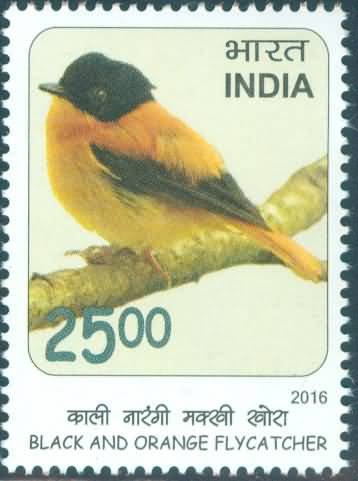
Black & Orange Flycatcher
Technical Data
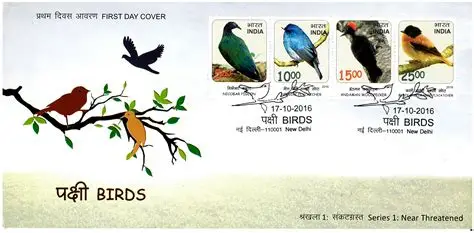
| Stamp Set | Birds - Series 1: Near Threatened |
|---|---|
| Date of Issue | October 17, 2016 |
| Denomination | Rs. 25 |
| Quantity | 300,000 |
| Perforation | 13¾ x 13¼ |
| Printer | Security Printing Press, Hyderabad |
| Printing Process | Wet Offset |
| Watermark | No Watermark |
| Colors | Multicolor |
| Credit (Designed By) | Ms. Nenu Gupta |
| Catalog Codes |
Michel IN 3012 Yvert et Tellier IN 2724 Stanley Gibbons IN 3185 |
| Themes | Animals (Fauna) | Birds |
The Black-and-Orange Flycatcher, scientifically known as Ficedula nigrorufa (Jerdon, 1839), is a striking and charismatic bird species endemic to the Western Ghats of southern India. Its vibrant plumage and specialized habitat preferences make it one of the unique avian treasures of the region. Classified as Near Threatened (NT) under the IUCN Red List, the species faces growing pressures from habitat modification and human expansion.
A Restricted Yet Rich Habitat
The Black-and-Orange Flycatcher occupies a moderately small geographical range, confined mainly to:
- Shola forests with dense undergrowth such as bamboo and rattan
- Moist ravines and thickets
- Cardamom and coffee plantations
- Elevations ranging from 700 m up to the highest Western Ghat summits
This bird is typically seen foraging low to the ground, hopping silently through damp, dense vegetation in search of insects.
Population Status and Behavior
- The exact population size is unknown, but the species is described as common or locally common within its limited range.
- Its behavior is highly adapted to cool, moist, and shaded habitats.
- The breeding season spans from March to July, during which the species establishes territories and nests within thick vegetation.
Though tolerant of some habitat modification, it remains sensitive to large-scale landscape changes.
Threats and Conservation Concerns
The Black-and-Orange Flycatcher is listed as Near Threatened due to increasing pressures associated with human activity in the Western Ghats:
Key Threats
- Habitat destruction and fragmentation
- Illegal encroachment into forests due to rising human population
- Livestock grazing within sensitive forest areas
- Harvesting of fuelwood, especially for tea factories
- Extraction of bamboo, canes, and other forest products
- Hydroelectric power projects and road-building, which reduce forest cover
If these pressures continue unmanaged, they could severely impact the species’ habitat and population stability.
Why Conservation Matters
The Black-and-Orange Flycatcher is a vital part of the Western Ghats’ ecological fabric. As an indicator of healthy shola ecosystems, its survival reflects the wellbeing of one of India’s most biodiverse landscapes. Conservation efforts that focus on protecting hill forests, regulating resource extraction, and promoting sustainable development are essential to safeguarding this species for the future.
Commemorative Postage Stamp
To raise awareness and celebrate India’s rich avifauna, the Department of Posts issued a commemorative postage stamp featuring the Black-and-Orange Flycatcher.
First Day Cover