
Builder’s Navy
Technical Data
| Date of Issue | December 4, 2005 |
|---|---|
| Denomination | Rs. 5 |
| Quantity | 800,000 |
| Perforation | comb 13¼ |
| Printer | Security Printing Press, Nashik |
| Watermark | No Watermark |
| Colors | Multicolor |
| Catalog Codes |
Michel IN 2114 Stamp Number IN 2129 Yvert et Tellier IN 1881 Stanley Gibbons IN 2299 WADP Numbering System - WNS IN046.05 |
| Themes | Navies | Ships | Warships |
Introduction
India has a long and rich maritime tradition that dates back several thousand years. The history of shipbuilding and seafaring in the country reflects remarkable technical knowledge and maritime expertise. Over time, this heritage evolved into the modern naval shipbuilding capability of the Indian Navy, which is proudly known today as a “Builder’s Navy”.
Ancient Maritime Tradition
The existence of an ancient sea-faring and shipbuilding tradition in India can be traced back to around 2300 BC. Archaeological evidence suggests that the world’s first tidal dock was constructed at Lothal during the Harappan Civilization. This dockyard was located near the present-day Mangrol harbour on the Gujarat coast.
Ancient Indian texts also contain references to maritime activities. The Rig Veda mentions the sea god Varuna, who possessed knowledge of ocean routes. It also describes naval expeditions using ships with a hundred oars to conquer distant kingdoms. Similarly, the Atharva Veda refers to well-constructed boats that were spacious and comfortable.
Shipbuilding During the Colonial Period
Even during the pre-independence period, Indian shipbuilders were highly respected for their craftsmanship. Many ships built in India were inducted into the Royal Navy. These included vessels such as HMS Hindostan, HMS Cornwallis, HMS Camel and HMS Ceylon.
Another important milestone was the construction of the Bombay Dock in 1735, which continues to be in use today at the Naval Dockyard in Mumbai.
Development of the Modern Indian Navy
After independence, the Indian Navy began with a modest fleet consisting of a few destroyers, frigates, mine sweepers, a corvette and a survey vessel inherited from the Royal Indian Navy.
Several key developments marked the growth of modern naval shipbuilding in India. These included the creation of the Corps of Naval Constructors in 1954, the establishment of the Central Design Office in 1964, and the decision to construct Leander-class frigate under licence at Mazagon Dock Shipbuilders Limited.
In 1970, the Directorate of Naval Ship Design was established. Later, the Directorates of Ship Production and Submarine Design were formed, eventually evolving into the Controllerate of Warship Production and Acquisitions at Naval Headquarters.
Growth of Indigenous Ship Design
Indian naval designers initially focused on small vessels such as ocean-going tugs, landing craft utilities, seaward defence boats and survey crafts. Over time, they advanced to designing more complex vessels including Landing Ship Tanks, the Sandhayak-class survey vessel and the training ship INS Tir.
These vessels were produced by major defence shipyards including Mazagon Dock Shipbuilders Limited, Garden Reach Shipbuilders & Engineers and Goa Shipyard Limited.
Advanced Warship Construction
During the mid-1980s, Indian naval designers successfully developed sophisticated warships such as missile corvettes, Delhi-class destroyer and Brahmaputra-class frigate.
Another significant achievement was the licensed production of two Type 209 submarine submarines at Mazagon Dock Shipbuilders Limited between 1984 and 1994.
The navy has also been engaged in the development of the modern Shivalik-class frigate, which incorporates advanced design concepts and stealth technology.
Indigenous Technology and Industry
Alongside shipbuilding, India has steadily developed indigenous machinery, equipment, weapons, systems and materials for its warships. Initially, this was achieved through collaborations with foreign manufacturers. Gradually, India built its own vendor base involving both public and private sector industries.
As a result of these efforts, the indigenous content in Indian warships and submarines has increased to more than 70 percent.
Commemorative Postage Stamp
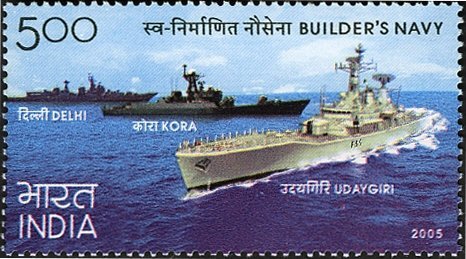
To recognise India’s achievements in indigenous naval shipbuilding, the Department of Posts issued a commemorative postage stamp on the theme of the “Builder’s Navy”. The stamp depicts a INS Udaygiri, representing the Leander-class frigate, along with a Kora-class corvette and a Delhi-class destroyer, symbolizing the progress and strength of India’s naval shipbuilding capability.
Leave a Comment
You must be logged in to post a comment.