
Cape Parrot
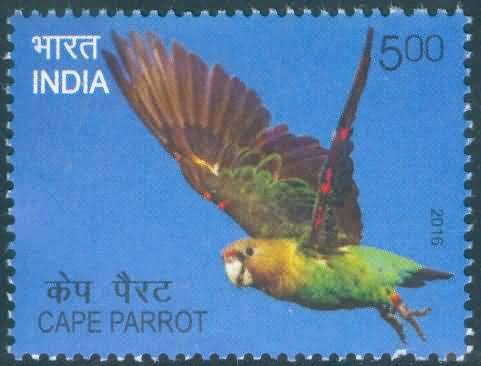
Technical Data
| Stamp Set | Exotic Birds |
|---|---|
| Date of Issue | December 5, 2016 |
| Denomination | Rs. 5 |
| Quantity | 200,000 |
| Perforation | 13¾ |
| Printer | Security Printing Press, Hyderabad |
| Printing Process | Wet Offset |
| Watermark | No Watermark |
| Colors | Multicolor |
| Credit (Designed By) | Smt. Alka Sharma |
| Catalog Codes |
Michel IN 3026A Stamp Number IN 2863 Yvert et Tellier IN 2733 Stanley Gibbons IN 3196 |
| Themes | Animals (Fauna) | Birds | Parrots |
The Forest Sentinel of South Africa
(Commemorative Postage Stamp)
The Cape Parrot, also known as Levaillant’s Parrot, is a striking, temperate-forest parrot found exclusively in South Africa. Admired for its robust build, rich coloration, and deep association with the ancient yellowwood forests, this rare species holds a cherished place in avian heritage. The commemorative postage stamp honours the Cape Parrot’s beauty and highlights the urgent need to protect its fragile habitat.
Distinctive Appearance
- The Cape Parrot is a moderately large, short-tailed parrot with a powerful beak, perfectly adapted for cracking hard nuts.
- Its plumage is a blend of dark brown, olive, and reddish tones, lending it a warm, earthy presence that harmonizes with its forest home.
- Subtle variations in plumage and size exist across populations, leading to long-standing debate among ornithologists regarding its classification.
- While appearances differ slightly, all forms possess the majestic, sturdy look characteristic of Poicephalus parrots.
Habitat & Distribution
- This species is endemic to South Africa, making it one of the country’s most treasured avian icons.
- It is closely associated with Afromontane Southern Mistbelt Forests, particularly regions rich in yellowwood trees.
- These forests provide essential nesting and feeding grounds, as the Cape Parrot relies heavily on these giant trees for survival.
Behaviour & Ecology
- A secondary cavity nester, the Cape Parrot prefers tall, dead yellowwood trees for nesting—a resource increasingly scarce.
- The species is intelligent, social, and often seen in small groups communicating in sharp, resonant calls.
- Their diet consists mainly of yellowwood fruits, nuts, berries, and seeds, reinforcing their ecological link to native forests.
- These parrots play a vital role in forest regeneration by dispersing seeds.
Conservation Challenges
The Cape Parrot faces several threats that have caused concerning population declines:
- Habitat loss due to logging, forest degradation, and reduced yellowwood populations.
- Psittacine Beak and Feather Disease (PBFD), a debilitating viral infection affecting feather quality and immune health.
- Local poaching and illegal trade, though less severe than in other parrot species, still poses risks.
These pressures have placed the Cape Parrot among South Africa’s most vulnerable birds, prompting dedicated conservation and research initiatives.
Taxonomic Significance
- The species’ classification has been a subject of debate due to the presence of three geographically separated but closely related forms.
- While some argue these may represent distinct species, the BirdLife International checklist recognizes them as subspecies of a single species, Poicephalus robustus.
- Regardless of taxonomy, the Cape Parrot remains a symbol of South Africa’s natural heritage.
Cultural & Ecological Importance
The Cape Parrot stands as a living emblem of South Africa’s forest ecosystems. Its survival is intertwined with the fate of ancient yellowwood trees—trees that hold deep cultural and historical value across the region. Conservation of this species therefore represents a broader commitment to preserving the country’s ecological legacy.
A Philatelic Tribute
The commemorative postage stamp celebrates the Cape Parrot as a rare and beautiful forest guardian. Through this issue, the Department of Posts acknowledges the need to protect endangered birds and their habitats, inspiring appreciation and awareness of these remarkable creatures.