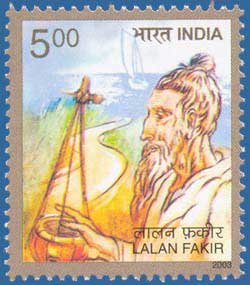
Folk Music – Lalan Fakir
Technical Data
| Stamp Set | Personality Series |
|---|---|
| Date of Issue | December 29, 2003 |
| Denomination | Rs. 5 |
| Quantity | 400,000 |
| Perforation | comb 13 |
| Printer | Calcutta Security Printers Ltd |
| Watermark | No Watermark |
| Colors | Multicolor |
| Catalog Codes |
Michel IN 2011 Stamp Number IN 2048 Yvert et Tellier IN 1776 Stanley Gibbons IN 2188 WADP Numbering System - WNS IN069.03 |
| Themes | Famous people | Men | Philosophers | Singers |
The Baul Saint of Bengal
Early Life
Lalon Fakir (1774–1890), also known as Fakir Lalon Shah, is regarded as the greatest figure among the Bauls of Bengal. He was born in Bhanrara village of Kushtia District, which is now located in Bangladesh.
Lalan Fakir was the only child of his parents. After losing his father at an early age, he was unable to receive formal institutional education. However, his village was rich in folk traditions and well known for its culture of devotional folk music, particularly Baul songs, which greatly influenced him from childhood.
Journey to Spiritual Life
From an early age, Lalan was deeply drawn to devotional singing. According to tradition, he once went on a pilgrimage with his neighbours. During the journey, he contracted smallpox and fell seriously ill. Believing him to be dead, his companions abandoned him.
A compassionate Muslim woman rescued him, nursed him back to health, and saved his life. However, when Lalan returned, his community refused to accept him back. This experience led him to renounce worldly life and embrace an ascetic path under the guidance of Siraj Sain, who became his spiritual mentor.
Philosophy and Teachings
Lalan Fakir later established a spiritual centre in the village of Cheuriya near Kushtia. From there, he spread his spiritual philosophy rooted in humanism, universal love, philanthropy, and secularism.
His teachings rejected rigid social divisions such as caste and religious barriers. Instead, he emphasised the unity of humanity and the search for inner spiritual truth.
Contribution to Baul Music
Baul songs are among the most popular forms of folk music in rural Bengal. Lalan Fakir played a major role in shaping and popularising this musical tradition. His devotional songs were simple yet deeply philosophical, touching the hearts of people across communities.
Through his music and teachings, Lalan created a powerful cultural movement that brought together people of different religions and social backgrounds. His open-minded and secular outlook gave a new dimension to the Baul tradition and inspired a profound cultural awakening in rural Bengal.
Influence on Literature and Culture
The great poet and philosopher Rabindranath Tagore was deeply influenced by Lalan Fakir’s philosophy and Baul traditions. Tagore incorporated many elements of Baul spirituality into his own compositions, helping to bring the essence of Baul culture to a wider audience.
Legacy
Lalan Fakir’s life and teachings left a lasting impact on the spiritual and cultural life of Bengal. His songs continue to be sung across Bengal, inspiring generations with their message of unity, humanity, and spiritual freedom.
Commemorative Postage Stamp
To honour his immense contribution to folk music and spiritual thought, India Post issued a commemorative postage stamp on Fakir Lalon Shah as part of the “Personality Series: Folk Music.” The stamp celebrates his legacy as a philosopher, saint, and one of the greatest exponents of Baul music.
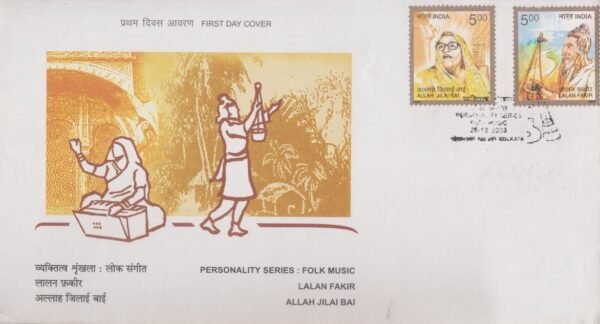
First Day Cover