
Centenary of Indian Council of Medical Research
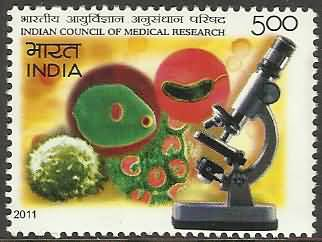
Technical Data
| Date of Issue | November 8, 2011 |
|---|---|
| Denomination | Rs. 5 |
| Quantity | 300,000 |
| Perforation | 13½ |
| Printer | Security Printing Press, Hyderabad |
| Printing Process | Wet Offset |
| Watermark | No Watermark |
| Colors | Multicolor |
| Credit (Designed By) | Shri Kamleshwar Singh Smt. Alka Sharma |
| Catalog Codes |
Michel IN 2622 Stanley Gibbons IN 2839 WADP Numbering System - WNS IN046.2011 |
| Themes | Anniversaries and Jubilees | Medical Science | Microscopes |
Advancing Health Through Research
Origins and Evolution
To support research activities related to medical science, officers of the then Indian Medical Service established the Indian Research Fund Association in 1911. After Independence, this pioneering body was rechristened as the Indian Council of Medical Research (ICMR). What began as an effort to conduct systematic “enquiry” into health problems has since evolved into India’s apex organization for biomedical research.
A National Network of Excellence
Over the decades, ICMR has grown into a vibrant and extensive research network comprising 30 permanent institutes and centres and over 70 field stations across the country. The Council employs more than 5,000 personnel, including around 750 scientists, reflecting its strong scientific and technical foundation. Its budgetary support has steadily increased over successive Plan periods, reaching ₹4,496 crore during the 11th Five Year Plan, underscoring the nation’s commitment to health research.
Mission and Vision
The core mission of ICMR is “better health through research.” In keeping with India’s evolving health landscape, the Council has continuously adapted its research priorities to address challenges arising from economic growth, demographic shifts, nutritional transitions, and changing disease patterns.
Research Stewardship and Strategy
ICMR provides national leadership in health research by conducting and supporting studies through its own institutions, while also promoting innovation through grants-in-aid to non-ICMR institutions. Its research strategy emphasizes close interaction with health systems and national disease control programmes, ensuring a seamless transition from laboratory to field, and from biomedical science to public health application.
Focus Areas and National Priorities
The research agenda of ICMR closely aligns with the country’s health policies and national priorities. The Council works in close coordination with national programmes aimed at control, elimination, and eradication of diseases. Key areas of focus include communicable diseases, maternal and child health, nutrition, and the health needs of marginalised populations, including tribals, women, and underprivileged communities.
Intramural and Extramural Research
To achieve its objectives, ICMR follows a twin-track approach:
- Intramural research, carried out through its own institutes
- Extramural research, supported through grants-in-aid to external institutions
Currently, about 25% of ICMR’s budget is allocated to extramural research, encouraging wider scientific participation and collaboration.
Global Collaboration and Ethics
In an increasingly globalized research environment, ICMR actively promotes international collaborations, contributes to human resource development, and plays a vital role in setting national research agendas. Ensuring that research is conducted in an ethically acceptable and scientifically robust manner remains a cornerstone of its mandate.
Commemorative Postage Stamp
Recognizing its century-long contribution to medical science and public health, India Post is pleased to issue a Commemorative Postage Stamp on the Indian Council of Medical Research, celebrating its pivotal role in advancing health research for the nation.
First Day Cover

Leave a Comment
You must be logged in to post a comment.