
Ravi Shankar
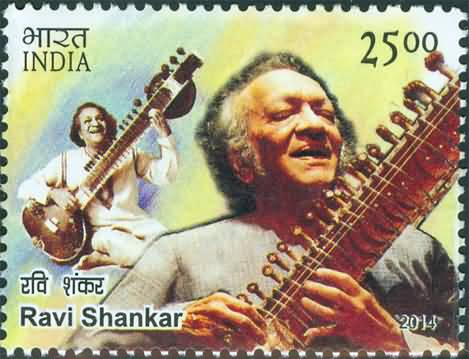
Technical Data
| Stamp Set | Indian Musicians |
|---|---|
| Date of Issue | September 3, 2014 |
| Denomination | Rs. 25 |
| Quantity | 800,000 |
| Perforation | 13½ |
| Printer | Security Printing Press, Hyderabad |
| Printing Process | Wet Offset |
| Watermark | No Watermark |
| Colors | Multicolor |
| Credit (Designed By) | Ms. Nenu Gupta Sh. Sankha Samanta |
| Catalog Codes |
Michel IN 2846 Yvert et Tellier IN 2591 Stanley Gibbons IN 3018 |
| Themes | Famous people | Men | Musical Instruments | Musicians |
Introduction
Pandit Ravi Shankar was an iconic sitar virtuoso, composer and one of the most influential ambassadors of Indian classical music on the global stage. His artistry, innovation and relentless dedication elevated Hindustani music to international acclaim and earned him a place among the greatest musicians of the 20th century.
Early Life
Ravi Shankar was born on 7th April, 1920, in Varanasi, Uttar Pradesh. He spent his childhood travelling with his brother Uday Shankar’s dance troupe, gaining early exposure to world cultures and performing arts. His deep inclination towards music led him to pursue rigorous training in the sitar under the legendary maestro Ustad Allauddin Khan of the Maihar Gharana.
Musical Journey
Ravi Shankar’s career was marked by extraordinary versatility and innovation.
- His sitar recitals were distinguished by technical brilliance, spiritual depth and melodic purity.
- He composed extensively for films, orchestras, ballets and festivals, blending classical discipline with global sensibilities.
- His collaborations with world-renowned artists such as Yehudi Menuhin, George Harrison, and several Western orchestras introduced Indian classical music to entirely new audiences.
- He played a central role in popularizing the sitar during the 1960s and 70s, becoming a cultural bridge between East and West.
He also composed the music for Satyajit Ray’s acclaimed Apu Trilogy, further establishing his stature as a creative genius.
Honours and Recognition
For his towering contributions, Pandit Ravi Shankar received numerous prestigious honours, including:
- Bharat Ratna (1999) – India’s highest civilian award
- Padma Bhushan and Padma Vibhushan
- Three Grammy Awards
- International accolades and honorary doctorates from leading global institutions
He was admired for his ability to maintain classical purity while embracing new musical dialogues across cultures.
Later Life and Legacy
Ravi Shankar continued to perform and teach well into his late years, inspiring students and musicians worldwide. His lineage of music is carried forward by his daughters Anoushka Shankar and Norah Jones. He passed away on 11th December, 2012, leaving behind a profound legacy that continues to shape global appreciation of Indian classical music.
Commemorative Stamp
In recognition of his unmatched contribution to music, a commemorative postage stamp on Pandit Ravi Shankar was issued by India Post, celebrating his role as a global cultural icon and a master of the sitar.
First Day Cover