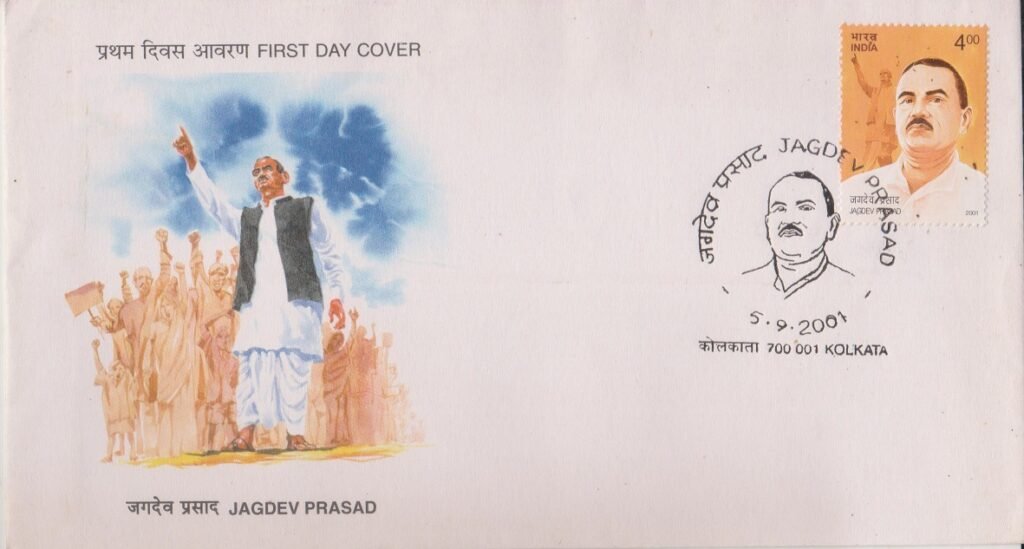
Jagdev Prasad

Technical Data
| Date of Issue | September 5, 2001 |
|---|---|
| Denomination | Rs. 4 |
| Quantity | 400,000 |
| Perforation | comb 13 |
| Printer | Eagle Press Ltd. |
| Printing Process | Offset Lithography |
| Watermark | No Watermark |
| Colors | Multicolor |
| Credit (Designed By) | Mr. Suresh Kumar |
| Catalog Codes |
Michel IN 1849 Stamp Number IN 1908 Yvert et Tellier IN 1615 Stanley Gibbons IN 2015 |
| Themes | Commemoration | Famous people | Journalists | Literary People (Poets and Writers) | Men | Politicians |
The Voice of the Oppressed and “Bihar Lenin”
Jagdev Prasad (1922–1974), often referred to as “Bihar Lenin,” was a fearless political leader who dedicated his life to fighting for the rights of the backward and marginalized sections of society. His relentless struggle against social inequality made him a prominent figure in Bihar’s political history.
Early Life and Education
Born into a humble family in Bihar, Jagdev Prasad faced numerous hardships during his early years. Financial constraints and caste-based discrimination made his journey challenging, yet his determination remained unshaken.
Despite these obstacles, he pursued higher education and earned a Master’s degree in Economics from Patna University in 1950, laying a strong foundation for his future role as a social reformer.
Influence of Socialist Ideology
Jagdev Prasad was deeply influenced by the socialist ideas of Ram Manohar Lohia. Inspired by Lohia’s vision, he joined the Socialist Party and began working towards eliminating social injustice and economic exploitation that persisted even after India’s independence.
He entered electoral politics in 1957, contesting from the Sasaram Lok Sabha constituency at Lohia’s encouragement. Although he lost the election, it marked the beginning of his active political journey.
Political Rise and Role in Bihar Government
In 1967, Jagdev Prasad was elected to the Bihar Legislative Assembly from Kurtha. He played a key role in forming the first coalition government in Bihar under the leadership of Mahamaya Prasad Sinha.
As the Minister in charge of the Health portfolio, he made significant contributions. However, he soon became disillusioned with the lack of fair representation for backward and marginalized communities within the government.
Formation of Shoshit Dal and Social Struggle
Driven by his commitment to social justice, Jagdev Prasad left both the government and his party. He went on to form his own political group, the “Shoshit Dal,” to advocate for the rights of the oppressed.
His persistent efforts led to major political shifts, including the rise and fall of several coalition governments. Over time, his demands gained national recognition, influencing the Union Government to address social inequalities through initiatives like the Backward Classes Commission.
Contributions to Journalism
Apart from politics, Jagdev Prasad was also a skilled writer and journalist. He began his journalistic career in 1953 with Janata, the publication of the Socialist Party.
He later edited the English weekly Citizen and the Hindi weekly Uday, using these platforms to raise awareness about social issues and advocate for reform.
Tragic End and Legacy
Jagdev Prasad’s life came to a tragic end in 1974. While addressing a rally in Kurtha, he was fatally injured during police firing, which broke out amid chaos at the gathering.
Despite his untimely death, his legacy as a champion of the oppressed continues to inspire generations. His contributions played a significant role in shaping policies aimed at uplifting backward communities in India.
Commemoration
In honor of his remarkable contributions, a commemorative postage stamp was issued on his death anniversary, recognizing his role as a revolutionary leader and a true advocate of social justice.
First Day Cover