
Centenary of the Jallianwala Bagh Massacre
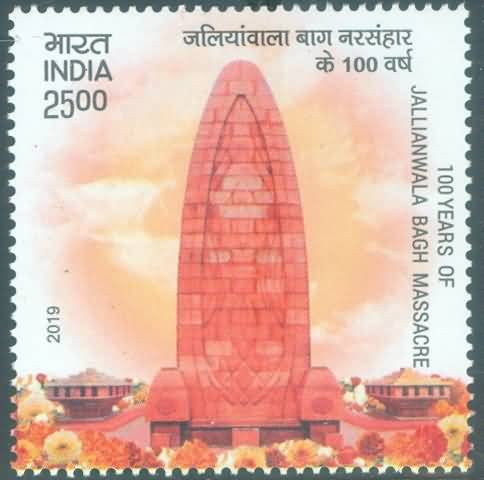
Technical Data
| Date of Issue | April 13, 2019 |
|---|---|
| Denomination | Rs. 25 |
| Quantity | 500,000 |
| Perforation | 14 x 14 |
| Printer | Security Printing Press, Hyderabad |
| Printing Process | Wet Offset |
| Watermark | No Watermark |
| Colors | Multicolor |
| Credit (Designed By) | Shri Kamleshwar Singh |
| Catalog Codes |
Michel IN 3518 Stamp Number IN 3114 Yvert et Tellier IN 3206 Stanley Gibbons IN 3601 |
| Themes | Anniversaries and Jubilees | Monuments |
A Dark Day in India’s Freedom Struggle
13th April 2019 marked the centenary of the Jallianwala Bagh Massacre, one of the most tragic and defining moments in India’s struggle for independence. On this day in 1919, over a thousand innocent men, women, and children were brutally killed and many more injured when Brigadier General Reginald Dyer ordered his troops to open fire on a peaceful gathering at Jallianwala Bagh, Amritsar.
This horrific event ignited the flame of resistance across the nation and became a turning point in India’s freedom movement, uniting people in their resolve to end colonial rule.
The Tragic Events of 13th April 1919
On the festival of Baisakhi, residents of Amritsar and neighbouring districts gathered at Jallianwala Bagh to peacefully protest the arrest of Mahatma Gandhi and local leaders Dr. Saif-ud-Din Kitchlew and Dr. Satyapal, who had organized the Satyagraha movement against the oppressive Rowlatt Act.
General Dyer, viewing the large assembly as a threat, marched in with troops composed of Baluchs and Gurkhas, blocking the only exit and ordering indiscriminate firing without warning. In just ten minutes, 1650 rounds were fired into the defenceless crowd. Hundreds died instantly; many others perished later from their injuries or in the desperate attempt to escape over walls or into the open well within the Bagh.
Aftermath and Legacy
The massacre, coupled with the Martial Law and brutal “crawling order” that followed, exposed the inhumanity of colonial rule. The victims were denied medical assistance, and reports of the tragedy were suppressed by the British authorities. Despite this, eyewitness accounts and later studies revealed the magnitude of the atrocity—over 500 dead and more than a thousand injured.
The event evoked widespread outrage across India. Rabindranath Tagore renounced his knighthood in protest, while Mahatma Gandhi intensified the call for non-cooperation. Shaheed Udham Singh avenged the massacre two decades later by assassinating Sir Michael O’Dwyer in London in 1940.
A Symbol of Sacrifice and Unity
Jallianwala Bagh stands today as a symbol of sacrifice, courage, and national awakening. The tragedy, though heart-wrenching, transformed India’s political consciousness and gave new momentum to the independence movement.
The Department of Posts is honoured to issue a Commemorative Postage Stamp on the Centenary of the Jallianwala Bagh Massacre — a solemn tribute to the martyrs who laid down their lives for the cause of India’s freedom.