
Kishore Kumar
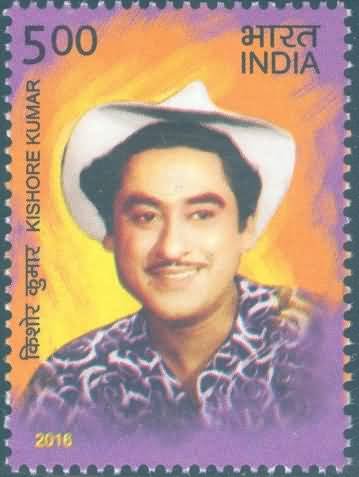
Technical Data
| Stamp Set | Legendary Singers of India |
|---|---|
| Date of Issue | December 30, 2016 |
| Denomination | Rs. 5 |
| Quantity | 300,000 |
| Perforation | 13¾ |
| Printer | Security Printing Press, Hyderabad |
| Printing Process | Wet Offset |
| Watermark | No Watermark |
| Colors | Multicolor |
| Credit (Designed By) | Sh. Sankha Samanta Smt. Alka Sharma |
| Catalog Codes |
Michel IN 3053A Yvert et Tellier IN 2757 Stanley Gibbons IN 3223 |
| Themes | Famous people | Headgear | Men | Singers |
The Evergreen Voice of Indian Cinema
Early Life and Musical Journey
Kishore Kumar (4 August 1929 – 13 October 1987) was one of India’s most versatile and beloved entertainers — a playback singer, actor, lyricist, composer, producer, director, and screenwriter. Born as Abhas Kumar Ganguly in Khandwa, Madhya Pradesh, he moved to Bombay to join his elder brother, the renowned actor Ashok Kumar. It was here that his artistic journey began, eventually transforming him into one of the most iconic voices of Indian cinema.
Initially aspiring to become an actor, Kishore Kumar’s extraordinary singing talent soon caught attention. His unique style, effortless expression, and remarkable ability to adapt his voice made him a legend in the world of playback singing.
Rise to Stardom in Playback Singing
Kishore Kumar began his playback singing career in the 1940s, but it was during the 1950s and 1960s that he achieved nationwide fame. His songs reflected a wide range of emotions — from light-hearted romantic numbers to soulful melodies filled with pathos.
He was known for bringing an unparalleled energy to his songs. His playful and spontaneous singing style perfectly matched the vibrant performances of actors like Dev Anand, Rajesh Khanna, and Amitabh Bachchan, for whom he became the voice of an era.
Some of his most unforgettable songs include “Roop Tera Mastana”, “Mere Sapno Ki Rani”, “Pal Pal Dil Ke Paas”, “Zindagi Ek Safar Hai Suhana”, and “Khaike Paan Banaraswala.” Each of these timeless classics continues to resonate with audiences, transcending generations.
A Multitalented Artist
Apart from being an exceptional playback singer, Kishore Kumar was also a gifted actor and filmmaker. He directed and produced several films, often infusing them with his trademark humour and creativity. His performances in films like Chalti Ka Naam Gaadi, Padosan, and Half Ticket showcased his comic brilliance and natural acting flair.
Kishore Kumar was also known for experimenting with sound and technique. He popularised yodeling in Indian music — a style inspired by Western influences — and adapted it seamlessly into Hindi songs such as “C.A.T. Cat Maane Bill…”, “Zindagi Ek Safar Hai Suhana”, and “Pyar Ka Mausam.” His innovative approach to singing expanded the expressive possibilities of Indian film music.
Musical Versatility and Legacy
Kishore Kumar sang in several Indian languages, including Bengali, Marathi, Assamese, Gujarati, Kannada, Bhojpuri, Malayalam, Odia, and Urdu, leaving behind a truly pan-Indian legacy. His ability to infuse emotion, humour, and melody into his songs made him one of the most versatile singers in the history of Indian cinema.
Throughout his career, he received numerous accolades for his playback singing, including multiple Filmfare Awards for Best Male Playback Singer. Even decades after his passing, his songs continue to dominate airwaves, playlists, and hearts — a testament to his timeless appeal.
A Philatelic Tribute
The Department of Posts proudly releases a Commemorative Postage Stamp in honour of Kishore Kumar, celebrating his unparalleled contribution to Indian cinema and music. This stamp serves as a tribute to his multifaceted genius — a singer whose voice captured every emotion, and an artist whose creativity continues to inspire generations.
Kishore Kumar remains, to this day, the evergreen voice of India, whose melodies will forever echo in the nation’s musical heritage.
First Day Cover
