
M. S. Subbulakshmi (1916-2004)
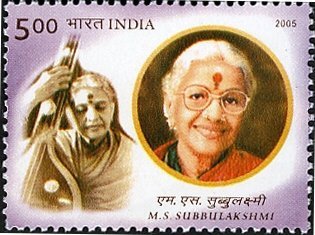
Technical Data
| Date of Issue | December 16, 2005 |
|---|---|
| Denomination | Rs. 5 |
| Quantity | 600,000 |
| Perforation | comb 13¼ |
| Printer | Security Printing Press, Nashik |
| Watermark | No Watermark |
| Colors | Multicolor |
| Catalog Codes |
Michel IN 2115 Stamp Number IN 2130 Yvert et Tellier IN 1879 Stanley Gibbons IN 2300 WADP Numbering System - WNS IN047.05 |
| Themes | Commemoration | Famous people | Music | Singers | Women |
Introduction
M. S. Subbulakshmi, popularly known as M.S., was one of the greatest Carnatic vocalists in India. Her melodious voice and deep devotion to music moved millions of listeners across the world. She remains one of the most beloved and respected figures in the history of Indian classical music.
Early Life and Musical Training
M. S. Subbulakshmi was born on 16 September 1916 in Madurai to her mother Shanmukhavadivu, a renowned veena player of her time. She received her early musical training from her mother and made her first public performance at the young age of 13.
She later studied under Srinivasa Iyengar of Madurai, who trained her up to the varnam stage. In subsequent years, she continued her learning under distinguished musicians such as Musiri Subramania Iyer and Semmangudi Srinivasa Iyer.
In 1940, she married T. Sadasivam, a freedom fighter and film director who became her mentor and supporter throughout her career.
Rise to National Fame
Two major events brought Subbulakshmi to national prominence. The first was her performance at the All India Dance Conference held in Mumbai in 1944, where her singing received immense appreciation.
The second was her role in the film Meera, produced by her husband. In this film she both acted and sang devotional songs, which brought her widespread recognition across India.
Her musical brilliance earned her high praise from national leaders. Jawaharlal Nehru famously called her the “Queen of Song,” while Sarojini Naidu admired the beauty of her voice and her captivating personality.
Musical Style and Devotion
M. S. Subbulakshmi was known for her extraordinary vocal range and technical perfection. Her music was deeply spiritual and devotional, reflecting her strong faith. Some of her most celebrated renditions include the devotional compositions Bhaja Govindam, Vishnu Sahasranamam, and Venkateswara Suprabhatam.
Mahatma Gandhi admired her singing of North Indian bhajans and requested her to sing on the occasion of his 78th birthday on 2 October 1947. He especially wished to hear the bhajan “Hari Tuma Haro,” whose message appeals to the divine to remove the suffering of mankind.
International Cultural Ambassador
Subbulakshmi became a cultural ambassador of India and performed concerts around the world, including in London, New York, Canada, and several countries in the Far East. In 1963 she performed at the renowned Edinburgh Festival.
In October 1966, she represented India by performing at the United Nations during the United Nations Day celebrations. She also inaugurated the Festival of India in London in 1982 and later in the Soviet Union in 1987.
Social Service and Charity
M. S. Subbulakshmi gave more than 200 benefit performances to support various national, social, religious, and cultural causes, raising over one crore rupees for charity. Her generosity and dedication to social service made her widely respected beyond the world of music.
Awards and Honours
Her remarkable contributions to music were recognized with numerous awards. She received the Padma Bhushan in 1954, one of the first recipients after the institution of national awards. She was also honoured with the prestigious title Sangeetha Kalanidhi.
In 1974 she received the Ramon Magsaysay Award and donated the entire prize money to charitable institutions such as Bharatiya Vidya Bhavan and V.H.S. Hospital. She was later awarded the Padma Vibhushan in 1975 and conferred the honorary title “Desikottama” by Visva-Bharati University in 1981.
In 1998, she was honoured with the Bharat Ratna, the highest civilian award in India.
Philosophy of Music and Education
Subbulakshmi believed that music should inspire devotion and spiritual reflection. According to her, ragas and bhajans were composed to guide the minds of listeners toward God. She emphasized the importance of correct pronunciation, proper intonation, and rigorous practice.
She strongly supported the traditional gurukula system of learning and advocated the compulsory teaching of music at all levels of education, believing that music could bring peace and serenity to the human mind.
Legacy and Commemoration
M. S. Subbulakshmi passed away on 11 December 2004. Her music, marked by devotion and technical brilliance, continues to inspire generations of musicians and listeners.
To honour her extraordinary contribution to Indian music and culture, the Department of Posts issued a commemorative postage stamp celebrating her life and achievements.
Leave a Comment
You must be logged in to post a comment.