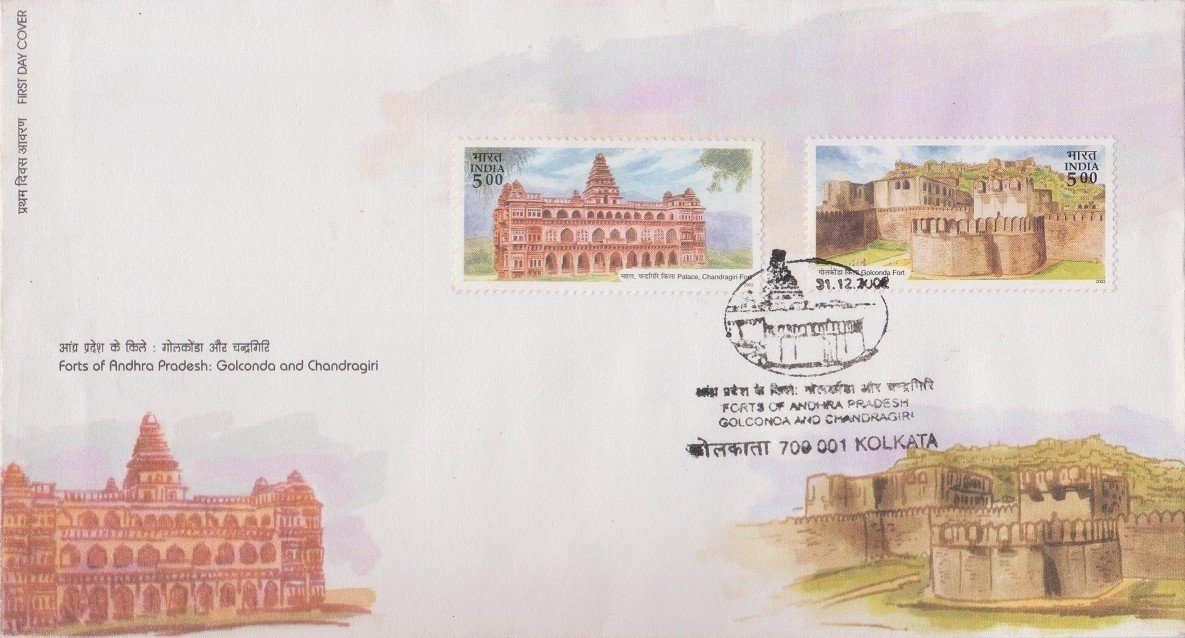
Palace, Chandragiri Fort
Technical Data
| Stamp Set | Forts of Andhra Pradesh Forts of India |
|---|---|
| Date of Issue | December 31, 2002 |
| Denomination | Rs. 5 |
| Quantity | 3,000,000 |
| Perforation | comb 13½ x 13 |
| Printer | Calcutta Security Printers Ltd |
| Printing Process | Offset Lithography |
| Watermark | No Watermark |
| Colors | Multicolor |
| Credit (Designed By) | Shri Kamleshwar Singh |
| Catalog Codes |
Michel IN 1942 Stamp Number IN 1991 Yvert et Tellier IN 1706 Stanley Gibbons IN 2111 WADP Numbering System - WNS IN054.02 |
| Themes | Architecture | Fortresses / Strongholds | Palaces |
History and Architecture
The palace at Chandragiri Fort is a remarkable example of the grandeur of the Vijayanagara Empire. Located about 12 km from Tirupati, this historic site once served as an important center of power and culture.
History of Chandragiri Fort Palace
Chandragiri Fort is believed to have been built around 1000 AD by Immadi Narasimha Yadavaraya. Later, the rulers of the Vijayanagara Empire expanded and strengthened the fort, turning it into a well-secured stronghold.
After the fall of the Vijayanagara Empire, its last rulers shifted their capital to Chandragiri. During this period, the magnificent palace complex within the fort was constructed in the early seventeenth century, reflecting the architectural excellence of the time.
Architecture of the Palace
The palace complex at Chandragiri Fort mainly consists of two prominent structures:
- Raja Mahal
- Rani Mahal
Raja Mahal
The Raja Mahal is the main palace and an outstanding example of Vijayanagara architecture. It features:
- A grand Durbar Hall used for royal gatherings
- A double-storeyed colonnade that enhances its elegance
- Impressive gopurams, with the largest one rising above the Durbar Hall
The structure reflects both strength and aesthetic beauty, showcasing the advanced building techniques of the era.
Rani Mahal
The Rani Mahal, though smaller, is equally graceful in design. It was likely used as the residence of the queens and royal women. Its architecture complements the Raja Mahal, maintaining harmony within the palace complex.
Fort Structure and Surroundings
The Chandragiri Fort is known for its strong fortifications, including:
- Massive cyclopean stone walls
- Bastions placed at regular intervals
- Strategically designed zig-zag entrances for defense
The fort complex spreads across approximately 25 acres and includes several temples within its boundaries, adding to its cultural and historical significance.
Today, the modern town of Chandragiri lies to the east of the fort hill, blending history with contemporary life.
Philatelic Importance
The historical importance of Chandragiri Fort and its palace has been recognized by India Post. A stamp set titled “Forts of India” was issued on 3 August 1984.
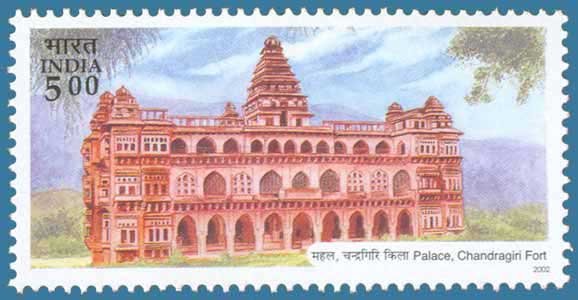
Later, another set titled “Forts of Andhra Pradesh” featured Chandragiri Fort along with Golconda Fort, highlighting their architectural and historical value.
Significance of Chandragiri Palace
The palace at Chandragiri Fort stands as a symbol of:
- The architectural brilliance of the Vijayanagara Empire
- The political history of South India
- The cultural richness of medieval Indian kingdoms
It continues to attract historians, tourists, and architecture enthusiasts.
Conclusion
The palace at Chandragiri Fort, with its majestic Raja Mahal and elegant Rani Mahal, offers a glimpse into the royal lifestyle and architectural excellence of the Vijayanagara period. It remains an important heritage site that preserves the legacy of one of India’s greatest empires.
First Day Cover