
Kanchipuram Silks
Technical Data
| Date of Issue | December 10, 2009 |
|---|---|
| Denomination | Rs. 5 |
| Quantity | 800,000 |
| Perforation | 13 |
| Printer | India Security Press, Nasik |
| Printing Process | Wet Offset |
| Watermark | No Watermark |
| Colors | Multicolor |
| Credit (Designed By) | Sh. Sankha Samanta |
| Catalog Codes |
Michel IN 2447 Stamp Number IN 2385 Stanley Gibbons IN 2673 WADP Numbering System - WNS IN100.2009 |
| Themes | Textile |
The Crown Jewel of Indian Handloom Textiles
Kanchipuram Silks, also known as Kanchipuram or Kanjeevaram saris, are among the most celebrated traditions of Indian handloom textiles. Woven in the historic temple town of Kanchipuram in Tamil Nadu, these magnificent silk saris are as renowned as the sacred temples that define the city’s cultural landscape.
With a legacy dating back centuries—ancient southern texts trace references to rich silks as early as the 2nd century—Kanchipuram Silks reflect a harmonious blend of devotion, craftsmanship, and royal patronage.
Historical Roots and Temple Patronage
Kanchipuram emerged as a major centre of silk weaving under the patronage of royal courts and temple institutions. The flourishing trade along the river Palar further strengthened the silk industry, enabling artisans to produce temple hangings, chariot decorations, ceremonial cloths, furnishings, and the iconic nine-yard sari.
Over time, migrating weavers contributed to refining techniques and expanding design vocabulary, establishing Kanchipuram as a premier hub of silk craftsmanship.
The Art of Weaving Kanchipuram Silks
The weaving of a Kanchipuram sari is a meticulous and collaborative process. Traditionally performed on a throw-shuttle pit loom or raised pit loom, the craft requires:
- Two weavers working together
- Three shuttles in operation
- A designer reading from a graph to guide thread lifting patterns
While modern jacquard and dobby mechanisms are now sometimes used, many artisans continue to preserve traditional handloom methods.
The silk used is typically twisted three-ply yarn, giving the fabric its compact structure, thickness, and durability.
Distinctive Features of Kanchipuram Silks
Kanchipuram Silks are easily recognizable due to:
- Bold contrasts between borders and body
- Rich, vibrant colour combinations
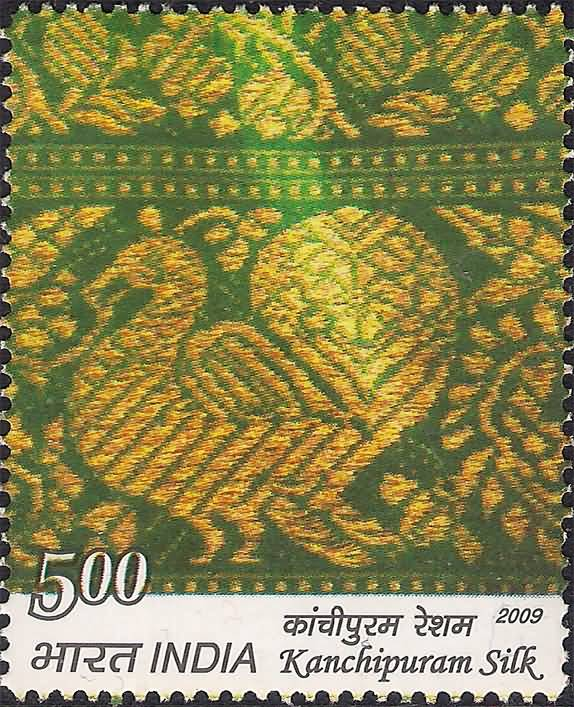
- Intricate motifs woven into the fabric
- Rows of animals, birds, flowers, creepers, and geometric designs
- A thick, lustrous texture
The brilliance of colour and natural sheen of silk create a regal appearance, making these saris highly prized for weddings, festivals, and ceremonial occasions.
Cultural and Economic Significance
Kanchipuram Silks are not merely garments—they are heirlooms passed down through generations. The craft sustains thousands of weaving families and represents the cultural identity of Tamil Nadu.
Recognizing the importance of the handloom sector, the Government of India introduced several developmental schemes during the 11th Five Year Plan, including initiatives for skill upgradation, marketing support, yarn supply at reasonable rates, welfare coverage, and design development. These measures aim to preserve traditional weaving while adapting to contemporary market needs.
Commemorative Postage Stamp on Kanchipuram Silks
Celebrating India’s extraordinary textile heritage, India Post has issued a commemorative postage stamp as part of the Indian Textiles series, featuring Kanchipuram Silks.
This philatelic tribute honours:
- The centuries-old silk weaving tradition of Kanchipuram
- The artistic excellence of Indian handloom weavers
- The cultural significance of temple-inspired motifs
- India’s enduring textile legacy
Through this commemorative stamp issue, Kanchipuram Silks are recognized as a timeless symbol of elegance, craftsmanship, and cultural continuity—woven threads of tradition that continue to shine across generations.
First Day Cover

Leave a Comment
You must be logged in to post a comment.