
The Silent Valley

Technical Data
| Date of Issue | November 15, 2009 |
|---|---|
| Denomination | Rs. 5 |
| Quantity | 3,000,000 |
| Perforation | 13 |
| Printer | Security Printing Press, Hyderabad |
| Printing Process | Wet Offset |
| Watermark | No Watermark |
| Colors | Multicolor |
| Credit (Designed By) | Mr. Suresh Kumar |
| Catalog Codes |
Michel IN 2434 Stamp Number IN 2373 Stanley Gibbons IN 2657 WADP Numbering System - WNS IN087.2009 |
| Themes | Bridges | Landscapes | Rivers | UNESCO World Heritage Sites |
India’s Pristine Rainforest in the Western Ghats
The Silent Valley National Park, located in the South Western Ghats of Kerala, is one of the world’s ten “hottest biodiversity hotspots.” Widely regarded as the last remaining stretch of virgin tropical rainforest in India, Silent Valley stands as a symbol of ecological preservation and environmental awareness.
Situated about 80 km northeast of Palakkad, this pristine forest region was declared a National Park on 14 November 1984. Today, it forms the core of the Nilgiri Biosphere Reserve, one of India’s most significant conservation landscapes.
Mythological and Historical Significance
Silent Valley’s legacy stretches beyond ecological importance into India’s mythological past. The forest is also known as Sairandhrivanam, a name derived from Draupadi of the Mahabharata. The Kunthi River that flows through the valley is named after Kunti, the mother of the Pandavas. These mythological associations add a timeless cultural dimension to the valley’s natural grandeur.
A 50-Million-Year-Old Rainforest
Believed to be over 50 million years old, Silent Valley’s evergreen rainforest is a rare ecological treasure. Surrounded by steep ridges and escarpments, its topographical isolation prevented large-scale human settlement. This natural protection allowed the forest to remain largely undisturbed, preserving its extraordinary biodiversity.
The origin of the name “Silent Valley” is uncertain. One popular belief suggests it refers to the unusual absence of cicadas, insects typically responsible for the characteristic forest sounds in tropical regions.
Exceptional Flora Diversity
The flora of Silent Valley is remarkably rich and diverse:
- Around 1,000 species of flowering plants
- 107 species of orchids, including rare and endemic varieties
- 100 species of ferns and fern allies
- 200 liverwort species
- 75 lichens
- Nearly 200 species of algae
Among its botanical treasures is Ipsea malabarica, an endemic ground orchid rediscovered after more than a century, reflecting the forest’s outstanding conservation value.
Unique and Endangered Wildlife
Silent Valley National Park is home to 23 mammalian species, including three endangered ones:
- Bengal tiger
- Lion-tailed macaque
- Nilgiri langur
Other notable species include elephants, leopards, sloth bears, gaur, wild dogs, Nilgiri tahr, and common langurs. The park also supports a stunning variety of birds, reptiles, amphibians, fish, and insects, making it a haven for wildlife enthusiasts and researchers alike.
The Silent Valley Movement: A Landmark Environmental Campaign
Between 1977 and 1980, the Silent Valley faced a major threat from the proposed Silent Valley Hydroelectric Project (SVHP), which would have submerged 830 hectares of forest. The proposal triggered a massive environmental movement involving scientists, writers, activists, NGOs, media, and the public.
This historic people’s movement ultimately led to the cancellation of the project and the declaration of Silent Valley as a National Park in 1983 by Prime Minister Indira Gandhi. The movement remains one of India’s most successful conservation campaigns and a milestone in the country’s environmental awakening.
Renowned ornithologist Salim Ali described Silent Valley as one of the richest, most threatened, and least studied habitats on Earth.
A Symbol of Ecological Consciousness
Silent Valley National Park represents more than a protected forest—it embodies India’s environmental conscience. Its quiet grandeur, dense canopy, flowing rivers, and extraordinary biodiversity make it a living testament to the power of conservation.
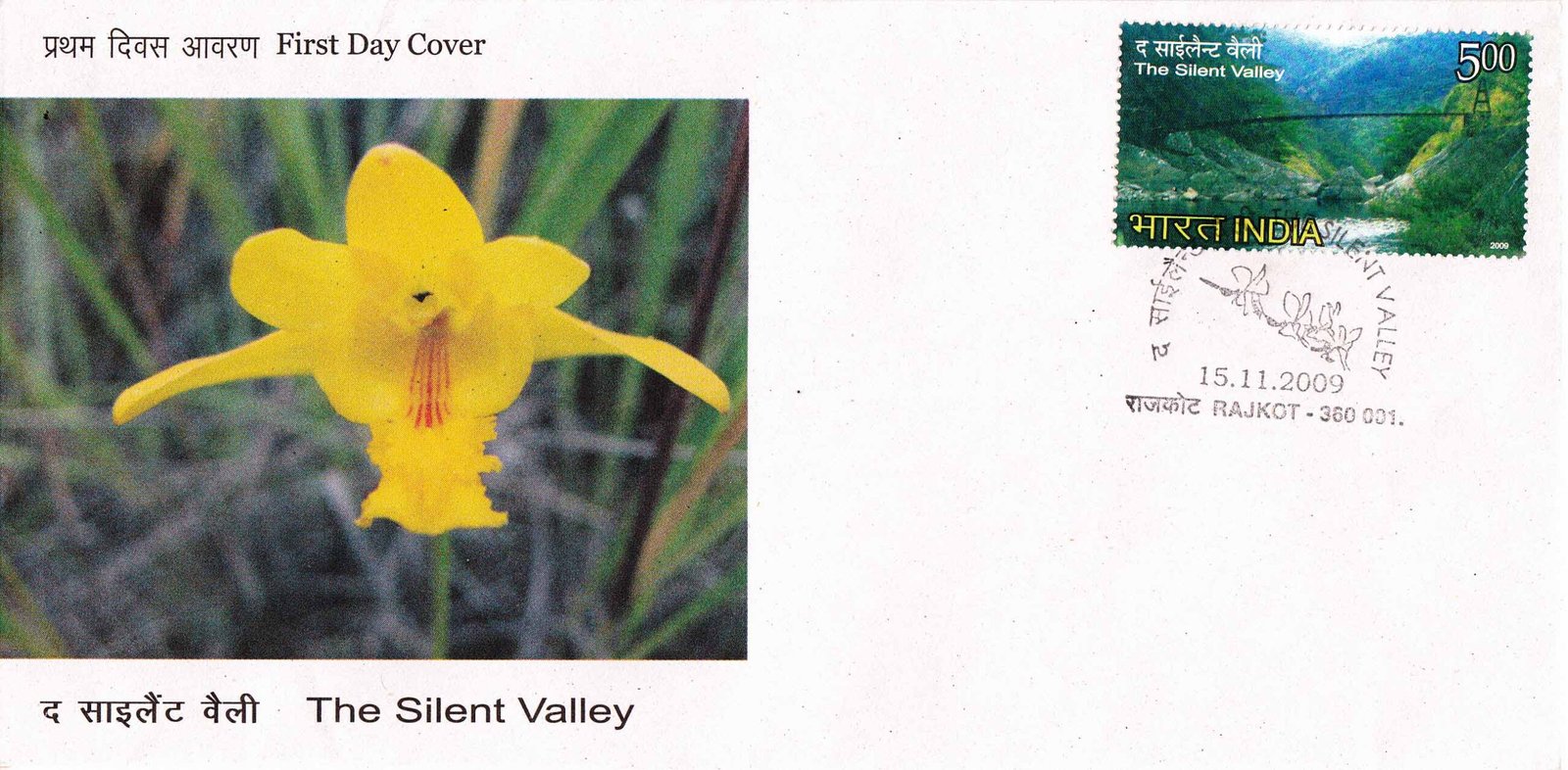
Often described as “a poem on earth,” Silent Valley continues to inspire environmental stewardship. In recognition of its 25th anniversary as a National Park, the Department of Posts issued a commemorative postage stamp, celebrating its invaluable contribution to India’s natural heritage.
First Day Cover
Leave a Comment
You must be logged in to post a comment.