
R. Sankar
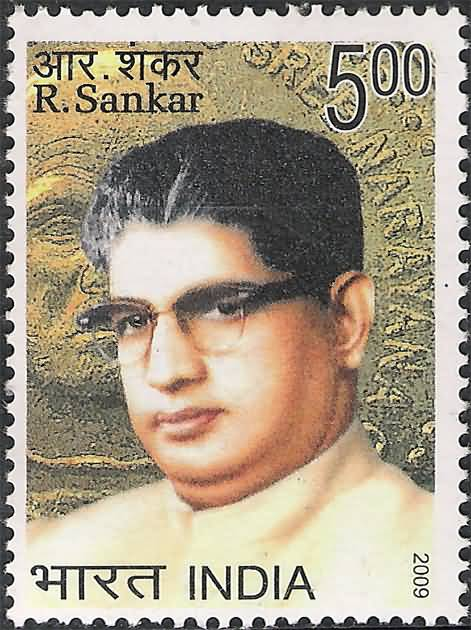
Technical Data
| Date of Issue | April 30, 2009 |
|---|---|
| Denomination | Rs. 5 |
| Quantity | 400,000 |
| Perforation | 13½ |
| Printer | Security Printing Press, Hyderabad |
| Printing Process | Wet Offset |
| Watermark | No Watermark |
| Colors | Multicolor |
| Credit (Designed By) | Mr. Suresh Kumar |
| Catalog Codes |
Michel IN 2369 Stamp Number IN 2322 Yvert et Tellier IN 2134 Stanley Gibbons IN 2589 WADP Numbering System - WNS IN025.2009 |
| Themes | Anniversaries and Jubilees | Famous people | Men | Optical Instruments | Politicians |
Freedom Fighter, Chief Minister of Kerala and Pioneer of Inclusive Education
R. Sankar was a distinguished freedom fighter, educationist, lawyer, journalist, administrator, social reformer, and political leader. A dynamic and multi-faceted personality, R. Sankar left an indelible mark on Kerala’s political, social, and educational landscape.
While he served with distinction as a Member of the Constituent Assembly, a Congress leader, Deputy Chief Minister, Finance Minister, and later Chief Minister of Kerala, his most enduring legacy remains his transformative contribution to education and social reform in the state.
Early Life and Education
R. Sankar was born on April 30, 1909, in Puthoor village near Kottarakara in Kollam district, Kerala, to Raman and Kunchali Amma. Growing up in a lower middle-class family facing financial and social challenges, Sankar nevertheless received a solid foundational education.
He began his schooling at Puthoor Primary School and later continued at an English school in Kottarakara. In 1924, with the support of a generous relative, he joined Maharaja’s College (now University College), Thiruvananthapuram, earning his B.A. degree in 1928.
Soon after graduation, he became Headmaster of Sivagiri School, founded by the renowned saint and social reformer Narayana Guru, whose teachings deeply influenced Sankar’s life and mission.
Legal Career and Freedom Struggle
Though he initially aspired to pursue higher studies in chemistry in England, financial constraints led him to study law at the Law College, Thiruvananthapuram. After qualifying, he began practicing as an advocate at the Kollam District Court in 1936.
However, his legal career soon gave way to active political involvement in the freedom movement. He joined the State Congress Party’s agitation in Travancore and was arrested in August 1938 for defying a ban and addressing a public meeting. He was sentenced to 18 months of imprisonment and fined ₹2,000. Over time, he spent a total of three years in prison for his political activism.
Leadership in Social Reform: S.N.D.P. Yogam
On December 20, 1944, R. Sankar was elected General Secretary of the Sree Narayana Dharma Paripalana Yogam (S.N.D.P. Yogam), a prominent social reform organization in Kerala.
Inspired by the teachings of Narayana Guru, Sankar emerged as a key figure in Kerala’s social renaissance. He adopted education as the most powerful tool for social transformation, particularly for lower caste communities historically denied access to schools and colleges.
Architect of Kerala’s Educational Transformation
R. Sankar’s greatest contribution lies in his pioneering efforts to expand inclusive education in Kerala.
Establishment of Sree Narayana Institutions
He founded several educational institutions named after Narayana Guru, including:
- Sree Narayana College, Kollam (1948) – which grew to become one of the largest colleges in Kerala in terms of student strength and postgraduate courses.
- Sree Narayana College for Women (1951) – the first exclusive women’s college established in the private sector in Kerala, which became the largest women’s college in the state by 1956.
Education Minister and Policy Reformer
As Minister for Education, Sankar promoted the establishment of numerous junior colleges across Kerala, particularly in the private sector. This innovative approach made higher education accessible to economically disadvantaged students who could not afford to travel to major cities.
He also created an Educational Fund under S.N.D.P. Yogam to support financially challenged students. In 1945 alone, he mobilized over ₹1,05,000 in public contributions in a single day. Additional funds were raised in 1946 and 1947 for primary, secondary, and general education.
Today, Kerala’s remarkable literacy rate — among the highest in India — is widely attributed to the visionary initiatives of leaders like R. Sankar. His emphasis on inclusive, community-driven education significantly shaped the state’s educational progress.
As noted by educationist V.R. Pillai, Sankar’s enduring place in Kerala’s history is as a distinguished educationist committed to academic excellence.
Journalism and Public Life
Beyond politics and education, R. Sankar also made significant contributions to journalism. He founded and edited the Malayalam daily Dinamani and pioneered the publication of a Malayalam Year Book in 1956, which was widely appreciated.
Political Career and Governance
R. Sankar’s political career was marked by several milestones:
- Elected Deputy Chief Minister in 1948, holding the Finance portfolio
- First Finance Minister of Kerala to present five consecutive budgets
- Became Chief Minister of Kerala in 1962
His administrative leadership reflected his commitment to social justice, fiscal responsibility, and inclusive development.
Legacy and Commemoration
R. Sankar passed away on November 6, 1972. His legacy as a freedom fighter, education reformer, and Chief Minister continues to inspire generations.
In recognition of his immense contributions to Kerala and the nation, India Post issued a commemorative postage stamp honoring R. Sankar — a visionary leader whose efforts helped shape modern Kerala’s educational and social landscape.
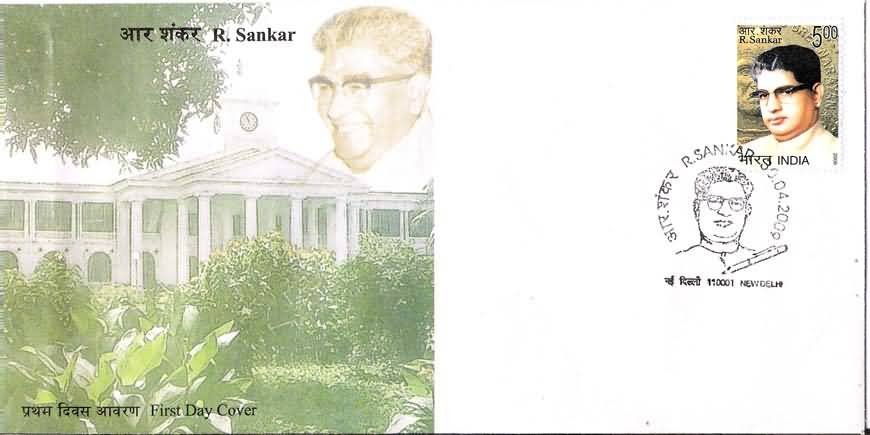
First Day Cover
Leave a Comment
You must be logged in to post a comment.