
Maharaja Gulab Singh

Technical Data
| Date of Issue | October 21, 2009 |
|---|---|
| Denomination | Rs. 5 |
| Quantity | 300,000 |
| Perforation | 13½ |
| Printer | Security Printing Press, Hyderabad |
| Printing Process | Wet Offset |
| Watermark | No Watermark |
| Colors | Multicolor |
| Credit (Designed By) | Sh. Brahm Prakash |
| Catalog Codes |
Michel IN 2416 Stamp Number IN 2356 Stanley Gibbons IN 2638 WADP Numbering System - WNS IN069.2009 |
| Themes | Commemoration | Famous people | Headgear | Men |
Founder of Jammu & Kashmir
Maharaja Gulab Singh, the founder of the princely state of Jammu & Kashmir, was born on 21 October 1792. His father, Mian Kishore Singh, held a jagir at Andarwah near Jammu. From an early age, Gulab Singh was trained in martial arts and warfare under the stern guidance of his grandfather, shaping him into a capable and determined leader.
Architect of a Unified Kingdom
Maharaja Gulab Singh is often regarded as the only ruler in India’s long history who significantly extended the geographical frontiers of the region. His conquest and annexation of Ladakh stand as one of his most remarkable achievements, securing his place in Indian history. The unified state of Jammu and Kashmir remains a lasting monument to his vision and statecraft.
Administrator and Reformer
Upon assuming the reins of administration, Gulab Singh acted decisively to suppress crime and corruption. He established law and order, bringing stability and peace to his territories. Trade and commerce flourished under his rule as routes were secured and governance strengthened.
He devoted himself wholeheartedly to the all-round development of his kingdom, ensuring unity and cohesion among its diverse regions.
Military Reorganization and Strength
The Maharaja paid special attention to the training, discipline, and welfare of his forces. Rather than imitating British models, he developed his own military organization suited to local conditions.
- Foundries and arsenals were established.
- Forts were repaired and properly garrisoned.
- Hill levies were organized into structured regiments.
- A formal code of military instructions and orders was introduced.
His army’s efficiency was widely acknowledged and proved its strength in several notable campaigns, earning admiration from contemporary observers.
A Unique Abdication
Maharaja Gulab Singh ruled until 20 February 1856. In a rare and noble gesture, he voluntarily abdicated the throne in favour of his son, symbolically offering himself as one of his subjects—an act that reflected his sense of duty and statesmanship.
Historical Assessment and Legacy
The eminent historian K. M. Panikkar described Gulab Singh as one of the few great Indian figures of the nineteenth century—an ambitious and resolute leader whose iron will and courage, tested in battles and crises, secured for him a throne and enduring fame.
The present state of Jammu & Kashmir stands as his enduring legacy. As long as it is remembered, his name will continue to occupy a distinguished place in Indian history.
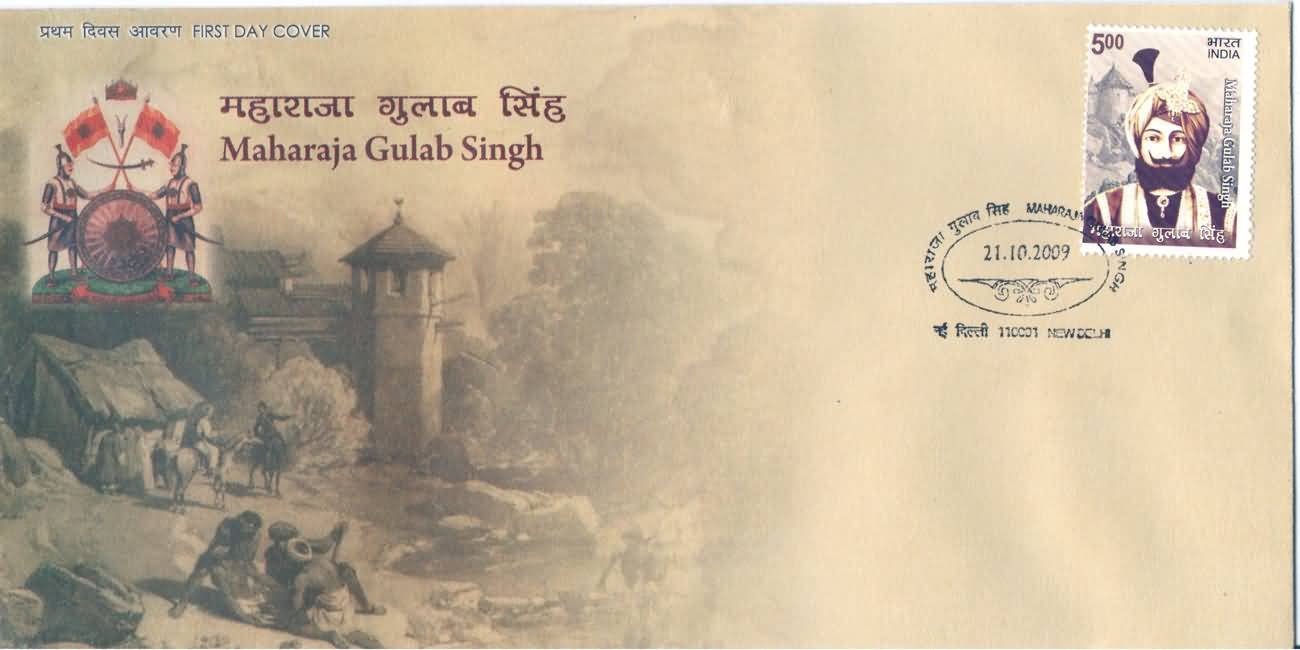
In honour of his remarkable contributions, the Department of Posts has issued a commemorative postage stamp on Maharaja Gulab Singh.
First Day Cover
Leave a Comment
You must be logged in to post a comment.