
Rajabhau Khobragade

Technical Data
| Date of Issue | November 11, 2009 |
|---|---|
| Denomination | Rs. 5 |
| Quantity | 400,000 |
| Perforation | 13½ |
| Printer | Security Printing Press, Hyderabad |
| Printing Process | Wet Offset |
| Watermark | No Watermark |
| Colors | Multicolor |
| Credit (Designed By) | Sh. Brahm Prakash |
| Catalog Codes |
Michel IN 2429 Stamp Number IN 2368 Stanley Gibbons IN 2652 WADP Numbering System - WNS IN082.2009 |
| Themes | Commemoration | Famous people | Men |
Champion of Social Justice
Baburao Khobragade, affectionately known as Rajabhau, was born on 25 September 1925 in Chandrapur, Maharashtra, to Shri Devaji and Smt. Indira Bai. His father, a forest contractor and social worker, instilled in him values of public service from an early age.
He received his early education at Jubilee High School, Chandrapur, completed his Inter Science from Nagpur Science College in 1943, and earned a B.A. degree from Morris College, Nagpur in 1945. On the advice of B. R. Ambedkar, he went to London in 1950 to study Law at Lincoln’s Inn, preparing himself for a life dedicated to justice and equality.
Early Leadership and Political Rise
Rajabhau’s leadership qualities were evident during his student years. Between 1943 and 1945, he served as Secretary of the Madhya Pradesh Scheduled Caste Students Federation. At just 27 years of age, he was elected President of the City Council (1952–55), where he undertook several developmental initiatives. In October 1953, he was elected Chairman of the Nagpur State Scheduled Caste Federation.
Recognising his organisational acumen, Dr. Ambedkar entrusted him with leading crucial election campaigns and the campaign for conversion to Buddhism. After Dr. Ambedkar’s demise, Rajabhau played a pivotal role in uniting Dalit leaders and forming the Republican Party of India to carry forward Ambedkar’s vision.
Parliamentary Career
In 1958, at the age of 33, Rajabhau was elected to the Rajya Sabha and was re-elected in December 1966. He served as Deputy Chairman of the Rajya Sabha from December 1961 to April 1972, holding office with distinction. Over an 18-year tenure in the Upper House, he earned respect for his integrity, dedication, and commitment to parliamentary democracy.
Advocacy for Land Reforms and Education
Rajabhau firmly believed that land distribution to the landless would reduce unemployment and enhance food grain production. To pursue this cause, he launched a Satyagraha in 1961 advocating land reforms.
Education for the downtrodden was another cornerstone of his work. He established schools and colleges, championing free education for children aged 6 to 14 years, convinced that education was the key to social transformation.
He also founded the weekly newspaper Prajasatta, using it as a platform to voice his ideas and advance social reform.
International Engagement
Rajabhau travelled extensively, visiting countries including Ireland, France, Switzerland, Italy, Germany, the USA, Hong Kong, China, Bhutan, Thailand, and Ceylon. In September 1965, at the invitation of the American government, he visited the United States and met Martin Luther King Jr., discussing issues related to civil rights and social equality.
Legacy
Barrister Rajabhau Khobragade was a revolutionary leader who devoted his life to the upliftment of the poor and marginalized. His tireless efforts for social justice, parliamentary democracy, land reforms, and education left a lasting impact on Indian society.
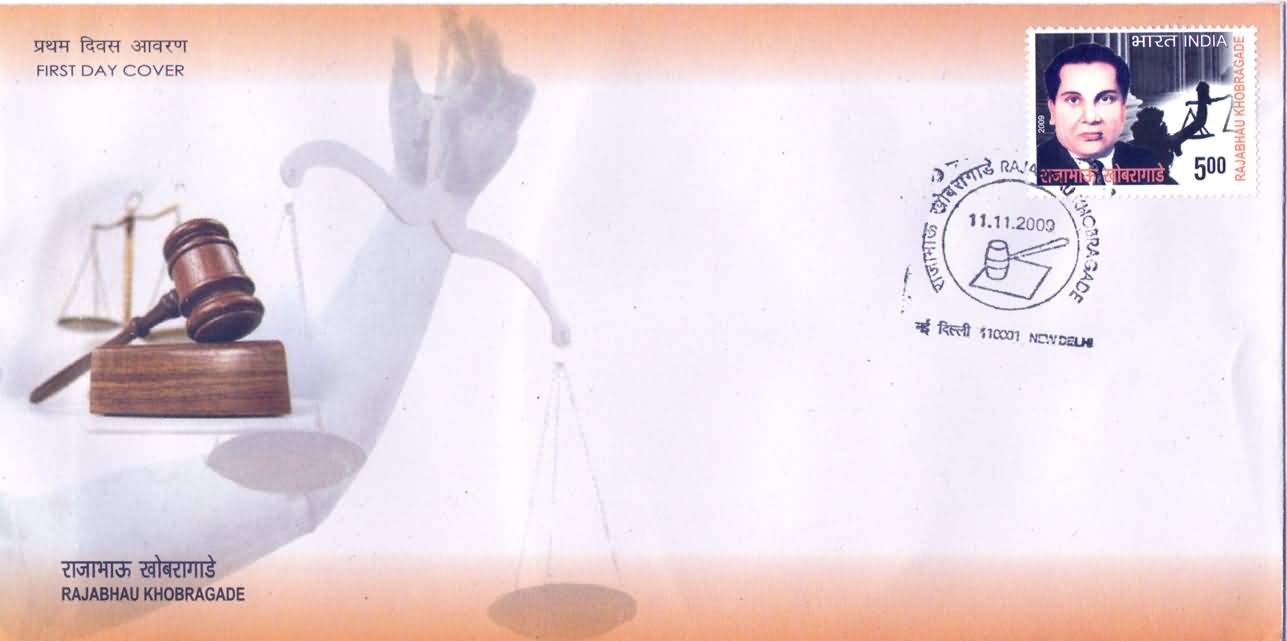
He passed away on 19 April 1984. In recognition of his invaluable contributions, the Department of Posts issued a commemorative postage stamp in honour of Barrister Rajabhau Khobragade.
First Day Cover
Leave a Comment
You must be logged in to post a comment.