
Dr. Benjamin Peary Pal
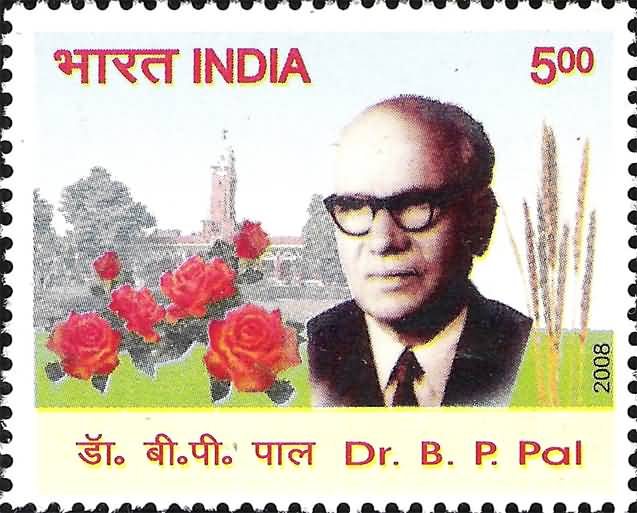
Technical Data
| Date of Issue | January 5, 2008 |
|---|---|
| Denomination | Rs. 5 |
| Quantity | 400,000 |
| Perforation | 13 |
| Printer | Security Printing Press, Hyderabad |
| Printing Process | Wet Offset |
| Watermark | No Watermark |
| Colors | Multicolor |
| Credit (Designed By) | |
| Catalog Codes |
Michel IN 2261 Stamp Number IN 2231 Stanley Gibbons IN 2464 WADP Numbering System - WNS IN005.2008 |
| Themes | Anniversaries and Jubilees | Biologists | Crops | Famous people | Men | Optical Instruments |
Pioneer of India’s Green Revolution
Dr. Benjamin Peary Pal was one of India’s most distinguished agricultural scientists, whose life and work laid the foundation for the country’s agricultural renaissance. Born on 26 May 1906 at Mukandpur in Punjab, he received his early education in Maymyo and Rangoon before earning a Ph.D. in Plant Genetics and Agriculture from the University of Cambridge in 1933.
In October 1933, he joined the Indian Agricultural Research Institute (then the Imperial Agricultural Research Institute) at Pusa, Bihar, as an Economic Botanist. By 1937, he became Head of the Division of Botany. Later, he served as Director General of the Indian Council of Agricultural Research (ICAR), guiding agricultural research and education in India for nearly six decades. After retirement, he continued contributing to national development, including serving as Chairman of the National Committee on Environmental Planning and Coordination. He passed away on 14 September 1989.
Contributions to Plant Genetics and Crop Improvement
As a geneticist and plant breeder, Dr. Pal spearheaded the development of wheat varieties resistant to rust diseases. The wheat variety NP809, which he helped breed, became the first in the world to possess concurrent resistance to stem, leaf, and stripe rusts. Even during his doctoral research at Cambridge, he demonstrated the potential of exploiting hybrid vigour in self-pollinated crops like wheat—an insight that later enabled the commercial use of hybrid vigour in cereals such as rice and wheat.
Apart from food crops, he also developed numerous exquisite varieties of roses and bougainvillea, reflecting his deep appreciation for the beauty and diversity of nature.
Architect of Agricultural Education and Research
Dr. Pal played a pivotal role in shaping India’s agricultural research infrastructure. He was the chief architect of the All-India Coordinated Research Projects, promoting interdisciplinary and inter-institutional collaboration. In 1958, he established a Post-Graduate School at IARI to strengthen human resource development for India’s emerging agricultural universities.
He actively fostered the growth of agricultural universities nationwide, integrating research, education, and extension services. As the principal author of the chapter “Education for Agriculture” in the report of the National Education Commission chaired by Daulat Singh Kothari, he emphasized the need for a holistic approach to agricultural advancement. His “symphony approach” to research and development was instrumental in ushering in the Green Revolution during the mid-1960s.
Global Recognition and Enduring Legacy
Dr. Pal’s contributions earned him national and international acclaim, including the Padma Vibhushan, Fellowship of the Royal Society of London, membership in the Japan Science Academy, and fellowships of all major science academies in India. His early call for “research for new genes” anticipated the global movement for conservation and enhancement of genetic resources. By integrating ecological principles into technology development, he helped guide India toward sustainable agriculture and long-term food security.
A man deeply committed to both science and society, Dr. Pal donated all his worldly possessions—including two houses in New Delhi and Shimla—to the Indian Agricultural Research Institute. His life remains a beacon of dedication, innovation, and selfless service.
Commemorative Postage Stamp
In recognition of his monumental contributions to agricultural science and national development, the Department of Posts issued a commemorative postage stamp in honour of Dr. B.P. Pal. The stamp celebrates the enduring legacy of a visionary scientist whose work continues to inspire generations of agricultural researchers and scholars.
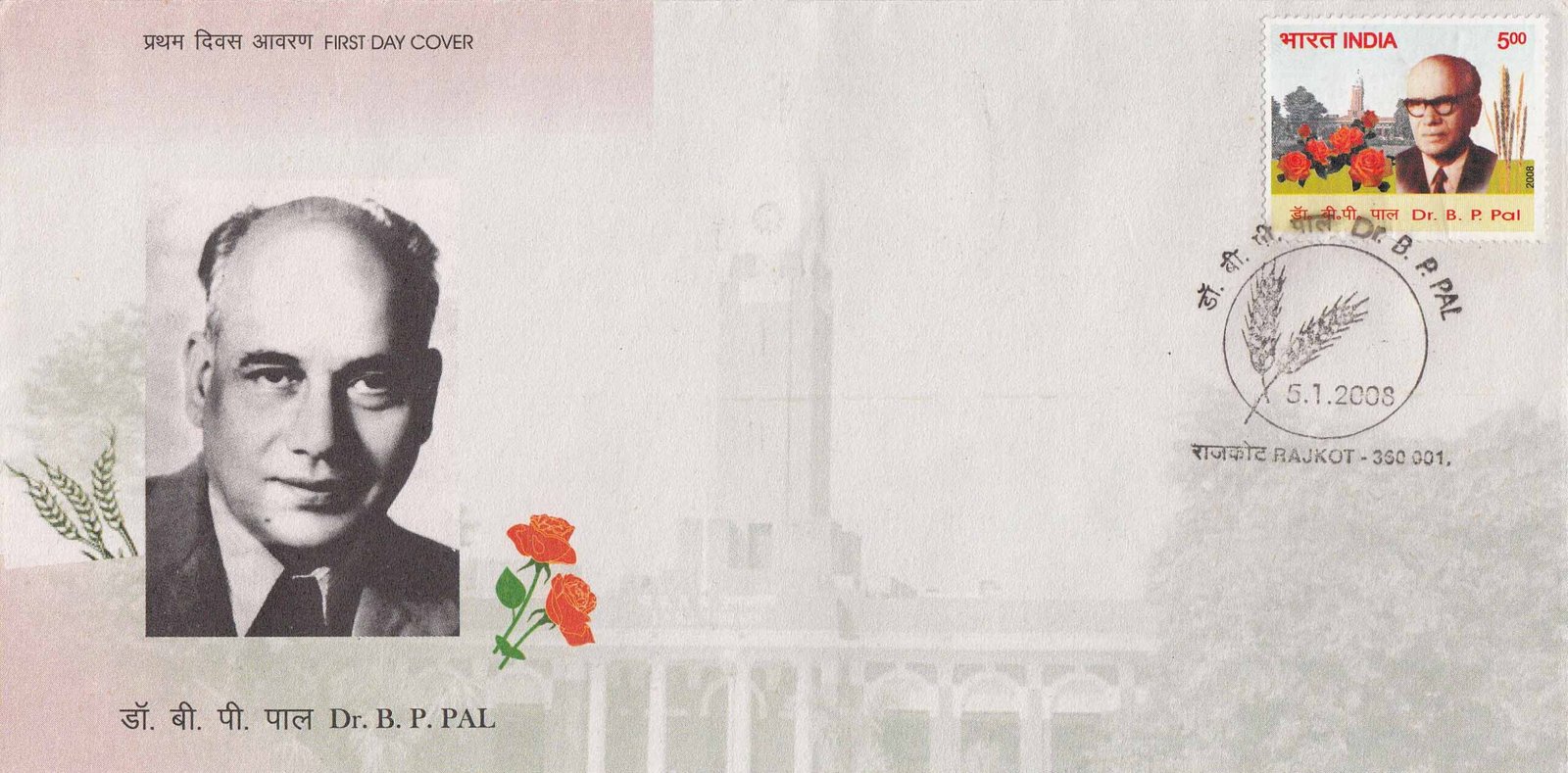
First Day Cover
Leave a Comment
You must be logged in to post a comment.