
Asrar ul Haq ‘Majaaz’
Technical Data
| Date of Issue | March 28, 2008 |
|---|---|
| Denomination | Rs. 5 |
| Quantity | 400,000 |
| Perforation | 13 |
| Printer | Security Printing Press, Hyderabad |
| Printing Process | Wet Offset |
| Watermark | No Watermark |
| Colors | Multicolor |
| Credit (Designed By) | Sh. Brahm Prakash |
| Catalog Codes |
Michel IN 2266 Stamp Number IN 2236 Stanley Gibbons IN 2470 WADP Numbering System - WNS IN010.2008 |
| Themes | Anniversaries and Jubilees | Famous people | Literary People (Poets and Writers) | Men | Philosophers | Revolutionaries |
The Melancholic Genius of Urdu Poetry
If the history of Urdu literature is viewed through the prism of emotional intensity and spontaneous melancholy, the name of Majaaz Lucknavi stands out as its epitome. Much like John Keats infused English poetry with a new lyrical sensibility, Majaaz brought a fierce emotional depth and romantic rebellion to Urdu verse. His poetry flowed effortlessly—free from laborious ornamentation or artificial sophistication. Rhythm came to him as naturally as breath. He sang of love and revolution in the same breath and envisioned a just social order where strength was tempered with compassion and the weak found security.
Born as Asrar-ul-Haq on 19 October 1911 in Rudauli, Barabanki district of present-day Uttar Pradesh, Majaaz received his education in Lucknow, Agra, and Aligarh. He graduated in 1936 from Aligarh Muslim University and later penned the university anthem, “Yeh Mera Chaman” (“This is my Garden”), still sung at convocations and solemn occasions.
Jo abr yahan se uthega,
Vo saare jahan par barsega
(The winds that arise from this campus shall rain upon the whole world.)
Association with the Progressive Writers’ Movement
At the age of 25, Majaaz was drawn to the Progressive Writers’ Movement, a powerful literary awakening led by figures such as Sajjad Zaheer and Mulk Raj Anand. Its first conference in Lucknow was presided over by Premchand and attended by literary luminaries including Faiz Ahmad Faiz, Firaq Gorakhpuri, Saadat Hasan Manto, Krishan Chander, and Rajinder Singh Bedi.
The movement sought to liberate literature from feudal clichés and rigid conventions. Inspired by its ideals, Majaaz transitioned from the traditional ghazal to the more contemporary nazm, a form better suited to his temperament and the spirit of the times.
Literary Contributions
Though Majaaz wrote sparingly, his poetic output remains invaluable. His collection Ahang (1938), later reprinted as Shab-e-Tab (1945) and Saz-i-Naau, established him as a powerful voice of his generation. He challenged the stereotypical imagery of jaam and saqi (the cup and cup-bearer) and sought to free Urdu poetry from rigid metrical traditions.
His celebrated nazm “Awara” became a defining work—an evocative portrayal of the restless youth wandering through illuminated city streets, burdened with existential anguish. Its haunting refrain echoes the poet’s inner turmoil:
Aye gham-e-dil kya karoon,
Aye wahshat-e-dil kya karoon…
(What shall I do, O sorrowing heart, what shall I do, O restless heart?)
The poem weaves personal anguish with social commentary, producing a lyrical outburst unmatched in its poignancy.
Later Life and Legacy
Majaaz later joined All India Radio, where he launched the radio magazine “Awaz.” He worked alongside eminent intellectuals such as Nirad C. Chaudhuri and Upendranath Ashk. However, his deeply sensitive temperament and recurring bouts of depression led to nervous breakdowns and personal struggles.
Often described as “Urdu literature’s vagabond genius,” Majaaz embodied the archetype of the melancholic hero-poet—alienated yet luminous. His life and times were later recreated by Ali Sardar Jafri in the television serial “Kahkashan” (1990), which paid tribute to great Urdu poets.
Majaaz died in Lucknow in conditions of poverty, leaving behind a legacy that continues to inspire lovers of Urdu poetry. His verse, though limited in quantity, remains rich in emotional intensity and revolutionary spirit.
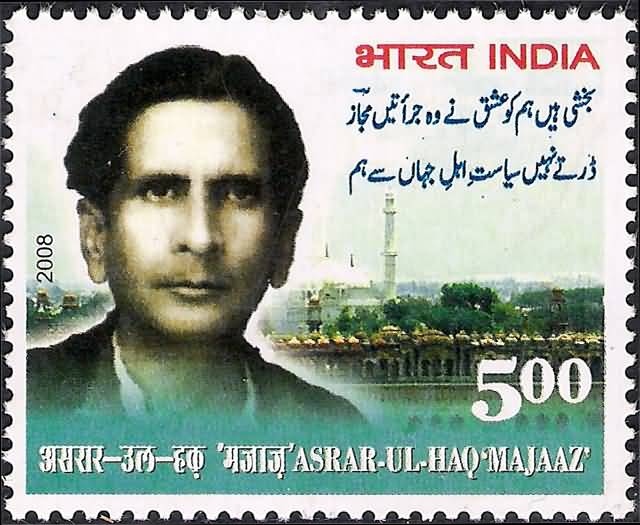
Commemorative Postage Stamp
In recognition of his enduring contribution to Urdu literature, the Department of Posts issued a commemorative postage stamp in honour of Asrar-ul-Haq ‘Majaaz’. The stamp celebrates a poet whose voice blended romance and rebellion, sorrow and song—ensuring that his luminous melancholy continues to resonate across generations.
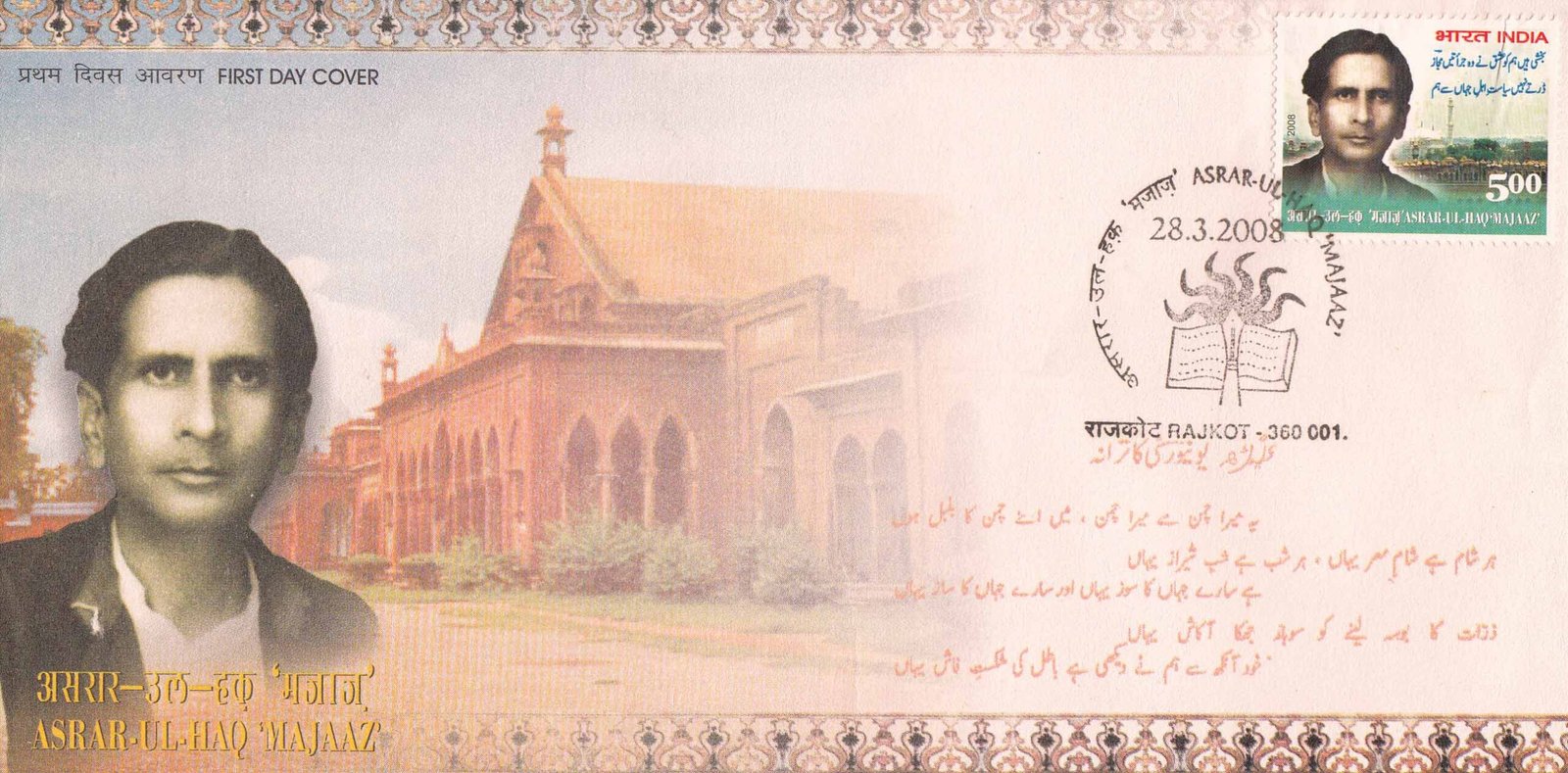
First Day Cover
Leave a Comment
You must be logged in to post a comment.