
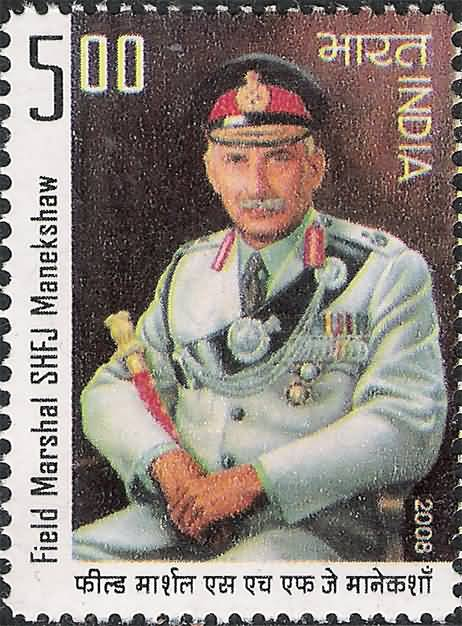
Field Marshal SHFJ Manekshaw
Technical Data
| Date of Issue | December 16, 2008 |
|---|---|
| Denomination | Rs. 5 |
| Quantity | 500,000 |
| Perforation | 13¼ |
| Printer | India Security Press, Nasik |
| Printing Process | Photogravure |
| Watermark | No Watermark |
| Colors | Multicolor |
| Credit (Designed By) | Shri Kamleshwar Singh |
| Catalog Codes |
Michel IN 2329 Stamp Number IN 2295 Stanley Gibbons IN 2552 WADP Numbering System - WNS IN071.2008 |
| Themes | Army | Commemoration | Famous people | Men |
India’s First Field Marshal and Architect of the 1971 Victory
Sam Manekshaw, popularly known as Sam Bahadur, remains one of India’s most celebrated military leaders. His courage, strategic brilliance, and charismatic leadership shaped the modern Indian Army and led to one of the most decisive victories in military history.
Early Bravery at the Sittang Bridge
In 1942, during World War II, a fierce battle was fought at the Sittang Bridge in Burma (now Myanmar). Then a young company commander, Manekshaw was leading his troops in intense hand-to-hand combat against invading Japanese forces when he was severely wounded by machine-gun fire. Despite his critical injuries, he refused evacuation, fearing his men would be left leaderless. His company captured the vital position.
Recognizing his extraordinary bravery, his commanding general awarded him the Military Cross on the battlefield itself, as the decoration was not granted posthumously and his survival seemed unlikely. This marked the beginning of an illustrious military career that would later make him independent India’s first Field Marshal.
Early Life and Military Training
Born on 3 April 1914 in Amritsar into a Parsi family, Manekshaw joined the first batch of the Indian Military Academy (IMA), Dehradun, on 30 September 1932. Commissioned on 4 February 1934, he was posted to the 4th Battalion, 12 Frontier Force Regiment (54th Sikh).
During World War II, he served with distinction in Burma and later attended the Staff College in Quetta. He played a significant role in rehabilitating over 10,000 Prisoners of War toward the end of the war. After Independence, his professional acumen proved invaluable in handling the complex military and administrative challenges following Partition, including the Jammu & Kashmir operations of 1947–48.
Leadership During Crisis and Reform
Manekshaw rose rapidly through the ranks. He commanded an Infantry Brigade, served as Commandant of the Infantry School, and later became Commandant of the Defence Services Staff College. In 1962, during the Chinese aggression, he took over command of 4 Corps at a critical juncture. His confident assurance to officers—“Gentlemen, I have arrived! There will be no more withdrawals in 4 Corps”—revived morale and restored confidence within the Army.
As General Officer Commanding-in-Chief of Eastern Command, he addressed insurgency challenges in Nagaland and was awarded the Padma Bhushan in 1968 for distinguished service.
Chief of Army Staff and the 1971 Indo-Pak War
On 7 June 1969, Manekshaw became the 8th Chief of Army Staff. His most defining moment came during the Indo-Pak War of 1971. With refugees flooding India from East Pakistan, he meticulously prepared the Armed Forces for a decisive campaign.
Under his leadership, Indian forces achieved a historic victory within just 14 days, leading to the unconditional surrender of over 93,000 Pakistani soldiers and civilians. The coordinated efforts of the Army, Navy, and Air Force resulted in the creation of Bangladesh following the Shimla Agreement.
His magnanimity was evident when he declined the honour of personally accepting the surrender in Dhaka, suggesting instead that it should go to his Eastern Army Commander. His compassion extended even to prisoners of war, whom he treated with dignity and respect.
Character and Legacy
Known for his wit, discipline, and razor-sharp memory, Manekshaw inspired professionalism and integrity within the Army. He was firm but fair, encouraging excellence while refusing to tolerate incompetence. His leadership style instilled a deep sense of duty and efficiency that continues to influence the Indian Army.
In 1972, President V. V. Giri awarded him the Padma Vibhushan for his exceptional service. On 1 January 1973, he was elevated to the rank of Field Marshal—the first in Indian military history. He retired shortly thereafter, concluding four decades of distinguished service.
Field Marshal Sam Manekshaw passed away on 27 June 2008 at Wellington Military Cantonment at the age of 94. He is survived by his daughters and grandchildren.
Soldiers like him never truly die—they live on in the spirit, pride, and courage of every Indian soldier.
Commemorative Postage Stamp in His Honour
To honour his extraordinary service to the nation, India Post issued a commemorative postage stamp dedicated to Field Marshal SHFJ Manekshaw.
This philatelic tribute celebrates the life of a soldier whose leadership, bravery, and vision shaped India’s military history and whose legacy continues to inspire generations.
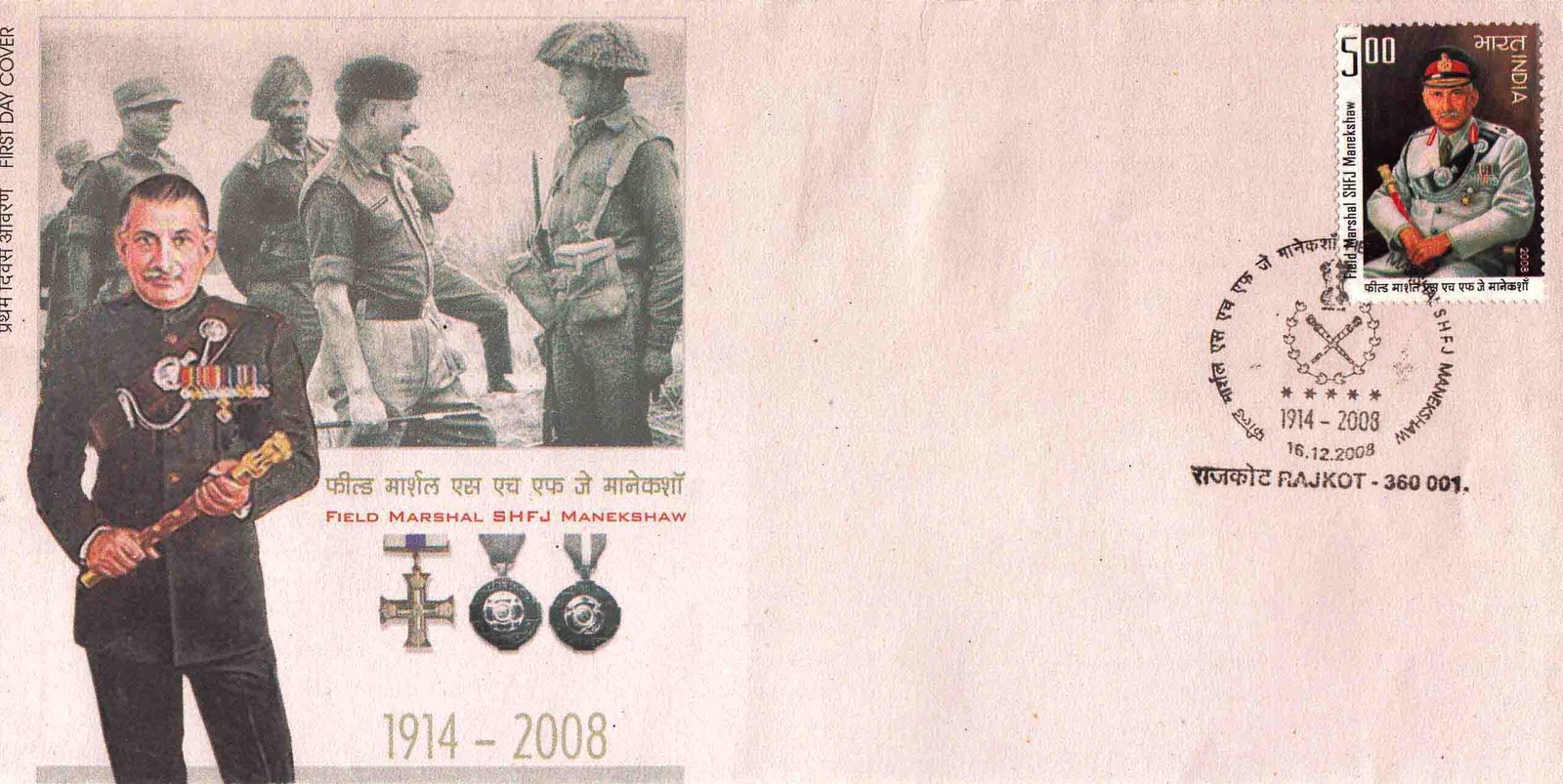
First Day Cover
Leave a Comment
You must be logged in to post a comment.