
Bimal Roy

Technical Data
| Date of Issue | January 8, 2007 |
|---|---|
| Denomination | Rs. 5 |
| Quantity | 400,000 |
| Perforation | 13 |
| Printer | Security Printing Press, Hyderabad |
| Printing Process | Wet Offset |
| Watermark | No Watermark |
| Colors | Multicolor |
| Credit (Designed By) | Sh. Bharati Mirchandani |
| Catalog Codes |
Michel IN 2185 Stamp Number IN 2181 Yvert et Tellier IN 1950 Stanley Gibbons IN 2376 WADP Numbering System - WNS IN001.2007 |
| Themes | Commemoration | Famous people | Men | Movies |
A Master Storyteller of Indian Cinema
The name Bimal Roy is deeply cherished by film lovers and remains synonymous with meaningful and socially conscious cinema. Rooted firmly in realism, his cinematic masterpieces such as Udayer Pathey (Bengali), Do Bigha Zameen, Devdas, and Bandini (Hindi) portray life with rare sensitivity and a distinctive poetic vision.
Quiet yet powerful in expression, Bimal Roy’s films explore the human condition in all its complexity—its drama, romance, suffering, and resilience—while celebrating the dignity of the human spirit. With subtlety and compassion, his storytelling exposes social inequality, economic exploitation, and injustice, leaving a lasting emotional impact that continues to resonate with audiences even today.
Early Life and Journey into Cinema
Born into an affluent landowning family, Bimal Roy was the seventh of nine children of Smt. Kironmoyee Roy and Shri Hem Chandra Roy, in the village of Suapur near Dhaka in erstwhile East Bengal. He was educated at the renowned Jagannath College, Dhaka. Despite his privileged background, circumstances compelled him to become self-reliant at a young age, eventually drawing him toward the world of cinema.
Roy began his career as a still photographer and soon became an assistant to the eminent filmmaker Nitin Bose, who served as his mentor. His journey from cinematographer to director and producer took shape at New Theatres, Calcutta. His exceptional talent earned him top billing as cinematographer for Mukti, directed by P. C. Barua—a rare honour at the time.
Cinema with a Social Conscience
As his artistic vision matured, Bimal Roy grew increasingly sensitive to social and economic injustice. His association with the Indian People’s Theatre Association (IPTA) marked a turning point in his career. He directed the path-breaking Bengali film Udayer Pathey, a courageous and inspiring portrayal of resistance against exploitation. The film deeply influenced a generation of filmmakers, including Satyajit Ray, Ritwik Ghatak, and Mrinal Sen.
Roy later remade the film in Hindi as Humrahi, which became a powerful voice of the progressive cultural movement in India.
Landmark Films and Enduring Characters
In 1950, Bimal Roy moved to Bombay at the invitation of Bombay Talkies, where he created some of his most iconic works. Among them, Do Bigha Zameen stands out as a poignant depiction of rural displacement, chronicling the struggle of Shambhu Mahato, a farmer forced into migrant labour in Kolkata. Influenced by Italian neorealists like Rossellini and De Sica, the film introduced a raw, humane realism to Hindi cinema.
In Devdas, Roy remained faithful to the literary soul of the classic novel while elevating it through unforgettable visual symbolism. The recurring image of the train, for instance, powerfully represents alienation and emotional exile. Characters like Paro embody strength, pride, and emotional depth—hallmarks of the women in Bimal Roy’s films.
Another unforgettable creation is Bandini, where the character Kalyani emerges as an enduring symbol of quiet strength and moral courage. The film’s haunting imagery, masterful sound design, and timeless music—especially the evocative song “O Mere Majhi”—make it one of the finest achievements of Indian cinema.
An Everlasting Legacy
Bimal Roy passed away in 1966, but his cinematic legacy continues to live on. Guided by a deeply personal vision, his films retain their relevance and emotional power, speaking across generations like all true classics. His work remains a benchmark for artistic integrity, social awareness, and humanism in Indian cinema.
Commemorative Postage Stamp
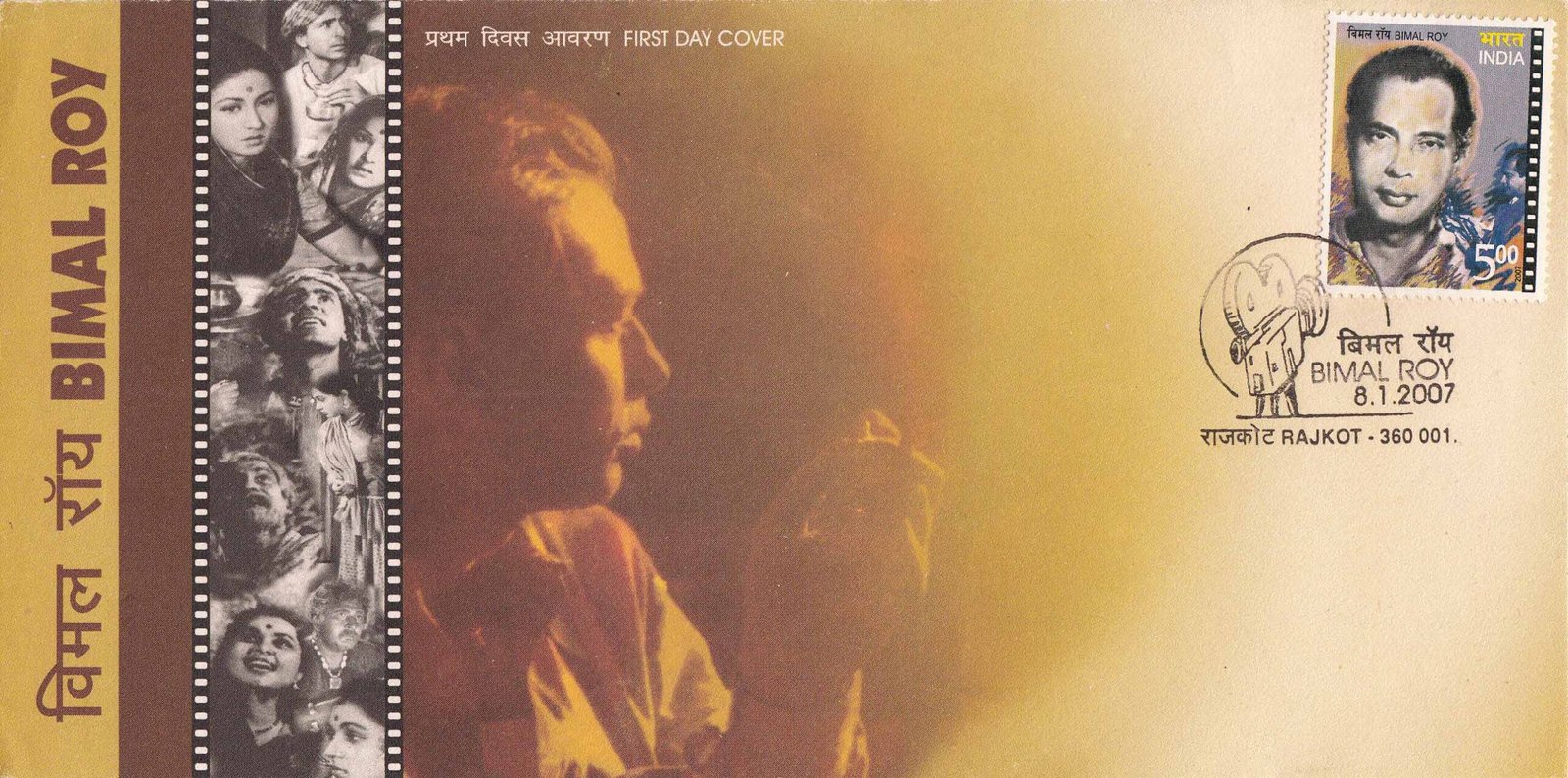
In recognition of his immense contribution to Indian cinema, the Department of Posts is privileged to issue a commemorative postage stamp in honour of Bimal Roy. This tribute celebrates a filmmaker whose art not only entertained but also enlightened, leaving an indelible mark on the cultural history of India.
First Day Cover
Leave a Comment
You must be logged in to post a comment.