
Water Year

Technical Data
| Date of Issue | December 28, 2007 |
|---|---|
| Denomination | Rs. 5 |
| Quantity | 400,000 |
| Perforation | 13 |
| Printer | Security Printing Press, Hyderabad |
| Printing Process | Wet Offset |
| Watermark | No Watermark |
| Colors | Multicolor |
| Credit (Designed By) | Mr. Suresh Kumar |
| Catalog Codes |
Michel IN 2255 Stamp Number IN 2228 Yvert et Tellier IN 2020 Stanley Gibbons IN 2457 WADP Numbering System - WNS IN071.2007 |
| Themes | Environment Protection | Stylized Figures / Persons | Water |
A Precious and Paradoxical Resource
“Water, water everywhere, but not a drop to drink.” In his celebrated poem The Rime of the Ancient Mariner, Samuel Taylor Coleridge captured the enduring paradox of water — abundant in appearance, yet scarce in usability. Though nearly two-thirds of the Earth’s surface is covered by water, the availability of fresh water remains one of the greatest challenges confronting humanity in the twenty-first century.
Global warming is intensifying this crisis. Rapid glacial melt, rising sea levels, and the inundation of low-lying regions threaten ecological and human security. At the same time, insufficient storage capacity across many regions leads to recurring floods during heavy rainfall and severe droughts during dry spells.
India’s Water Scenario
India faces a particularly complex and demanding water future. The country’s total water availability has been assessed at 1869 billion cubic meters (BCM), of which only 1123 BCM is utilizable — comprising 690 BCM of surface water and 433 BCM of groundwater resources.
Rainfall in India is highly seasonal and unevenly distributed. Nearly 50% of annual precipitation occurs within just 15 days, while over 90% of river flows take place in a brief four-month monsoon period. Historically, communities adapted ingeniously to this pattern by settling along riverbanks or constructing tanks and underground storage systems. Water management was largely community-driven and sustainable.
Over the past 150 years, India has invested heavily in water infrastructure to address growing demand and mitigate crises. Yet significant challenges remain.
Storage and Per Capita Availability
India can currently store only about 30 days of rainfall, compared to nearly 900 days in major river basins of arid developed nations. The country’s per capita storage capacity stands at approximately 207 cubic meters, far below that of China, which is about 1111 cubic meters.
With a steadily increasing population, per capita water availability is declining and is projected to fall to around 1341 cubic meters by 2025. Climate change is expected to further strain resources, increasing the urgency for expanded storage and efficient management systems.
Key Challenges in the Water Sector
India’s water sector faces multiple interrelated challenges:
- Declining per capita availability of water
- Over-exploitation of groundwater leading to falling water tables
- Deterioration of water quality
- Cost and time overruns in irrigation and multi-purpose projects
- Poor maintenance of existing infrastructure
- Recurring floods and droughts as major natural disasters
Addressing these issues requires an integrated national perspective that prioritizes conservation, efficient utilization, and sustainable development.
National Commitment: Water Year 2007
Recognizing the gravity of the situation, the Union Cabinet, in its meeting held on 4 January 2007, accepted the proposal of the Ministry of Water Resources to declare 2007 as Water Year. The National Common Minimum Programme placed significant emphasis on strengthening the water sector, with plans to increase public investment in irrigation.
Irrigation and drinking water were identified as two critical components of Bharat Nirman, aimed at accelerating rural infrastructure development and ensuring equitable access to essential resources.
Commemorative Postage Stamp: Water Year 2007
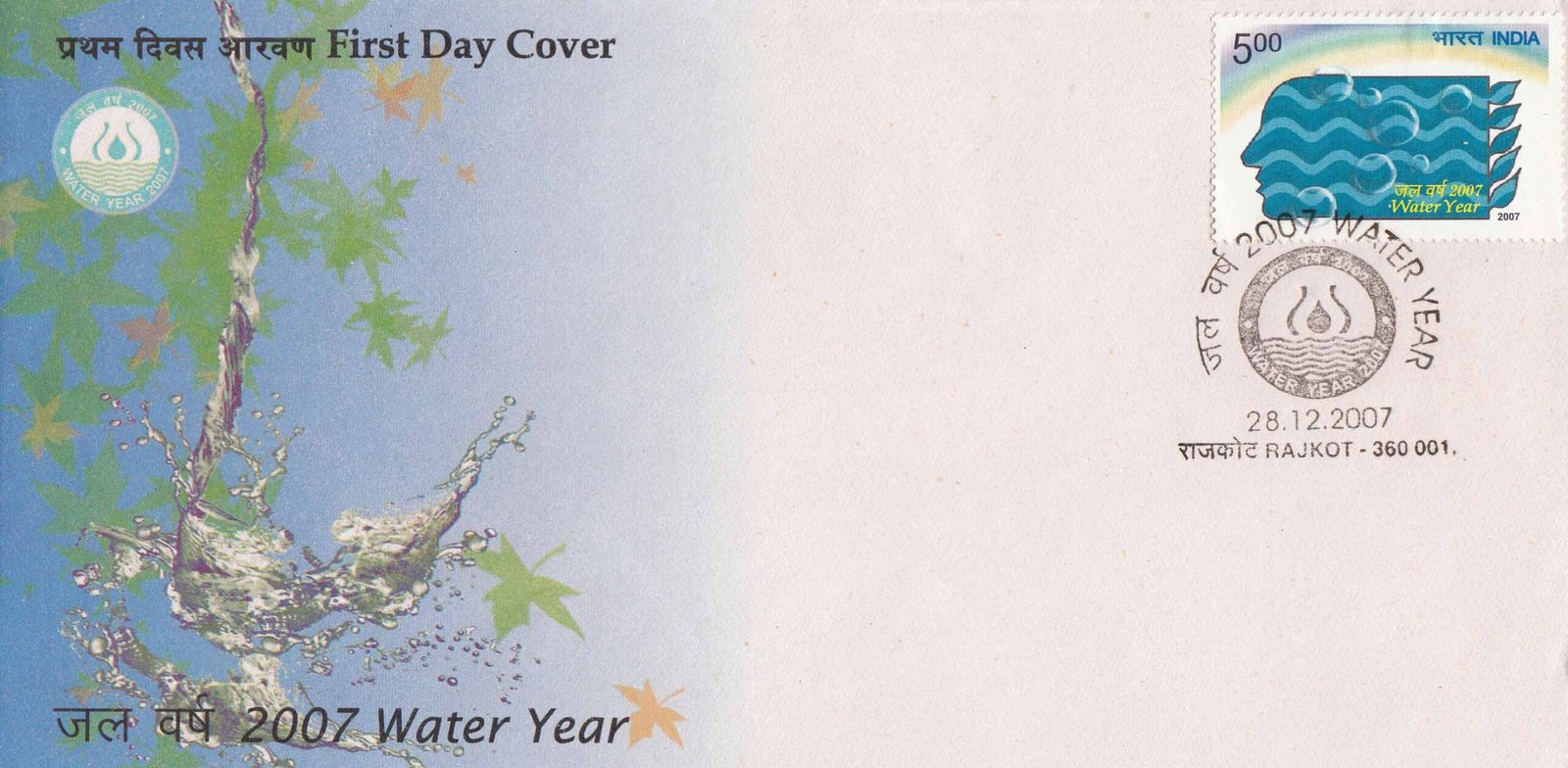
To mark this national commitment and raise awareness about sustainable water management, India Post issued a commemorative postage stamp on “Water Year 2007.” The stamp symbolizes the collective responsibility to harvest, conserve, and utilize water effectively.
By highlighting the importance of water governance and sustainable practices, the stamp serves as a reminder that safeguarding this precious resource is essential for India’s continued growth and the well-being of future generations.
First Day Cover
Leave a Comment
You must be logged in to post a comment.