
Vithalbhai Patel- First Indian Elected Speaker
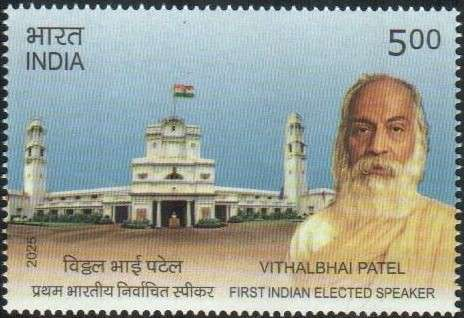
Technical Data
| Date of Issue | August 24, 2025 |
|---|---|
| Denomination | Rs. 5 |
| Quantity | 305,910 |
| Printer | Security Printing Press, Hyderabad |
| Printing Process | Wet Offset |
| Colors | Multicolor |
| Credit (Designed By) | Sh. Sankha Samanta |
| Catalog Codes |
Colnect codes IN 2025.08.24-01 |
| Themes | Famous people | Flags | Freedom Fighters | Government Buildings | Men | Politicians |
Early Life and Education
Vithalbhai Patel was born on 27 September 1873 in Nadiad, Gujarat, and raised in Karamsad. He pursued self-education and initially practised as a junior lawyer in Godhra and Borsad. Determined to study law in England, he enrolled at the Middle Temple, London. His journey was made possible by the sacrifice of his younger brother, Vallabhbhai Patel, who gave up his own opportunity to study abroad—an enduring testimony to their strong fraternal bond.
Entry into Public Life
Vithalbhai Patel entered electoral politics in 1912, winning a seat in the Bombay Legislative Council. He championed progressive legislation on municipal governance, town planning, and education. His 1917 proposal to extend compulsory primary education to municipal districts outside Bombay earned widespread praise.
Elected to the Imperial Legislative Council in 1918, he resigned in 1920 to support Mahatma Gandhi’s Non-Cooperation Movement. However, the suspension of the movement after the Chauri Chaura incident in 1922 led him to chart a new path. He co-founded the Swaraj Party with the aim of resisting colonial rule through legislative action rather than boycott.
Rise to the Speaker’s Chair
Vithalbhai’s legislative experience and nationalist leadership made him a natural choice for the highest parliamentary office. In March 1925, after the retirement of Sir Frederick Whyte, he was elected Speaker (President) of the Central Legislative Assembly, defeating T. Rangachariar by just two votes. His unanimous re-election in 1927 affirmed his stature and credibility.
Transformative Tenure as Speaker (1925–1930)
Vithalbhai Patel’s tenure revolutionised India’s legislative functioning:
Professionalising Parliamentary Procedures
Before his leadership, the Assembly’s procedures were largely ad hoc. He introduced systematic rules, regulations, and traditions aligned with democratic norms. Drawing inspiration from the British Parliamentary system, he adapted the practices to Indian needs and realities, giving the Assembly a distinct identity.
Ensuring Neutrality and Dignity of the Chair
He established the enduring convention of a neutral Speaker, intervening only to maintain order or cast a deciding vote. His 1927 study tour of Britain and Ireland enriched his reforms and elevated India’s parliamentary standards.
Institutionalising Legislative Independence
In 1928, he created a separate office for the Assembly, independent of the Government of India—an unprecedented move asserting legislative autonomy and setting the foundation for India’s free parliamentary institutions.
Champion of Members’ Rights and Free Speech
Vithalbhai Patel was a staunch defender of legislators’ freedom of speech, rights, and privileges, often ruling against attempts to curb debate. He safeguarded members who raised sensitive issues, including discussions on British repression during nationalist protests.
On 8 April 1929, when Bhagat Singh and Batukeshwar Dutt threw non-lethal bombs in the Assembly, he maintained calm, adjourned the session with dignity, and, while condemning the act, expressed sympathy for the patriotic motives that inspired such protests.
He also broke tradition by not vacating the Speaker’s Chair during the Viceroy’s address, asserting the Speaker’s authority and emphasising legislative sovereignty.
Nationalist Leader with Unquestionable Integrity
Despite being a senior Swaraj Party leader, he remained impartial as Speaker. He refused to fund party activities from his salary, instead donating to national causes through Gandhiji to avoid any perception of bias. His tactful yet firm relationship with Viceroy Lord Irwin helped secure initiatives such as relief work during Gujarat’s 1927 floods and discussions that sowed seeds for the later Round Table Conference.
Legacy
Even though colonial structures limited the Assembly’s legislative powers and often vetoed reforms, Vithalbhai’s leadership empowered legislators to challenge imperial authority. His constitutional wit, deep knowledge of law, and unwavering commitment to democratic values influenced generations of parliamentarians.
His declining health led to treatment in Europe, where he passed away in 1933. His legacy is immortalised through the Gujarat Legislative Assembly building and the parliamentary practices he introduced, which continue to guide Indian democracy.
Commemorative Postage Stamp
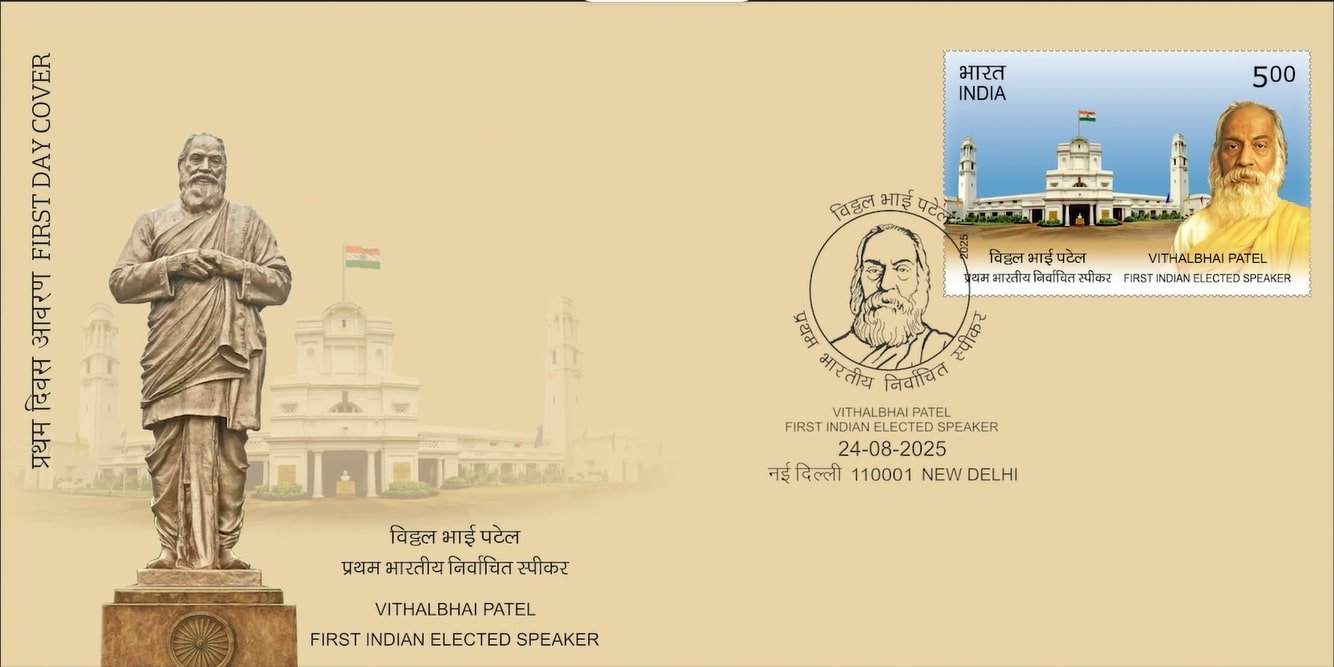
The Department of Posts proudly issues a Commemorative Postage Stamp in honour of Vithalbhai Patel—a visionary statesman, legislative reformer, and champion of democratic rights. This stamp pays tribute to his strategic brilliance, sacrifices, and pivotal role in shaping India’s parliamentary traditions, securing his place as a founding pillar of India’s democratic journey.
First Day Cover
Leave a Comment
You must be logged in to post a comment.