
100th Birth Anniversary of Arudra

Technical Data
| Date of Issue | December 16, 2025 |
|---|---|
| Denomination | Rs. 5 |
| Quantity | 303,280 |
| Printer | Security Printing Press, Hyderabad |
| Printing Process | Wet Offset |
| Credit (Designed By) | Ms. Neetu Arora |
A Multifaceted Luminary of Telugu Culture
Early Life and Intellectual Awakening
Bhagavatula Sadasiva Sankara Sastri, popularly known by his pen name Arudra, was born on 31 August 1925 in Visakhapatnam. He hailed from a distinguished family with a lineage extending over four centuries. Rooted in traditional learning, Arudra nevertheless broke away from orthodoxy early in life, rejecting caste-based practices and embracing a humanist and progressive worldview.
His poetic awakening occurred during a defining historical moment—the Japanese bombing of Visakhapatnam during World War II. This experience inspired his first major poem, Loha Vihangalu (Metal Birds), a powerful anti-war composition that marked his literary debut and set the tone for his socially conscious writing.
Eclectic Formative Years
Arudra’s early life reflected remarkable diversity of experience. He served in the Royal Indian Air Force, worked as a photographer, and later entered the fields of journalism and Telugu cinema. Under the influence of prominent literary mentors, he developed a distinctive voice that blended modernist aesthetics with social responsibility. A lifelong learner, Arudra pursued a wide range of interests—from mastering chess to exploring the depths of Telugu literary history.
Scholarship and Literary Magnum Opus
Arudra’s most monumental scholarly contribution is Samagra Andhra Sahityam, the most comprehensive documentation of Telugu literary history ever undertaken. Originally spanning thirteen volumes, later condensed into four, this seminal work traces the evolution of Telugu literature from its origins to the modern era. Distinguished by its rigorous research and engaging narrative style, the work remains an indispensable reference for scholars while remaining accessible to general readers.
Poet, Lyricist, and Cultural Icon
As a poet and lyricist, Arudra brought exceptional literary finesse to popular culture. He authored over 3,000 film songs, seamlessly blending poetic sophistication with mass appeal. His lyrics—ranging from devotional hymns to romantic and philosophical compositions—became enduring cultural staples. Works such as Tavareyaham, a poignant reflection on war and human suffering, underscore his depth and versatility as a poet.
Revivalist of Traditional Arts
Arudra was also a passionate researcher and revivalist of traditional performing arts. His scholarly work on Vilasini Natyam, a near-forgotten classical dance form, played a crucial role in its preservation and revival. His interdisciplinary approach—bridging literature, cinema, dance, and cultural research—reflected his belief that art transcends rigid boundaries.
A People’s Writer and Enduring Legacy
Arudra described himself as a “Sangha Jeevi”—a writer of and for the people. He believed that while epics endure on paper, lyrics live in the hearts and voices of the people. This philosophy continues to resonate as India navigates the balance between cultural preservation and modernity. His works remain widely taught, performed, and discussed, inspiring successive generations of Telugu writers, scholars, and artists.
The centenary of Arudra’s birth has renewed interest in his vast legacy, reaffirming his pivotal role in shaping Telugu and Indian cultural history. His vision of making literature accessible without diluting its essence remains deeply relevant today.
Philatelic Tribute
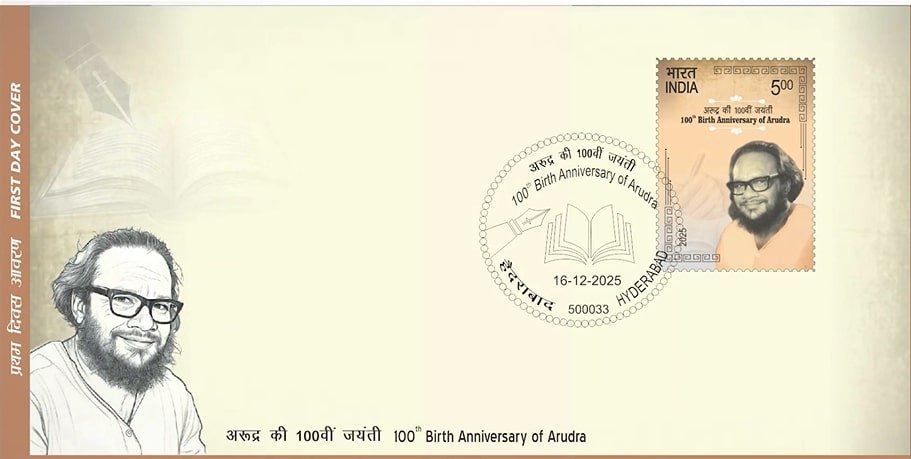
To honour this towering figure who seamlessly bridged scholarly excellence and popular culture, the Department of Posts proudly releases a commemorative postage stamp celebrating Arudra’s centenary. The stamp stands as a tribute not only to his extraordinary contributions but also to the enduring significance of Telugu literature in India’s cultural fabric.
First Day Cover
Leave a Comment
You must be logged in to post a comment.