
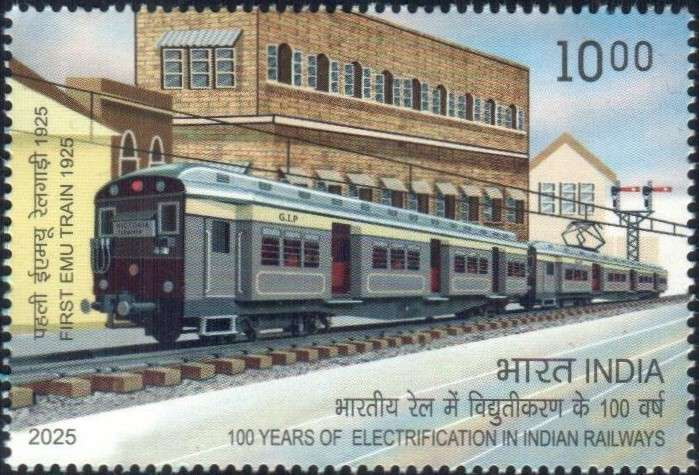
First EMU Train 1925
Technical Data
| Date of Issue | December 31, 2025 |
|---|---|
| Denomination | Rs 10 |
| Printer | Security Printing Press, Hyderabad |
| Printing Process | Wet Offset |
| Colors | Multicolor |
| Credit (Designed By) | Sh. Sankha Samanta |
| Catalog Codes |
Colnect codes IN 2025.12.31-01a |
| Themes | Anniversaries and Jubilees | Electricity | Railways |
Indian Railways: A Catalyst of National Integration
The Indian Railways, a powerful symbol of national integration and economic development, has played a transformative role in shaping transportation in India. Among its many milestones, the adoption of electric traction stands out as a landmark achievement, reflecting the organisation’s forward-thinking vision and enduring commitment to sustainability and efficiency.
Dawn of Electric Traction in India
The history of electric traction in India began in 1925, when the first electric train was introduced on the Harbour Line between Bombay V.T. (now Chhatrapati Shivaji Maharaj Terminus) and Kurla. This pioneering step marked the beginning of a new era in rail transport, characterised by cleaner, faster and more efficient operations. The initial electrification employed the 1.5 kV DC system, representing a significant technological advancement for its time.
Transition to a Modern Standard
Encouraged by early success, Indian Railways gradually expanded its electrified network. After Independence, emphasis was placed on adopting a uniform and globally accepted system. The transition to 25 kV AC electrification, known for its economic and operational advantages, gained momentum during the 1960s. This shift laid a strong foundation for the large-scale electrification of railway routes across the country.
Contribution to Economic and Industrial Growth
Electric traction has been a cornerstone of India’s industrial and economic progress. Enhanced efficiency in rail transport has enabled the smooth movement of goods and raw materials, fostering industrial growth and strengthening connectivity between urban centres and rural hinterlands. This has significantly contributed to balanced regional development.
Commitment to Environmental Sustainability
By reducing dependence on fossil fuels, electric traction has made Indian Railways a leader in eco-friendly transportation. The adoption of energy-efficient technologies and integration of renewable energy sources such as solar and wind power have further strengthened its role in minimising carbon emissions and promoting environmental sustainability.
Rapid Electrification in Recent Years
Over the past decade, Indian Railways has witnessed exponential growth in electrification, aligned with the Government’s vision of energy security and environmental responsibility.
- Over 44,000 route kilometres have been electrified in the last ten years
- More than 30,000 route kilometres were electrified in the past five years alone
- Indian Railways is steadily progressing towards 100% electrification of its broad-gauge network by 2025
A Century of Innovation and Progress
As Indian Railways celebrates 100 years of electric traction, it honours a legacy of innovation, resilience and progress. The remarkable expansion of railway electrification mirrors India’s ambition to modernise infrastructure and embrace sustainable development.
Looking Ahead
This centenary milestone is not merely a reflection of past achievements but a vision for the future—where Indian Railways continues to lead the nation in green transportation, technological advancement and nation-building.
Commemorative Postage Stamps
To mark this historic achievement, the Department of Posts is delighted to release a Commemorative Postage Stamps on “100 Years of Electrification in Indian Railways”, celebrating its immense contribution to economic development and its steadfast commitment to transforming transportation in India.
First Day Cover

Leave a Comment
You must be logged in to post a comment.