
Puppets of India
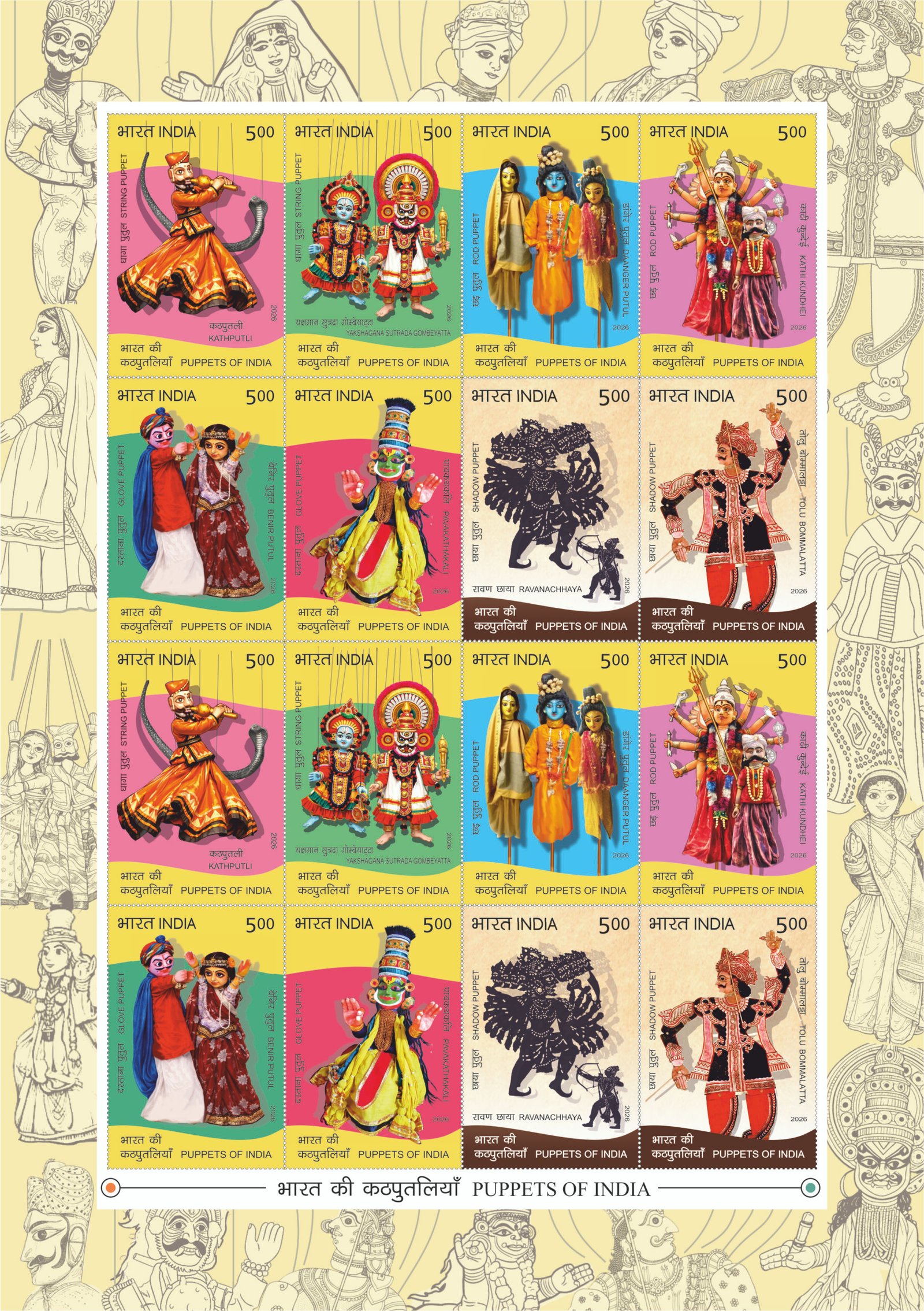
Technical Data
| Date of Issue | February 13, 2026 |
|---|---|
| Denomination | Rs. 80 |
| Quantity | 111,000 |
| Printer | Security Printing Press, Hyderabad |
| Printing Process | Wet Offset |
| Colors | Multicolor |
| Credit (Designed By) | Sh. Sankha Samanta |
| Catalog Codes |
Colnect codes IN 2026.02.13-01 |
| Themes | Puppets |
Living Traditions of Storytelling and Craftsmanship
The earliest reference to puppetry in India appears in the epic Mahabharata, dating back to around the ninth century BC. Panini (4th century BC) and Patanjali also mentioned puppets in their works. The Tamil poet Tiruvalluvar (2nd century BC) wrote that the movements of a person without conscience resemble “marionettes moved by strings,” highlighting how deeply embedded puppetry was in philosophical and literary thought.
In classical Sanskrit theatre, the Sutradhara—literally “the holder of strings”—introduces and directs the play. The term also signifies an architect or master craftsman, and metaphorically refers to God as the cosmic manipulator of human destiny.
India today sustains nearly twenty living traditions of glove, string, rod, and shadow puppetry, making it one of the few countries where all four classical forms continue to thrive. These traditions are spread across the country and are deeply rooted in mythology, folklore, and community life. Puppet plays commonly enact stories from the Ramayana, the Mahabharata, and the Puranas, alongside local legends and contemporary themes.
The design, costume, colour, and size of puppets reflect the characters they portray. Puppets often speak in stylized or whistling voices, and the art form is traditionally transmitted within families, with children learning by observing and assisting their elders.
Major Traditions of Indian Puppetry
Kathputli (Rajasthan)
Kathputli, the most recognized string puppet tradition of northern India, originates from Rajasthan. The word combines kath (wood) and putli (doll). Traditionally performed by the nats or bhats, this art flourished under the patronage of legendary king Vikramaditya.
Stories often celebrate local heroes, especially Amar Singh Rathore of Nagaur, whose bravery and dramatic death remain central themes. Performers travel during the dry season and return to agricultural work after the monsoon.
Yakshagana Sutrada Gombeyatta (Karnataka)
Karnataka’s rich puppetry heritage includes Sutrada Gombeyatta (string puppetry) and Togalu Gombeyatta (shadow puppetry). These forms closely resemble the dance-drama tradition of Yakshagana in costume, music, and narrative style.
Large wooden puppets—up to one metre tall—are manipulated with strings and are accompanied by singers and percussionists. Stories are primarily drawn from the Ramayana, Mahabharata, and Puranas. The art received patronage from the Vijayanagara rulers.
Daanger Putul (West Bengal)
Daanger Putul Nach is a rod puppet tradition of West Bengal featuring performances that may last up to three hours. The repertoire includes episodes from the Ramayana, social dramas, and Bengali tales.
The large wooden puppets, carved and painted in traditional pata style, perform on bamboo-and-cloth stages with live musical accompaniment including khol, nagara, harmonium, and cymbals.
Kathi Kundhei (Odisha)
Kathi Kundhei is a reconstructed rod puppet tradition of Odisha. Performances begin with a stuti (invocation), followed by mythological episodes such as the battles of Durga and Mahishasura or Rama and Ravana.
The 60-centimetre puppets have carved wooden heads and jointed shoulders, with movements controlled by rods and internal strings.
Benir Putul (West Bengal)
Benir Putul, a traditional glove puppet theatre of West Bengal, is also known as “Merchants’ Puppets.” Concentrated in Medinipur district, performances typically feature sparring male and female characters with terracotta heads and wooden limbs.
Small travelling groups perform in villages, using rhythmic gestures enhanced by bells or cymbals tied to the puppets’ wrists.
Pavakathakali (Kerala)
Pavakathakali is Kerala’s glove puppet theatre, developed under the influence of the classical dance-drama Kathakali.
The term combines Pava (puppet) and Kathakali (story play). Emerging about two centuries ago, it adapted Kathakali’s stylized costumes, makeup, and gestures into miniature puppet form. Traditionally performed to educate and entertain children, it familiarizes audiences with the Ramayana and Mahabharata while imparting moral values.
Ravanachhaya (Odisha)
Ravanachhaya, meaning “Shadow of Ravana,” is an ancient shadow puppet tradition of Odisha. Based on the Odia version of the Ramayana, it follows the Vichitra Ramayana of Vishvanath Khuntia.
Simple, unpainted leather puppets create striking silhouettes against an illuminated screen. Once popular in Angul and Dhenkanal, the tradition now survives mainly in parts of Angul district.
Tolu Bommalatta (Andhra Pradesh)
Tolu Bommalatta, the shadow puppet theatre of Andhra Pradesh, is among the earliest surviving folk forms of the region. Translucent, multi-coloured leather puppets are projected against a white screen, producing vivid pictorial compositions brought to life through movement, music, and dialogue.
The creative skill of the singer-manipulators adds depth and dramatic intensity to the performances.
Philatelic Recognition
Recognizing the cultural richness and diversity of Indian puppetry, India Post is pleased to issue a set of Four Miniature Sheets and One Sheetlet on Puppets of India.
This commemorative issue celebrates:
- India’s ancient storytelling traditions
- The artistic craftsmanship of puppet-making
- The continuity of family-based transmission
- The vibrant regional diversity of performance styles
The stamps pay tribute to puppetry as a dynamic form of cultural expression that blends theatre, music, sculpture, painting, and oral tradition. Through this philatelic release, the Department of Posts honours an art form that has preserved India’s myths, history, social commentary, and moral imagination across centuries.
Leave a Comment
You must be logged in to post a comment.