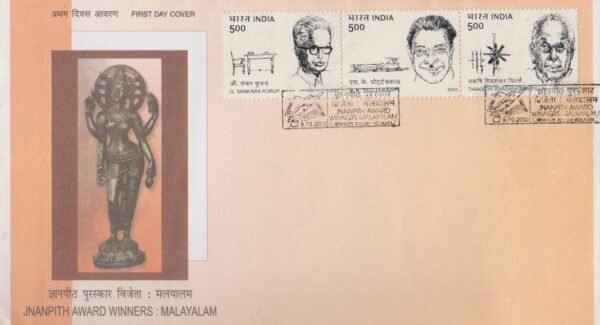
Malaylam Jnanpith Literary Award Winners
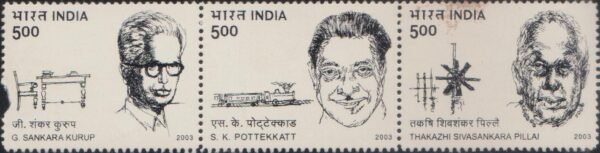
Technical Data
| Date of Issue | October 10, 2003 |
|---|---|
| Denomination | Rs. 15 |
| Perforation | comb 13½ x 13 |
| Printer | Security Printing Press, Nashik |
| Printing Process | Photogravure |
| Watermark | No Watermark |
| Colors | Black | Cream |
| Credit (Designed By) | Smt. Alka Sharma |
| Catalog Codes |
Michel IN 1980-1982 Stamp Number IN 2025 Yvert et Tellier IN 1745-1747 Stanley Gibbons IN 2154a |
| Themes | Authors | Famous people | Literary People (Poets and Writers) | Literature | Men |
Stamps in this Se-Tenant


The Jnanpith Award is one of the most prestigious literary honours in India. It recognises exceptional contributions to literature in languages listed in the Constitution of India under the Eighth Schedule, reflecting the unity and diversity of Indian culture. Continuing its series on Jnanpith laureates that began in 1997, India Post issued a set of three commemorative postage stamps honouring three distinguished writers of Malayalam literature—G. Sankara Kurup, S. K. Pottekkatt, and Thakazhi Sivasankara Pillai.
S. K. Pottekkatt (1913–1982)
S. K. Pottekkatt was a writer, traveller and political idealist whose humanitarian vision deeply influenced his contemporaries. A versatile author, he wrote in many literary forms including short stories, novels, plays, poetry and travelogues. His stories often contained unexpected twists that revealed the ironies of human relationships.
An acute observer of human behaviour, Pottekkatt combined romantic sensibility with realism in his novels. Works such as Nadan Premam (Village Love Story), Oru Desathinte Katha (Story of a Country-side), and Oru Theruvinte Katha (Story of a Street) earned him recognition as one of India’s leading novelists. He believed that writers have a responsibility toward shaping society, and this conviction guided his literary work. Pottekkatt was also among the pioneers of travel writing in India, and his travelogues—blending information, personal reflections and anecdotes—were as engaging as a well-written thriller.
G. Sankara Kurup
G. Sankara Kurup was a poet of mystical inclination whose poetry displayed refined language, artistic discipline and deep intellectual depth. With around forty publications—including poetry, dramas and essays—he made an outstanding contribution to Malayalam literature.
Critics identify four interwoven phases in his creative evolution: romanticism, mysticism, nationalism and humanism. Works such as Sandhya Taram (Twilight Star), Sooryakanti (Sunflower), and Pushpageeti (Song of Flower) reflect romantic and lyrical themes. In contrast, Azhimukham (Harbour Mouth) and Raktabindu (Drop of Blood) convey strong nationalist sentiments. His universal humanism finds expression in Pathikante Pattu (Song of the Wayfarer).
His celebrated collection Odakkuzhal (The Flute) won the Jnanpith Award and stands as a masterpiece blending pure romanticism with profound mysticism.
Thakazhi Sivasankara Pillai (1912–1999)
Through his deeply rooted stories of Kuttanad, Thakazhi Sivasankara Pillai portrayed the lives and struggles of ordinary people with remarkable authenticity. His multi-layered narratives transcended regional boundaries and presented universal human experiences.
Concern for the underprivileged formed a major theme in his early novels such as Thottiyude Makan (Scavenger’s Son) and Randidangazhi (Two Measures), which delivered powerful social messages. Later, in the classic Chemmeen (Shrimps), greater emphasis was placed on narrative style and storytelling techniques.
His exploration of the relationship between art and life continued in works like Enippadikal (Rungs of the Ladder) and Chukku (Dried Ginger). This literary journey culminated in Kayar (The Coir Rope), widely regarded as his magnum opus. Besides novels, he wrote numerous articles, biographical sketches and travelogues.
Stamp Design and Significance
The stamp designs incorporate visual elements associated with the lives of these writers:
- The stamp honouring G. Sankara Kurup features a writing desk and chair symbolising his intellectual pursuits.
- The stamp on S. K. Pottekkatt, a legendary traveller, shows a vintage steam locomotive moving in the background.
- The stamp dedicated to Thakazhi Sivasankara Pillai depicts a water wheel, commonly seen in the paddy fields of Kuttanad—the setting of many of his stories.
Through this set of commemorative stamps, India Post celebrates the vibrant creativity of Indian literature and honours the masters whose writings have captivated readers across the country.
First Day Cover