Tamralipta Jatiya Sarkar
Technical Data
| Date of Issue | December 17, 2002 |
|---|---|
| Denomination | Rs. 10 |
| Perforation | comb 13¼ x 13 |
| Printer | Security Printing Press, Nashik |
| Printing Process | Photogravure |
| Watermark | No Watermark |
| Colors | Multicolor |
| Credit (Designed By) | Sh. Sankha Samanta |
| Catalog Codes |
Michel IN 1936-1937 Stamp Number IN 1985 Yvert et Tellier IN 1701-1702 Stanley Gibbons IN 2104a |
| Themes | Anniversaries and Jubilees | Famous people | Men | Newspapers |
Stamps in this Se-Tenant

A Historic Chapter in India’s Freedom Struggle
The Quit India Movement was a turning point in India’s struggle for independence. Launched in 1942, this mass movement clearly declared that British rule in India could no longer continue. Although the movement was suppressed, it made it evident that the British Government would soon have to relinquish control over India.
Formation of Tamralipta Jatiya Sarkar
One of the most unique features of the Quit India Movement was the establishment of parallel governments in different parts of the country, such as Satara in Maharashtra, Ballia in Uttar Pradesh, and Tamluk in West Bengal.
Among these, the Tamralipta Jatiya Sarkar in Tamluk was particularly remarkable. Established on 17 December 1942, this national government functioned independently for about 21 months.
The Tamralipta Jatiya Sarkar was highly organized and innovative. It set up:
- Police stations
- Military departments
- Courts of justice
- A system for revenue collection
This made it one of the most effective examples of self-governance during the freedom struggle.
Role of Tamluk in the Freedom Movement
Tamluk, located in the Midnapore district of West Bengal, had long been a center of nationalist activities. The region was already charged with revolutionary spirit when Mahatma Gandhi gave the famous “Do or Die” call in August 1942.
During the uprising:
- Local people captured several police stations
- Colonial administrative institutions were rendered ineffective
- The British authority in the region weakened significantly
The Tamralipta Jatiya Sarkar continued to function effectively until August 1944, when Mahatma Gandhi advised its dissolution due to changing circumstances.
Ajoy Kumar Mukherjee: Architect of the Movement
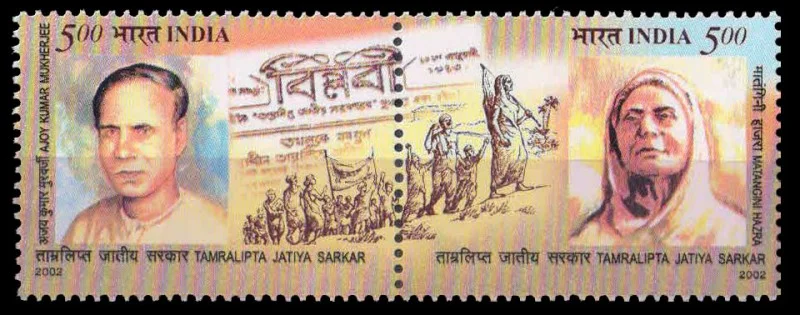
Ajoy Kumar Mukherjee was one of the प्रमुख leaders and architects of the Tamralipta Jatiya Sarkar. A dedicated freedom fighter, he devoted his early life to India’s independence.
After independence, he continued to serve the nation and worked for the upliftment of the underprivileged. He had a distinguished political career and served as the Chief Minister of West Bengal on three occasions, while remaining a member of the State Assembly for nearly three decades.
Matangini Hazra: A Symbol of Courage
Matangini Hazra was an extraordinary freedom fighter who displayed immense courage and determination. Widowed at an early age, she led a life dedicated to the nation.
At the age of 73, she actively participated in the Quit India Movement. On 29 September 1942, she led a procession in Tamluk, holding the national flag.
Despite being shot by British forces, she continued to advance with the flag in her hands. Even in her final moments, the national flag remained unfurled, symbolizing her unwavering patriotism.
‘Biplabi’ and Philatelic Significance
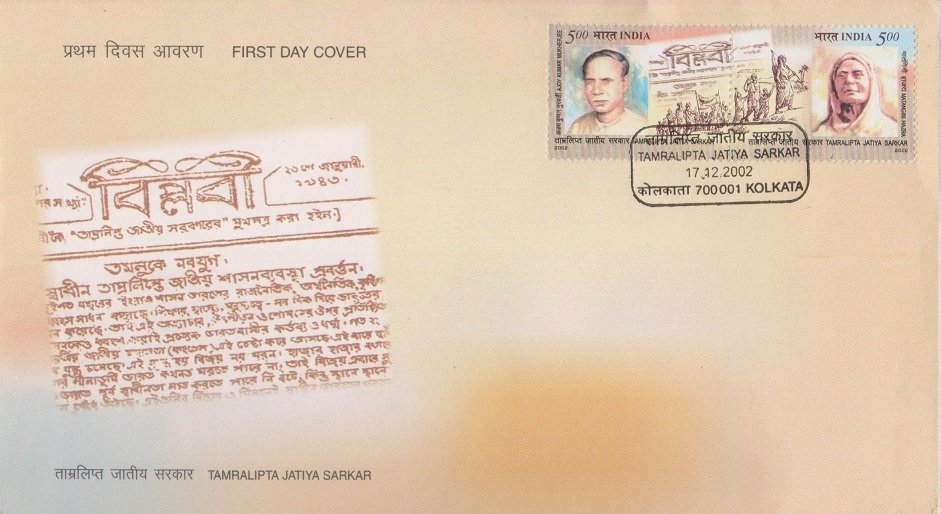
The revolutionary movement in Tamluk also produced its own publication, ‘Biplabi’, a newspaper that served as the official voice of the Tamralipta Jatiya Sarkar. It played a key role in spreading awareness and information during the movement.
The First Day Cover of the commemorative stamp features an issue of ‘Biplabi’ dated 26 January 1943, marking the beginning of the administrative role of the national government.
To honor the contributions of Ajoy Kumar Mukherjee and Matangini Hazra, India Post issued commemorative postage stamps in a se-tenant format, celebrating their role in India’s freedom struggle.
Conclusion
The story of the Quit India Movement and the Tamralipta Jatiya Sarkar highlights the spirit of self-governance and resistance that defined India’s fight for independence. Leaders like Ajoy Kumar Mukherjee and Matangini Hazra exemplified courage, sacrifice, and dedication.
Their legacy continues to inspire generations and remains an important chapter in the history of India’s freedom movement.
First Day Cover