
India’s Human Space Programme
Technical Data
| Stamp Set | India’s Human Space Programme |
|---|---|
| Date of Issue | April 12, 2026 |
| Denomination | Rs. 20 |
| Quantity | 111,000 |
| Printer | Security Printing Press, Hyderabad |
| Printing Process | Wet Offset |
| Colors | multicolor |
| Credit (Designed By) | Mr. Suresh Kumar |
| Catalog Codes |
Colnect codes IN IN 2026.04.12-02 |
| Themes | Outer Space | Space Traveling | Spacecraft |
ISRO’s Journey to Global Space Leadership
The Indian Space Research Organisation (ISRO), a leading arm of the Department of Space, has spent more than five decades driving innovation in space technology for national development and international cooperation. From launching satellites to preparing astronauts for space travel, ISRO has become a major force in the global space industry.
The Beginning of India’s Space Journey
India’s modern space programme began in 1962 under the visionary leadership of Vikram A. Sarabhai with the creation of INCOSPAR. In 1969, this initiative evolved into ISRO, laying the foundation for one of the world’s most successful space agencies.
Since then, ISRO has developed dependable launch vehicles such as:
- PSLV
- GSLV
- LVM3
- SSLV
These launch systems have enabled India to place satellites into orbit for communication, weather forecasting, broadcasting, navigation, disaster management, and natural resource monitoring.
ISRO’s Major Achievements in Space Exploration
ISRO has gained global recognition through scientific missions and commercial launch services led by NewSpace India Limited.
Some landmark missions include:
- Chandrayaan-3 – Successful Moon landing mission
- Aditya-L1 – India’s first mission to study the Sun
- NISAR – Joint Earth observation mission with NASA
These milestones highlight India’s growing strength in advanced space science and exploration.
India’s Human Space Programme and Gaganyaan
A new era has begun with India’s Human Space Programme. ISRO is preparing for Gaganyaan, the nation’s first crewed space mission.
At the center of this programme is the Gaganyaan crew module, representing India’s ability to send humans into space safely. Supporting this mission is the Human Rated Launch Vehicle (HRLV), designed to carry 2 to 3 astronauts into a 300–400 km orbit.
Bharatiya Antariksh Station: India’s Future in Space
India is also developing the Bharatiya Antariksh Station, an indigenous modular space station planned for Low Earth Orbit by 2035.
This project marks India’s transition into an elite spacefaring nation with long-term orbital capabilities.
Chandrayaan-3 and Lunar Success
The Chandrayaan-3 lander and rover symbolize India’s successful lunar exploration achievements. The mission strengthened India’s position among the few nations to achieve a controlled Moon landing.
Historic ISS Mission by Shubhanshu Shukla
India achieved another proud milestone when Shubhanshu Shukla became the first Indian astronaut to visit the International Space Station through the Axiom-04 mission.
He returned successfully after an 18-day scientific mission aboard the ISS, marking a historic achievement for both ISRO and India.
Celebrating India’s Space Heritage
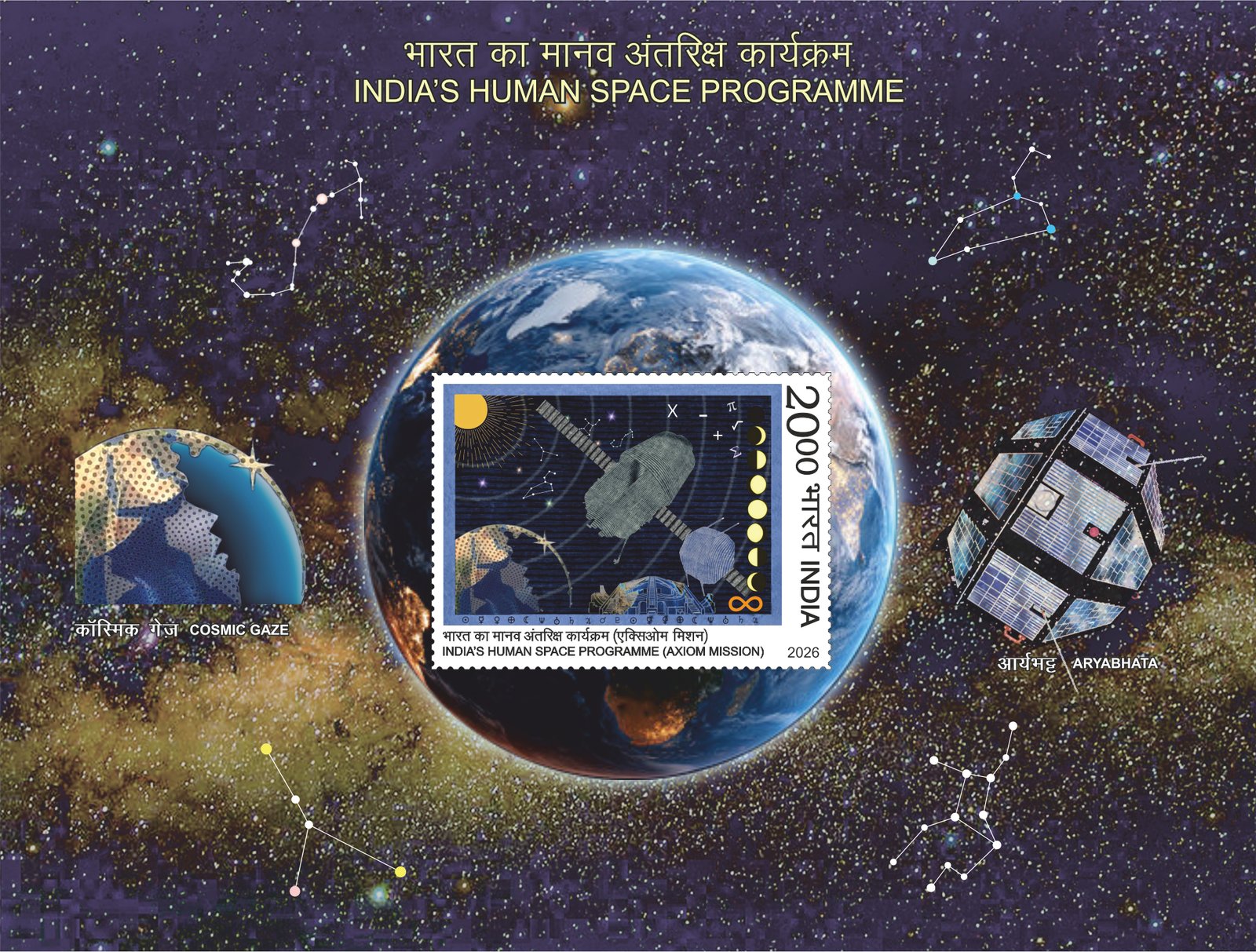
The Axiom-04 mission patch reflects India’s journey from ancient astronomical knowledge to modern space exploration. It includes symbols representing:
- Earth as shared origins
- An astronaut reaching for the stars
- The Gaganyaan capsule
- The Sun as life and energy
- Lunar phases celebrating Moon missions
- Aryabhata, India’s first satellite
- Jantar Mantar, honoring India’s scientific heritage
- Infinity symbolizing endless exploration and learning
Together, these elements present India’s permanent and growing presence in space.
India’s Future in Space
The Department of Posts has issued a souvenir sheet celebrating India’s Human Space Programme. These commemorative releases recognize India’s remarkable progress—from being a participant in space missions to becoming a leader in space technology and exploration.
With future missions such as a Venus orbiter, Chandrayaan-4, Chandrayaan-5, Gaganyaan, and the Bharatiya Antariksh Station, India’s journey among the stars is only beginning.
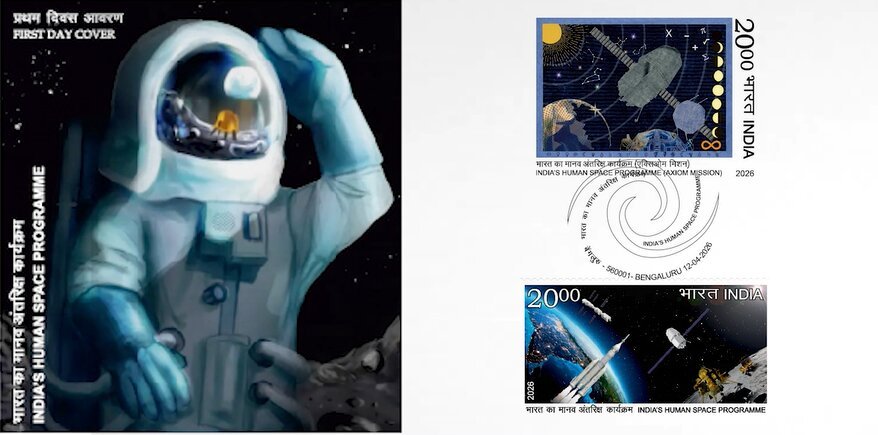
First Day Cover
Leave a Comment
You must be logged in to post a comment.