
100 Years of Tata Power
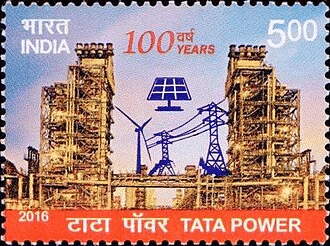
Technical Data
| Date of Issue | June 10, 2016 |
|---|---|
| Denomination | Rs. 5 |
| Quantity | 4 |
| Printer | Security Printing Press, Hyderabad |
| Printing Process | Wet Offset |
| Credit (Designed By) | Ms. Nenu Gupta |
The Vision and Core Operations of Tata Power
Guided by the foundational philosophy of Mr. Jamsetji Tata—who believed that abundant, affordable, and clean power is vital for economic progress—Tata Power has served as a pioneer in India’s energy sector for over a century. Today, it stands as the nation’s largest integrated power utility, managing a comprehensive value chain that encompasses fuel and fuel logistics, conventional and renewable power generation, transmission, distribution and retail, operations and maintenance services, and power trading.
Historical Milestones and Capacity Expansion
The company began its journey in 1915 by setting up a hydroelectric facility at Khopoli in the foothills of the Western Ghats, harnessing the potential energy of the Lonavala lakes to power Mumbai. Over the decades, its generation capabilities grew significantly. In 1956, Tata Power launched a thermal power station at Trombay with an initial capacity of 62.5 MW, which eventually evolved into a 500 MW multi-fuel plant. By 1990, the Trombay facility was expanded with a second 500 MW thermal unit and a gas-based 180 MW plant to secure uninterrupted power for Mumbai City.
Tata Power expanded its infrastructural footprint further into the 21st century. In 2003, it entered into a joint venture with the Power Grid Corporation of India Ltd. to construct a 1200 km long transmission line delivering electricity from Bhutan to Delhi. Later, in 2013, the company commissioned India’s first 4000 MW Ultra Mega Power Project at Mundra, Gujarat, utilizing advanced super critical technology. Today, its total generation capacity has reached 8,669 MW, supported by a steady pipeline of domestic and international developments.
Strategic Partnerships and Global Footprint
Tata Power is distinguished as the only company to secure public-private partnerships (PPP) across all three core sectors of the power industry: Generation (Maithon and Dagachhu), Transmission (Powerlinks), and Distribution via TPDDL, a joint venture with the Government of NCT of Delhi that serves a populace of 6 million. To support its resource requirements, the company holds a strategic stake in Indonesian coal mines and operates its own transport ships to supply coal to the Mundra plant.
The company’s influence extends globally through prominent overseas ventures, including the Cennergi JV with Exxaro in South Africa, a hydro project joint venture in Georgia with IFC and Clean Energy, and the Dugar hydro project in India in partnership with SN Power of Norway. Additionally, its Strategic Engineering Division (SED) has spent three decades developing defense production technologies, while the Tata Power Trading Company Ltd. (TPTCL) operates as a leading force in national power trading.
Sustainability, Conservation, and Community Impact
Environmental stewardship remains central to the corporate mission. Tata Power Solar was established twenty-five years ago as an early commitment to clean energy. To mitigate climate change, the company actively prioritizes clean coal sourcing alongside its renewable projects. Its dedicated Mahseer Conservation program, launched in the 1970s, continues to protect this endangered fish species.
Public awareness is driven effectively through the Tata Power Club Enerji initiative. Started in 2007 with just 12 schools in Mumbai, it has grown into a nationwide movement spanning ten major cities, including Pune, Bengaluru, Kolkata, Delhi, Ahmedabad, Jamshedpur, Lonavla, and Belgaum. The club has sensitized over 9.3 million citizens, resulting in the conservation of more than 14.2 million units of electricity. This collective energy saving prevents 14,200 tonnes of CO2 emissions, which is equivalent to powering approximately 6943 homes for a full year.
Corporate Social Responsibility efforts also heavily target eco-restoration in the ecologically sensitive Western Ghats, where over 7 million saplings representing 60 distinct tree species have been planted, complemented by an ongoing re-forestation program planting 600,000 trees regularly. For local communities, Tata Power provides rural self-employment training programs alongside essential healthcare initiatives, including regular medical check-ups, distributed medicines, eye exams, and regional blood donation camps.
Leave a Comment
You must be logged in to post a comment.