
Handlooms of India
Technical Data
| Date of Issue | August 7, 2026 |
|---|---|
| Denomination | Rs. 20 |
| Quantity | 329,997 |
| Printer | Security Printing Press, Hyderabad |
| Printing Process | Wet Offset |
| Credit (Designed By) | Mr. Suresh Kumar |
| Themes | Textile | Textile Industry |
A Rich and Diverse Tradition
India’s handloom tradition is among the oldest and most diverse in the world, representing the unbroken legacy of craftsmanship that spans millennia. As one of the country’s largest livelihood sectors after agriculture, handlooms support more than 35 lakh weavers and allied workers and contribute significantly to textile production and exports. India accounts for nearly 95 percent of the world’s handwoven fabric, reflecting the remarkable skill and creativity of its weaving communities. The sector preserves traditional knowledge, sustains rural economies, and serves as a vibrant expression of India’s cultural diversity.
National Handloom Day
National Handloom Day is observed annually on 7 August to commemorate the launch of the Swadeshi Movement in 1905, a landmark event in India’s freedom struggle that championed indigenous industry and self-reliance. Instituted in 2015, the observance recognises the invaluable contribution of handloom weavers to the nation’s cultural and economic life and promotes the preservation of India’s rich textile heritage.
Paithani Saree — Maharashtra
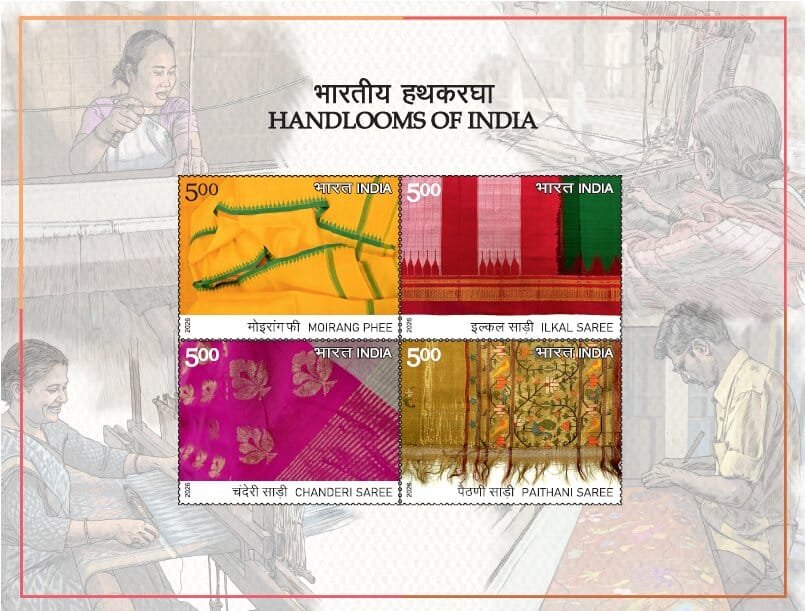
Originating from the historic town of Paithan in Maharashtra, the Paithani saree is one of India’s most celebrated silk handlooms. Woven in silk with gold and silver zari using the tapestry weaving technique, it is distinguished by richly ornamented borders and an elaborate pallu.
Traditional motifs such as peacock, mor, Asawali, Panja, and Muthada, together with floral and avian forms, exemplify the elegance and splendour of this renowned weave.
Moirang Phee — Manipur
Moirang Phee is the traditional handwoven textile of the Meitei community of Manipur, originating in Moirang in Bishnupur District. Woven primarily in cotton, it is characterised by the distinctive Moirang Pheeji motif along the borders.
According to local tradition, the motif is inspired by the teeth of the Pakhangba, the mythical serpent deity of Manipur. Giving rise to the alternate name of Yarong Phee, meaning “cloth with a pronged teeth pattern,” the textile is a unique expression of the region’s cultural identity and folklore.
Chanderi Saree — Madhya Pradesh
Named after the historic town of Chanderi in Madhya Pradesh, Chanderi is renowned for its sheer texture, delicate transparency, and lightweight elegance. Traditionally woven from silk and cotton, it is produced on pit looms with a jacquard or dobby mechanism that intricately interlocks the warp and weft.
Chanderi features woven motifs such as buti, jaal, ashrafi, and temple-inspired designs, along with traditional floral and geometric patterns. Its vibrant colours, striped pallav, and distinctive borders make it one of the most recognisable handloom traditions of southern India.
Ilkal Saree — Karnataka
Originating from the town of Ilkal in northern Karnataka, the Ilkal saree is known for its distinctive weaving technique and unique method of constructing the pallu. Traditionally woven using the kondi technique, it combines contrasting colours and intricate patterns to create its characteristic appearance.
Its vibrant colours, striped pallav, and temple-inspired borders make it one of the most recognisable handloom traditions of southern India.
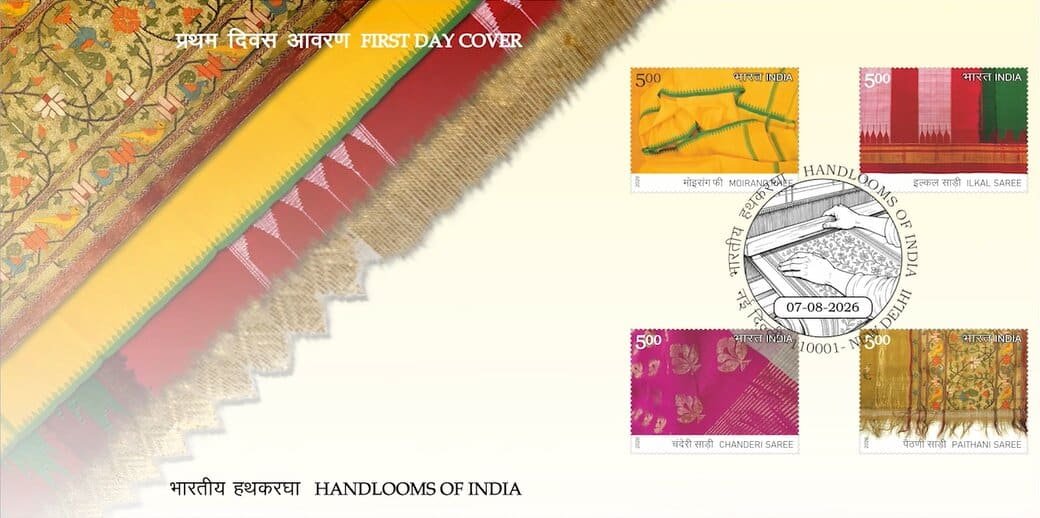
First Day Cover
Leave a Comment
You must be logged in to post a comment.