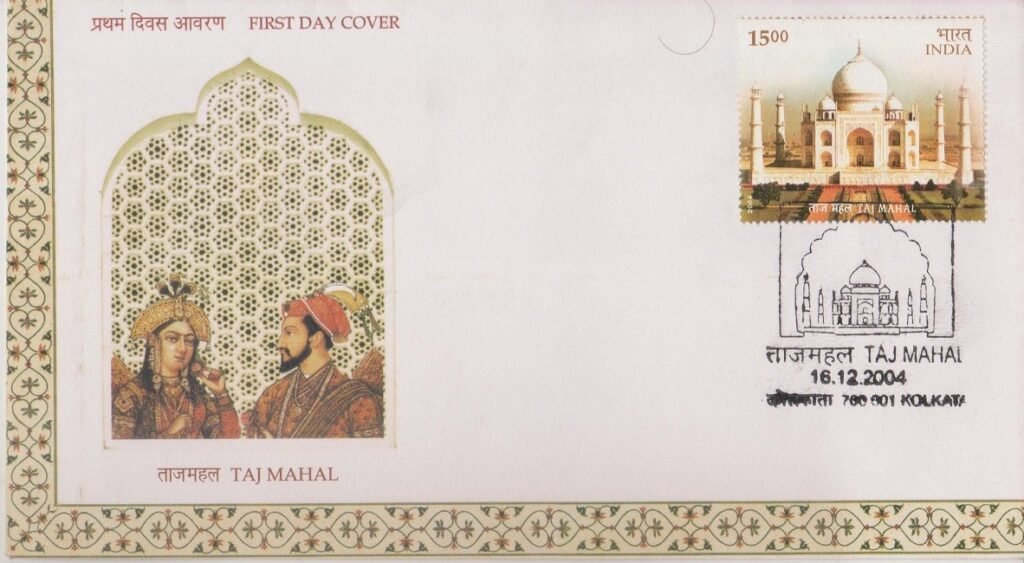
Taj Mahal

Technical Data
| Date of Issue | December 16, 2004 |
|---|---|
| Quantity | 100,000 |
| Printing Process | Photogravure |
| Credit (Designed By) | Sh. Sankha Samanta Smt. Alka Sharma |
The Eternal Symbol of Love and Architectural Perfection
The Taj Mahal has inspired poets, artists, and musicians for centuries. Its timeless beauty and architectural perfection have made it one of the most admired monuments in the world. Travelers from across the globe visit Agra not merely to see the remnants of the Mughal era, but to witness the Taj Mahal — the ultimate monument of love.
In a country rich with magnificent historical structures, the Taj Mahal stands unmatched. Its elegance, harmony, and emotional symbolism make it one of the most flawless architectural creations ever built.
The Love Story Behind the Taj Mahal
The Taj Mahal was built by the Mughal emperor Shah Jahan in memory of his beloved wife Mumtaz Mahal.
Mumtaz Mahal was originally known as Arjumand Banu Begum. She married Prince Khurram, the son of Jahangir, at the age of 21. Their marriage was one of deep affection and loyalty. Mumtaz accompanied the prince through both the luxuries of royal palaces and the hardships of military campaigns.
In 1628, Prince Khurram ascended the Mughal throne and adopted the title Shah Jahan, meaning “King of the World.” He bestowed upon his beloved wife the titles Mumtaz Mahal (“Exalted of the Palace”) and Mumtaz-ul-Zamani (“Exalted of the Age”).
However, their happiness was short-lived. In 1631, Mumtaz Mahal died at the age of 39 in Burhanpur while giving birth to their child. Grief-stricken, Shah Jahan vowed to build a memorial that would surpass every monument the world had ever seen.
Construction of the Taj Mahal
The construction of the Taj Mahal began in 1632 and was completed around 1654. According to historical accounts by the French traveler Jean-Baptiste Tavernier, more than 20,000 craftsmen and labourers worked for 22 years to build this architectural marvel.
Materials were sourced from across India and Asia:
From India
- Red sandstone from Fatehpur Sikri, Karauli, Tantpur, and Paharpur
- White marble from Makrana
- Jasper from Punjab
- Diamonds from Panna
From Abroad
- Jade and crystal from China
- Turquoise from Tibet
- Lapis lazuli and sapphire from Sri Lanka
- Carnelian and coal from Arabia
Nearly 28 types of precious and semi-precious stones were inlaid into the marble using intricate decorative techniques. Around 1,000 elephants were used to transport the materials required for construction.
Architecture and Design
The Taj Mahal complex consists of five major elements:
- Darwaza – The grand main gateway
- Bagicha – The beautifully designed Mughal garden
- Mosque – A functioning place of worship
- Naqqarkhana – The guest or rest house
- Rauza – The central mausoleum
The majestic central dome rises 187 feet and is surrounded by four elegant minarets. The design blends Persian, Central Asian, and Islamic architectural styles, creating a perfectly balanced structure.
The main mausoleum houses the cenotaphs of Shah Jahan and Mumtaz Mahal, surrounded by an intricately carved octagonal marble screen known as a jali. The actual graves lie in a lower chamber beneath the central hall.
Artistic Decoration and Craftsmanship
The decoration of the Taj Mahal reflects the artistic traditions of Islamic architecture. Three major techniques were used:
- Stone carving in high relief
- Painted stucco work
- Pietra dura (inlay of precious stones in marble)
The monument’s architectural brilliance was the result of the combined efforts of several master craftsmen:
- Ustad Ahmad Lahori – Chief architect
- Ismail Khan Afridi – Dome specialist
- Amanat Khan Shirazi – Master calligrapher
Their artistry transformed marble and stone into a timeless masterpiece.
Changing Colours of the Taj Mahal
One of the most fascinating aspects of the Taj Mahal is the way it changes colour throughout the day. The white marble reflects different shades depending on the light and atmosphere:
- Soft pink in the morning
- Milky white during the evening
- Golden under moonlight
The monument shines like a jewel during full-moon nights, when the semi-precious stones embedded in the marble reflect the moon’s glow. Many believe these changing colours symbolize the different moods of a woman.
Global Recognition and Legacy
The Taj Mahal remains one of the most celebrated monuments in the world and is recognized as a UNESCO World Heritage Site. Its beauty and symbolism continue to captivate millions of visitors every year.
The English poet Edwin Arnold beautifully described the monument as:
“Not a piece of architecture, as other buildings are, but the proud passions of an emperor’s love wrought in living stones.”
Philatelic Tribute
In recognition of this extraordinary architectural masterpiece and its significance as a symbol of eternal love, India Post issued a Souvenir Sheet consisting of one number of commemorative postage stamp honoring the Taj Mahal one of the most iconic landmarks of India and the world.
First Day Cover