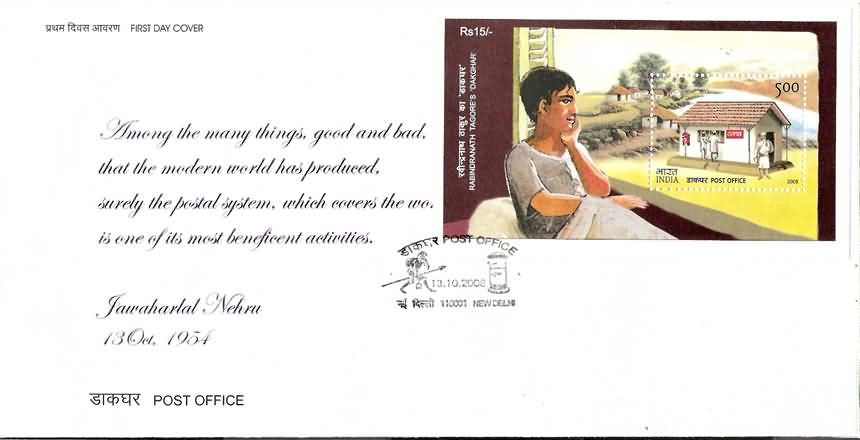
Post Office (Dak Ghar)

Technical Data
| Date of Issue | October 13, 2008 |
|---|---|
| Denomination | Rs. 15 |
| Quantity | 200,000 |
| Perforation | 13 |
| Printer | Security Printing Press, Hyderabad |
| Printing Process | Wet Offset |
| Watermark | No Watermark |
| Colors | Multicolor |
| Credit (Designed By) | Sh. Sankha Samanta |
| Catalog Codes |
Michel IN BL60 Stamp Number IN 2302a WADP Numbering System - WNS IN046MS.2008 |
| Themes | Buildings | Literature | Philately | Post Offices | Stamp Day |
A Timeless Institution
In an age dominated by telephones, mobile phones, and e-mail, we often take modern communication for granted. Behind these conveniences stand generations of inventive minds and devoted workers whose spirit of adventure built the institutions we cherish today. Among them, the Post Office occupies a unique and intimate place in human life.
The Post Office is more closely bound to human relationships than perhaps any other public institution. It carries messages of love, hope, sorrow, and celebration—connecting hearts through the simple yet powerful medium of a letter.
The Romance of the Letter
Few things evoke as much anticipation as the arrival of a letter. The rustle of paper, the familiar handwriting, the eager wait at the doorstep—these experiences are woven into the emotional fabric of society.
This sense of longing and expectation finds beautiful expression in Rabindranath Tagore’s celebrated play Dak Ghar (“The Post Office”). In the play, a young boy anxiously awaits a letter from the King, to be delivered through a newly opened post office in his village. The letter becomes a symbol of hope, connection, and unseen love.
As the Watchman remarks in the play:
“Ha! Ha! Postman, indeed! Rain or shine, rich or poor, from house to house delivering letters—that’s very great work.”
These words capture the dedication of the humble postal worker who braves natural calamities, wild terrain, and countless hardships to ensure communication never ceases.
Tradition and Modernity
Today, the Post Office is far more than a carrier of letters. Through its vast network, it offers a diverse range of services, including financial transactions and public services that reach even the remotest corners of the country. Its deep understanding of local communities makes it an efficient and cost-effective facilitator of communication and development.
India Post represents both tradition and modernity—a living institution that has evolved with time while preserving its foundational role in human connection. It stands as a symbol of continuity amid change.
Symbolism in Dak Ghar
Through Dak Ghar, Gurudev Rabindranath Tagore portrayed the Post Office as a symbol of goodwill, compassion, and the King’s benevolent love for his people. The letter in the play transcends its physical form—it becomes a metaphor for hope, freedom, and spiritual connection.
Souvenir Sheet
To celebrate this profound literary work and its enduring message, a Souvenir Sheet consisting of one commemorative postage stamp was issued on Philately Day 2008, honouring Rabindranath Tagore’s Dak Ghar—a timeless tribute to communication, compassion, and the human spirit.
First Day Cover