
Sarpagandha (Rauvolfia serpentina)
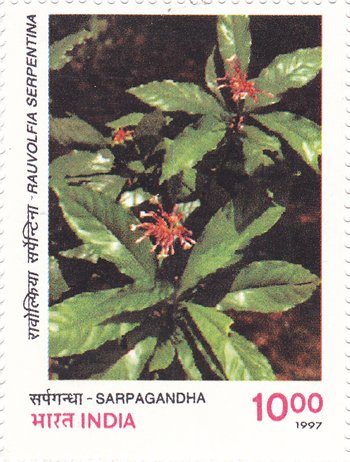
Technical Data
| Stamp Set | Indian Medicinal Plants |
|---|---|
| Date of Issue | October 28, 1997 |
| Denomination | Rs. 10 |
| Perforation | comb 14 |
| Printer | Security Printing Press, Nashik |
| Printing Process | Photogravure |
| Watermark | No Watermark |
| Colors | Multicolor |
| Credit (Designed By) | |
| Catalog Codes |
Michel IN 1585 Stamp Number IN 1642 Yvert et Tellier IN 1357 Stanley Gibbons IN 1749 |
| Themes | Plants (Flora) |
Sarpagandha (Rauvolfia serpentina), belonging to the Apocynaceae family, is one of the most important medicinal plants in India and is regarded as a valuable contribution of ancient Indian medicine to the world. It has been widely used in traditional healing systems for centuries because of its remarkable therapeutic properties.
The roots of Sarpagandha contain the alkaloid reserpine, which gained international recognition as an effective remedy for hypertension (high blood pressure). Ayurvedic texts also describe the plant for its sedative and hypnotic effects, making it useful in calming the nervous system and promoting restful sleep.
Traditionally, Sarpagandha has been used in the treatment of high blood pressure, insomnia, insanity, and schizophrenia. Its medicinal value made it an important herb in both classical Ayurveda and modern pharmacology.
The plant is widely distributed in India, particularly in the sub-Himalayan region, Assam, lower Gangetic plains, Eastern and Western Ghats, and parts of Central India.
The medicinal drug derived from Sarpagandha consists mainly of the air-dried roots of the plant. Besides the roots, its liquid extract, dried extract, and tincture are also recognized in the Indian Pharmacopoeia.
Commemorative postage stamp
Sarpagandha continues to be remembered as one of India’s most significant herbal medicines and was honoured by the Department of Posts through the commemorative postage stamp series on the Medicinal Plants of India.