
Universal Declaration of Human Rights
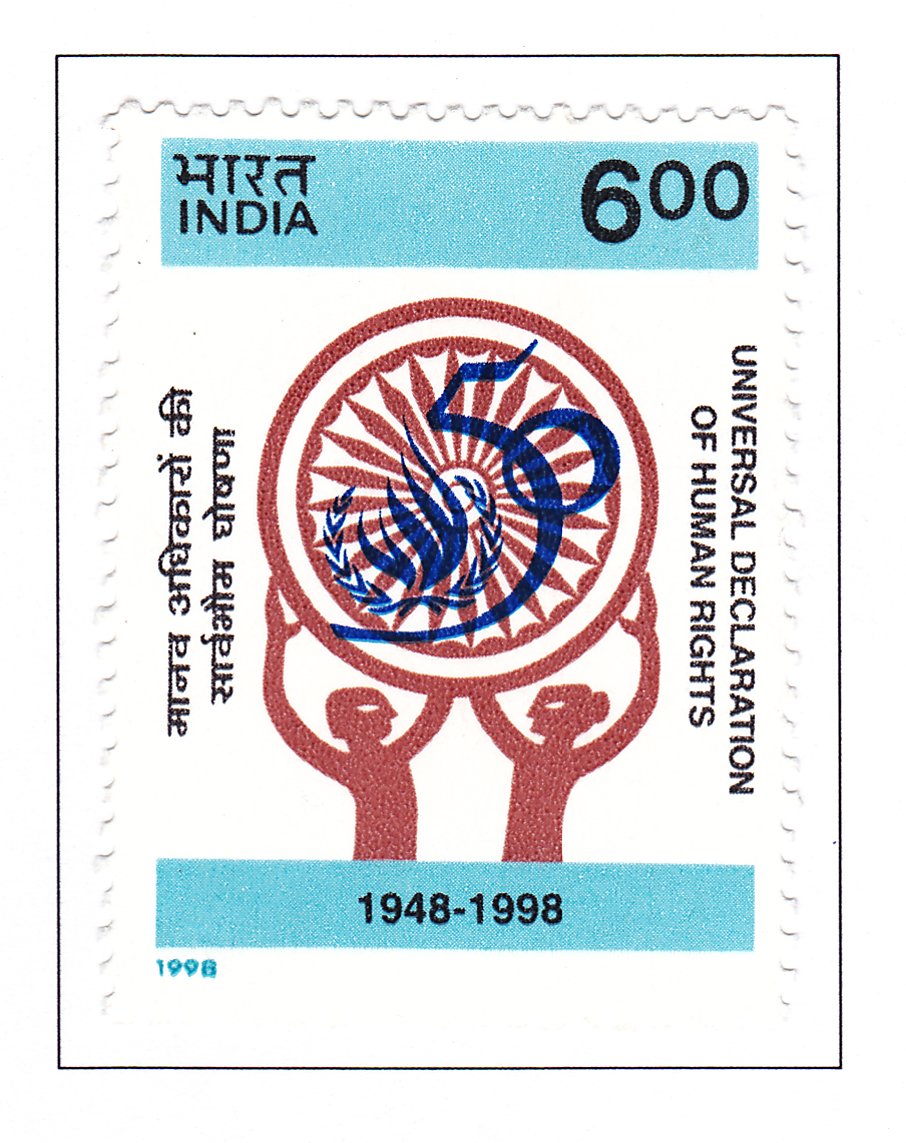
Technical Data
| Stamp Set | Golden Jubliees |
|---|---|
| Date of Issue | March 8, 1998 |
| Denomination | Rs. 6 |
| Quantity | 700,000 |
| Perforation | comb 13 x 13½ |
| Printer | Security Printing Press, Nashik |
| Printing Process | Photogravure |
| Watermark | No Watermark |
| Colors | Multicolor |
| Credit (Designed By) | |
| Catalog Codes |
Michel IN 1616 Stamp Number IN 1675 Yvert et Tellier IN 1383 Stanley Gibbons IN 1780 |
| Themes | Anniversaries and Jubilees | Human Rights | Seals(Emblems) | Stylized Figures / Persons |
History, Significance, and India’s Role
The Universal Declaration of Human Rights (UDHR) was adopted by the United Nations General Assembly on 10 December 1948. It marked the first truly global proclamation of human rights and fundamental freedoms, establishing a common standard of achievement for all nations and peoples.
At its core, the Universal Declaration of Human Rights emphasizes the recognition of the inherent dignity and equal, inalienable rights of all members of the human family. These principles form the foundation of freedom, justice, and peace in the world.
Key Features of the Universal Declaration of Human Rights
The strength of the UDHR lies in its universal acceptance and its comprehensive vision of human rights, which includes:
- Civil and political rights
- Economic and social rights
- Cultural rights
The Declaration is rooted in the idea that human dignity is universal, a value reflected across cultures, religions, and philosophies throughout history.
Influence on the Indian Constitution
The adoption of the Universal Declaration of Human Rights coincided with the framing of the Indian Constitution. Many of the rights outlined in the UDHR are reflected in India’s Constitution:
- Fundamental Rights (Part III) ensure civil and political freedoms
- Directive Principles of State Policy (Part IV) promote social and economic justice
This alignment highlights India’s strong commitment to upholding global human rights standards.
50th Anniversary of the Universal Declaration of Human Rights
In 1998, the international community celebrated the 50th anniversary of the UDHR. The commemorative year began on 10 December 1997 and concluded on 10 December 1998, marked by a special session of the United Nations General Assembly.
A major highlight of the celebrations was the focus on women’s rights, recognizing their critical role in advancing human rights globally.
India’s National Initiatives
To commemorate the 50th anniversary of the Universal Declaration of Human Rights, India established a National Committee led by the Home Minister. The initiative included a wide range of activities aimed at strengthening human rights awareness and protection.
The celebrations were launched on Human Rights Day (10 December 1997) by the National Human Rights Commission (NHRC).
A National Plan of Action was developed with key objectives:
- Promoting human rights awareness
- Expanding human rights education
- Strengthening national institutions
- Encouraging long-term initiatives for human rights protection
A detailed calendar of events ensured that these efforts led to sustained and meaningful action.
Commemorative Stamp and Women’s Rights
To mark this significant milestone, a commemorative postage stamp was released. The occasion also highlighted the importance of women’s rights, which were a central focus of India’s National Plan of Action.
This tribute also honors two influential women associated with the drafting of the Universal Declaration of Human Rights:
- Eleanor Roosevelt – who played a key leadership role in drafting the Declaration
- Hansa Mehta – who ensured the inclusion of gender-equal language in the document
Conclusion
The Universal Declaration of Human Rights remains a cornerstone of international human rights law. Its principles continue to guide nations, including India, in promoting equality, dignity, and justice for all.