Yuri Gagarin
Technical Data
| Date of Issue | April 12, 2001 |
|---|---|
| Denomination | Rs. 15 |
| Quantity | 800,000 |
| Perforation | comb 13 |
| Printer | Calcutta Security Printers Ltd |
| Printing Process | Offset Lithography |
| Watermark | No Watermark |
| Colors | Multicolor |
| Credit (Designed By) | Sh. Sankha Samanta |
| Catalog Codes |
Michel IN 1829 Stamp Number IN 1889 Yvert et Tellier IN 1595 Stanley Gibbons IN 1996 |
| Themes | Anniversaries and Jubilees | Astronauts | Famous people | Men | Rockets | Space Traveling | Spacecraft |
The First Human in Space and His Historic Legacy
On April 12, 2001, the world celebrated the 40th anniversary of humanity’s first spaceflight, honoring Yuri Gagarin (1934–1968)—the first human to journey into outer space. His groundbreaking mission aboard Vostok 1 marked a turning point in space exploration and opened the door to future scientific discoveries beyond Earth.
Early Life and Inspiration
Yuri Gagarin was born in Klushino, a small village located about 100 miles west of Moscow. Raised in a humble family of collective farm workers, he developed an early ambition to become a pilot.
During his school years, Gagarin showed a keen interest in mathematics and physics. He later trained as a foundry worker at a trade school. His intellectual and creative growth was influenced by renowned writers such as Henry Wadsworth Longfellow, Victor Hugo, and Charles Dickens, as well as the pioneering rocket scientist Konstantin Tsiolkovsky.
Journey to Becoming a Cosmonaut
Gagarin continued his education at a technical school in Saratov, where he joined a flying club and began training as a pilot. He later enlisted in the Soviet Air Force and received advanced training at the Orenburg Aviation School, where he learned to fly MiG aircraft.
In 1957, he graduated with top honors and was commissioned as a lieutenant. It was during this period that he married Valentina Goryacheva.
Historic Spaceflight: Vostok 1
Driven by his dream of space travel, Yuri Gagarin applied for the Soviet space program in 1959 and was selected for cosmonaut training. He excelled in the intense physical and psychological tests, emerging as the top candidate.
On April 12, 1961, Gagarin made history by orbiting Earth aboard Vostok 1, becoming the first human in space. His 108-minute flight demonstrated not only human capability in space but also provided valuable scientific insights.
Chief Designer Sergei Korolev praised Gagarin’s observational skills, noting that he gathered an extraordinary amount of information during his brief mission.
Global Fame and Later Years
After safely returning to Earth, Yuri Gagarin became an international hero. He traveled across the world as a symbol of peace and scientific progress, representing the achievements of human exploration.
Despite his fame, Gagarin remained committed to space exploration and began training for future missions, including the Soyuz program. Tragically, on March 27, 1968, he died in a jet crash during a test flight.
In honor of his contributions, a crater on the Moon was named after him.
Indo-Soviet Space Collaboration
The legacy of Yuri Gagarin holds special significance for India due to its long-standing collaboration with the Soviet Union in space science. This partnership led to the launch of India’s early satellites, including:
- Aryabhata
- Bhaskara I
- Bhaskara II
A major milestone was the joint manned mission in 1984 aboard the Soyuz T-11.
Legacy of Yuri Gagarin
Yuri Gagarin’s historic journey transformed space exploration and inspired generations worldwide. His courage, dedication, and pioneering spirit continue to symbolize humanity’s quest to explore the unknown.
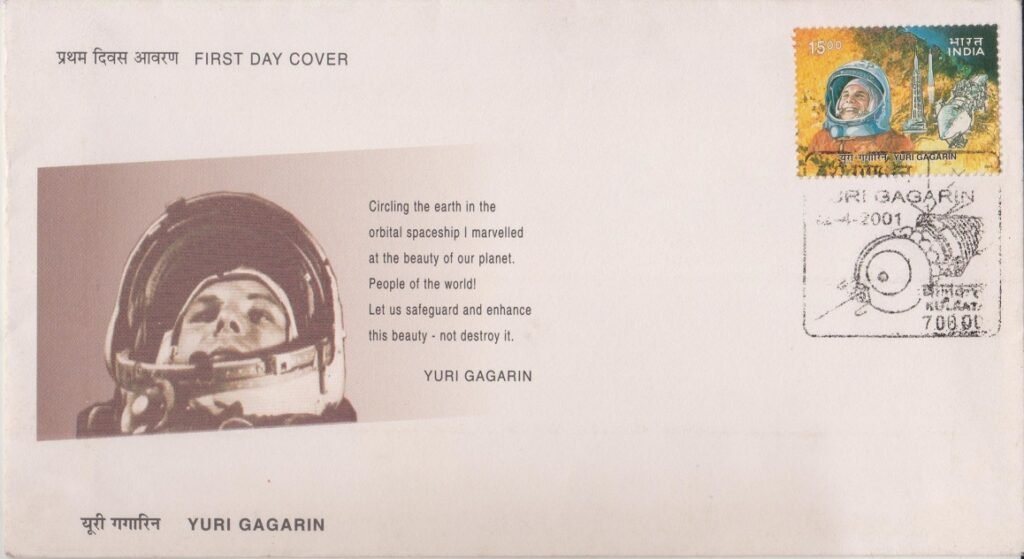
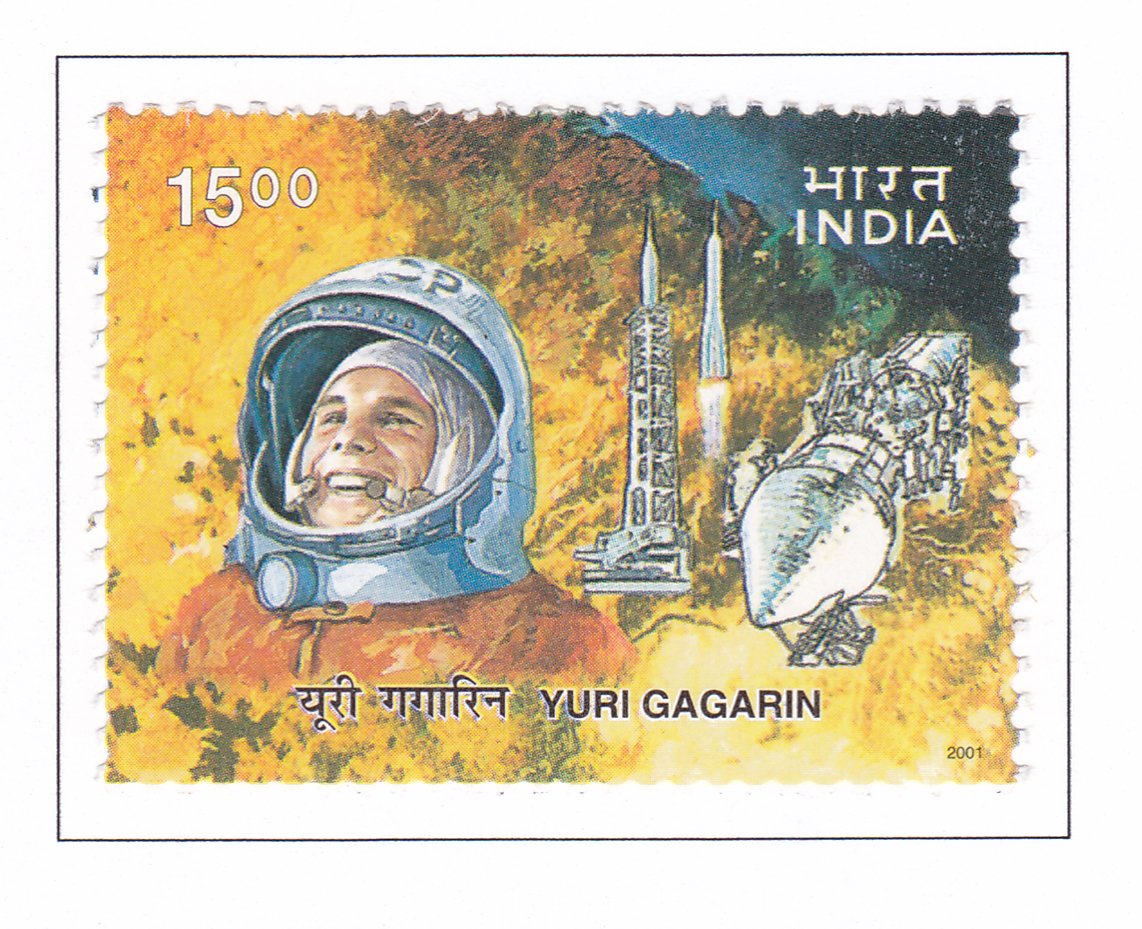
To commemorate his extraordinary achievement, the Department of Posts issued a special Commemorative postage stamp marking the 40th anniversary of the first human spaceflight.
First Day Cover