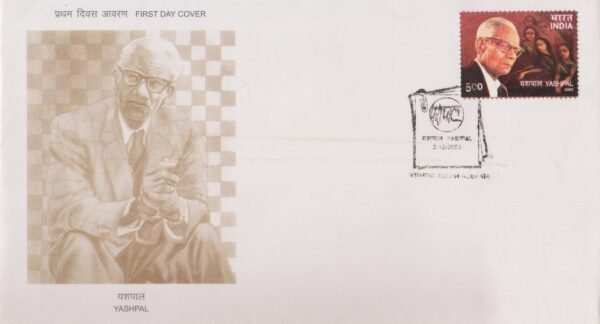
Yashpal (1903-1976)

Technical Data
| Date of Issue | December 3, 2003 |
|---|---|
| Denomination | Rs. 5 |
| Quantity | 400,000 |
| Perforation | comb 13½ |
| Printer | Security Printing Press, Nashik |
| Printing Process | Photogravure |
| Watermark | No Watermark |
| Colors | Multicolor |
| Credit (Designed By) | Shri. Benoy Varghese Smt. Alka Sharma |
| Catalog Codes |
Michel IN 2002 Stamp Number IN 2041 Yvert et Tellier IN 1767 Stanley Gibbons IN 2178 WADP Numbering System - WNS IN059.03 |
| Themes | Anniversaries and Jubilees | Authors | Famous people | Literary People (Poets and Writers) | Literature | Men | Optical Instruments |
Introduction
Yashpal was a prominent revolutionary, thinker and one of the most influential writers in Hindi Literature. Known for his fearless criticism, deep insight and powerful writing, he challenged social norms and inspired future generations through both his revolutionary activities and literary works.
Early Life and Education
Yashpal was born on 3 December 1903 in Punjab into a middle-class family. He received his early education at Gurukul Kangri University in Haridwar, and later studied at National College Lahore.
During his student life, India was witnessing intense patriotic movements. These events greatly influenced the young Yashpal and awakened in him a strong desire to fight for the country’s freedom.
Participation in the Revolutionary Movement
Initially, Yashpal participated in the Non-Cooperation Movement, but he later felt that it did not adequately address the needs of the poor or effectively challenge British rule. Consequently, he joined the revolutionary organisation Hindustan Socialist Republican Association.
His fellow revolutionaries included well-known freedom fighters such as Bhagat Singh, Sukhdev Thapar, Chandra Shekhar Azad, and Bhagwati Charan Vohra.
On 24 December 1929, Yashpal and Bhagwati Charan Vohra carried out a bombing attempt on the train of Lord Irwin in Delhi. The incident created widespread attention. Later, Yashpal was captured after an armed encounter in Allahabad and was sentenced to fourteen years of rigorous imprisonment. However, he was released in 1938 under a general amnesty granted to political prisoners by the Congress government.
Beginning of His Literary Career
After his release from prison, Yashpal began his career as a writer. His works included short stories, essays, novels and memoirs, all reflecting his strong patriotic ideals and social concerns.
In 1939, he founded a monthly journal called “Viplava”, through which he strongly criticized social injustice and economic exploitation. His writings were influenced by Marxist ideology, and he believed that India’s social problems could be solved by creating a just political and economic system with equal opportunities for all.
Major Literary Works
Yashpal produced several remarkable literary works. His famous novel Jhootha Sach deals with the tragic events surrounding the Partition of India. The novel is often compared to the works of great European writers like Honoré de Balzac, Victor Hugo, and the epic scope of War and Peace.
Another important work by him is the historical novel Divya. His writings have been translated into many Indian and more than fifteen foreign languages.
Advocacy for Social Reform
Throughout his literary career, Yashpal strongly advocated gender equality and campaigned for giving women equal status in society. He also criticized irrational religious practices and social inequalities. These bold ideas often provoked criticism from conservative sections of society.
Awards and Recognition
In recognition of his contributions to literature and the freedom movement, the Government of India honoured him with the Padma Bhushan in 1970. He also received several literary honours including the Sahitya Akademi Award, Mangala Prasad Puruskar, Dev Puruskar, and Sahitya Varidhi.
Legacy
Yashpal passed away in 1976 while working on the fourth volume of his memoirs. His simple yet powerful style and deep understanding of social problems left a lasting impact on Hindi literature.
Commemoration
To honour his remarkable contributions, India Post issued a commemorative postage stamp on the birth centenary of Yashpal, depicting the writer in a thoughtful mood and highlighting his concern for social and gender issues.
Conclusion
Yashpal remains a significant figure in India’s literary and revolutionary history. His fearless voice, progressive ideas and powerful writings continue to inspire readers and thinkers, ensuring his lasting place in the history of Hindi literature.
First Day Cover