
200th Session of Rajya Sabha (Council of State)
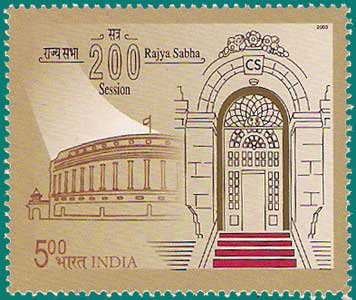
Technical Data
| Date of Issue | December 11, 2003 |
|---|---|
| Denomination | Rs. 5 |
| Quantity | 800,000 |
| Perforation | comb 13½ |
| Printer | Calcutta Security Printers Ltd |
| Printing Process | Wet Offset |
| Watermark | No Watermark |
| Colors | Multicolor |
| Credit (Designed By) | Mr. Suresh Kumar Ms. Nenu Gupta |
| Catalog Codes |
Michel IN 2005 Stamp Number IN 2043 Yvert et Tellier IN 1770 Stanley Gibbons IN 2181 WADP Numbering System - WNS IN062.03 |
| Themes | Anniversaries and Jubilees | Buildings | Government Buildings | Parliaments |
The Upper House of India’s Parliament
Introduction
The Rajya Sabha is the Upper House of the Parliament of India. It plays a vital role in strengthening democracy, ensuring best parliamentary practices, and contributing to nation-building. The House functions under the chairmanship of the Vice-President of India, who serves as its presiding officer.
Historical Background
The concept of a bicameral legislature in India dates back to the Government of India Act 1919, which introduced a two-house central legislature in 1921 consisting of the Council of States and the Legislative Assembly under the Governor-General. Later, under the Government of India Act 1935, the Legislative Assembly was renamed the House of Assembly.
After independence, the Constituent Assembly of India debated the structure of the Indian legislature from 1946 to 1950. It finally decided on a bicameral Parliament consisting of the President, the Rajya Sabha and the Lok Sabha. The Council of States was officially renamed Rajya Sabha in 1954.
Composition and Structure
According to the Constitution of India, the maximum strength of the Rajya Sabha is 250 members, including 12 nominated members appointed by the President for their expertise in fields such as literature, science, art and social service.
Unlike the Lok Sabha, the Rajya Sabha is a permanent body and is never dissolved. However, one-third of its members retire every two years, ensuring continuity in legislative work. Members are elected indirectly by the elected members of State Legislative Assemblies.
Functions and Powers
The Rajya Sabha performs several important functions in the parliamentary system:
Legislative Role:
Its primary responsibility is to participate in the law-making process by debating and passing legislation.
Representational Role:
As a federal chamber, it represents the interests and aspirations of the states within the national Parliament.
Accountability of Government:
Through debates, questions and discussions, it holds the government accountable for its actions and policies.
Judicial Functions:
The Rajya Sabha participates in important constitutional procedures such as the impeachment of the President and removal of judges.
Special Powers:
The House has the authority to allow Parliament to legislate on matters listed under the State List and to create All India Services in the national interest.
However, its role in financial matters is limited because Money Bills can be introduced only in the Lok Sabha.
Role as a Revising Chamber
Rajya Sabha serves as an important revising chamber. It carefully examines legislation passed by the Lok Sabha and often suggests amendments to improve the quality of laws. Many of these amendments have been accepted, making legislation more effective and balanced.
Parliamentary Committees
Committees are an essential part of parliamentary functioning. The Rajya Sabha has a well-organized committee system that connects the Parliament, the Executive and the public.
At present, there are:
- 12 Parliamentary Standing Committees
- 24 Department-Related Parliamentary Standing Committees, out of which 8 are directly under the Rajya Sabha
These committees examine legislation, review government policies, and gather expert opinions before presenting their reports. Their functioning is generally non-partisan and objective.
Parliamentary Sessions
Sessions of Parliament are convened by the President of India, who has the authority to summon and prorogue either or both Houses. Typically, Parliament meets in three sessions each year to conduct legislative and parliamentary business.
Contribution to Indian Democracy
Since its first sitting on 13 May 1952, the Rajya Sabha has played a constructive role in shaping national policies and legislation. Through debates, discussions and parliamentary procedures, it has provided a platform for addressing public concerns and strengthening democratic governance.
Over the years, the House has significantly contributed to maintaining the unity, integrity and federal character of India, reinforcing the faith of citizens in the democratic system.
Commemorative Postage Stamp
To commemorate this historic milestone, India Post issued a commemorative postage stamp marking the 250th Session of the Rajya Sabha, celebrating its long and meaningful contribution to India’s parliamentary democracy.