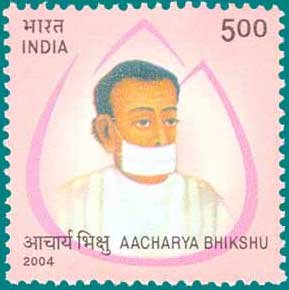
Acharya Bhikshu (1726-1803)
Technical Data
| Date of Issue | June 30, 2004 |
|---|---|
| Denomination | Rs. 5 |
| Quantity | 400,000 |
| Perforation | comb 13 x 13½ |
| Printer | Security Printing Press, Nashik |
| Printing Process | Photogravure |
| Watermark | No Watermark |
| Colors | Multicolor |
| Credit (Designed By) | Smt. Alka Sharma |
| Catalog Codes |
Michel IN 2032 Stamp Number IN 2068 Yvert et Tellier IN 1794 Stanley Gibbons IN 2211 WADP Numbering System - WNS IN018.04 |
| Themes | Famous people | Literary People (Poets and Writers) | Men | Philosophers | Reformers |
Founder of the Terapanth Sect of Jainism
Acharya Bhikshu was a distinguished philosopher, reformer, poet, and spiritual leader who initiated a major reform movement within Jainism. He founded the Terapanth sect of the Svetambara tradition and worked tirelessly to purify religious practices and promote ethical living based on truth, non-violence, and social responsibility.
Background of Religious Reform
Throughout history, many major religions have emerged or undergone transformation during periods of social and religious decline. When rituals, superstition, and rigid traditions overshadow the true purpose of religion—purity of mind and service to humanity—reform movements often arise. Faiths such as Christianity, Islam, Confucianism, Sikhism, Buddhism, and Jainism themselves developed as reactions to ritualistic excesses and social inequalities. Acharya Bhikshu’s movement within Jainism also represented such a reformist response to misinterpretations and distortions of religious principles.
Early Life
Acharya Bhikshu was born in Kantaliya in Pali District, Rajasthan, on the thirteenth day of the waxing moon in the month of Ashad in Vikram Samvat 1783. His parents were Shah Balluji Saklecha and Deepanji.
He was married to Sugannibai from a neighboring village. However, after the untimely deaths of both his father and wife, he chose the path of asceticism and spiritual discipline. He became a disciple of Acharya Raghunathji, under whose guidance he began his religious life.
Founding of the Terapanth Sect
After studying ancient Jain scriptures deeply, Acharya Bhikshu became increasingly dissatisfied with the prevailing religious practices that he believed had deviated from the true teachings of Jain philosophy. Rejecting superstition, blind faith, and conservative orthodoxy, he left the village of Bagadi and travelled to Kelba in the region of Mewar.
There, on 28 June 1760, he formally established the Terapanth religious Sangha, marking the beginning of a reform movement that emphasized discipline, ethical purity, and adherence to the original Jain teachings.
Literary and Philosophical Contributions
Acharya Bhikshu was a prolific writer and composed nearly 38,000 shlokas (verses). His writings have been compiled in the work Bhikshu Granth Ratnakar.
Among his most important philosophical works is Nav Padarth Sadbhav, which elaborates on the nine fundamental principles of Jain philosophy. His writings advocated a society free from exploitation and emphasized moral discipline, compassion, and truth.
Teachings and Social Vision
Acharya Bhikshu’s teachings focused on spiritual transformation and ethical conduct. He emphasized that true religion could not be established merely through fear of punishment or hope of reward, but required a genuine transformation of the human heart.
He strongly advocated:
- Purity of means in achieving spiritual goals
- Compassion toward all living beings
- Opposition to violence and exploitation
- Service to the poor, suffering, and helpless
According to him, acts of compassion and assistance to those in need were not acts of charity but duties and social responsibilities. His philosophy stressed that truth and goodness should guide society regardless of caste, creed, or place of origin.
Legacy and Continuing Influence
Acharya Bhikshu attained eternal bliss in Vikram Samvat 1860 at Siriyari. His teachings, however, continued to inspire generations of followers.
The Terapanth tradition has been carried forward by successive spiritual leaders, including Acharya Mahapragya, who developed the system of meditation known as Preksha Meditation. His concept of Jeevan Vigyan further elaborated the spiritual and psychological benefits of meditation, helping people address stress, addiction, and emotional challenges.
Today, the Terapanth philosophy continues to promote humanitarianism, peace, ethical living, and secular values, reflecting the reformist vision of Acharya Bhikshu.
Commemoration
To honour the life and teachings of this great spiritual reformer, India Post issued a commemorative postage stamp dedicated to Acharya Bhikshu, the founder and first spiritual head of the Svetambar Terapanth sect of Jainism. The stamp pays tribute to a visionary saint whose ideas continue to inspire social harmony and spiritual awakening.
First Day Cover