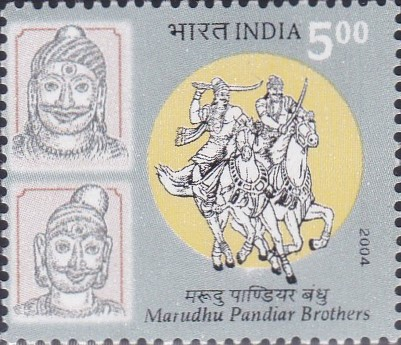
Marudhu Pandiar Brothers
Technical Data
| Date of Issue | October 24, 2004 |
|---|---|
| Denomination | Rs. 5 |
| Quantity | 400,000 |
| Perforation | comb 14 |
| Printer | Security Printing Press, Nashik |
| Printing Process | Photogravure |
| Watermark | No Watermark |
| Colors | Multicolor |
| Credit (Designed By) | |
| Catalog Codes |
Michel IN 2054 Stamp Number IN 2082 Yvert et Tellier IN 1819 Stanley Gibbons IN 2234 WADP Numbering System - WNS IN040.04 |
| Themes | Animals (Fauna) | Equestrianism and horse riding | Famous people | Freedom Fighters | Horses | Kings | Mammals | Men |
Early Freedom Fighters of Tamil Nadu
The Marudhu Pandiar Brothers, popularly known as Periya Marudhu and Chinna Marudhu, occupy a significant place in the history of Tamil Nadu. They led a powerful rebellion against British rule in 1800–1801, which many historians consider one of the earliest organized struggles for India’s independence.
Early Life and Background
Periya Marudhu was born in 1748, while his younger brother Chinna Marudhu was born in 1753. They were the sons of Udaiyar Servai and Ponnathal.
Their father served as a general in the army of the Raja of Ramnad, and under his guidance the brothers were trained in various martial arts and warfare skills from an early age. Their bravery and exceptional fighting ability earned them the honorary title “Pandian” from the ruler of Ramnad.
Service in the Sivaganga Kingdom
Later, the brothers accepted an invitation from the ruler of Sivaganga and joined his army as military commanders.
In 1772, Sivaganga faced an attack from a powerful British force. Although the Marudhu brothers fought bravely, the king was killed during the battle. After this tragedy, the brothers pledged their loyalty to Velu Nachiyar, the widowed queen of Sivaganga.
They protected the queen and helped her administer the kingdom. Eventually, Queen Velu Nachiyar entrusted the governance of Sivaganga entirely to the Marudhu brothers. They ruled the region from 1780 to 1801.
Administration and Social Harmony
The rule of the Marudhu Pandiar brothers was known for its secular outlook and social harmony. They worked for the welfare of the people by:
- Creating employment opportunities for the poor
- Encouraging religious tolerance
- Supporting the construction of temples and places of worship for different faiths
Their governance strengthened the unity and prosperity of the Sivaganga region.
The South Indian Rebellion Against the British
Chinna Marudhu, the younger brother, was an exceptional political strategist. He worked tirelessly to build alliances with regional leaders across southern India, particularly from Thanjavur to Tirunelveli.
With the support of local rulers and resistance groups, the brothers organized a large uprising against the British East India Company.
On 16 June 1801, Chinna Marudhu issued the famous “Rebel Proclamation” at Tiruchirappalli and Srirangam. This historic proclamation called upon people from all communities to unite and fight against British rule.
Capture and Martyrdom
Under the leadership of the Marudhu brothers, several battles were fought against the British. However, in 1801, British forces eventually captured them.
On 24 October 1801, Periya Marudhu and Chinna Marudhu were executed by hanging at Tiruppattur, along with many of their relatives and supporters.
Their sacrifice made them enduring symbols of resistance and patriotism in South India.
Commemorative Postage Stamp
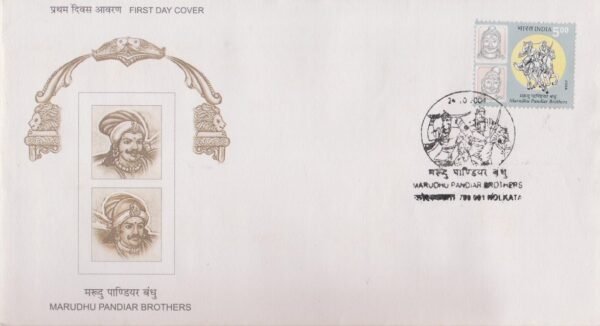
To honour their courage and contribution to the early freedom struggle, India Post issued a commemorative postage stamp dedicated to the Marudhu Pandiar Brothers, ensuring that their legacy as pioneers of India’s resistance against colonial rule continues to inspire future generations.
First Day Cover