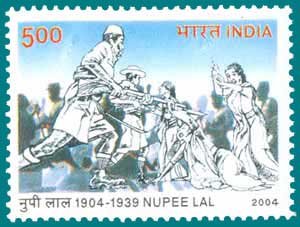
Nupee Lal Protest Movement
Technical Data
| Date of Issue | December 12, 2004 |
|---|---|
| Denomination | Rs. 5 |
| Quantity | 800,000 |
| Perforation | comb 13½ |
| Printer | Security Printing Press, Nashik |
| Printing Process | Photogravure |
| Watermark | No Watermark |
| Colors | Multicolor |
| Credit (Designed By) | Mr. Suresh Kumar Smt. Alka Sharma |
| Catalog Codes |
Michel IN 2065 Stamp Number IN 2091 Yvert et Tellier IN 1828 Stanley Gibbons IN 2246 WADP Numbering System - WNS IN051.04 |
| Themes | Anniversaries and Jubilees | Sculptures |
A Historic Women’s Movement in Manipur
The Nupee Lal, also known as the Women’s Agitation of 1939, represents one of the most significant chapters in the modern history of Manipur. During this remarkable movement, thousands of Manipuri women united to protest against the policies of the British Raj and the administration of the Manipur State Darbar under the Maharaja.
Background of the Movement
The roots of the agitation can be traced back to November 1938, when about 356 citizens submitted a petition to Maharaja Churachand Singh, urging him to establish a Legislative Council and appoint members of the Darbar from among the elected representatives.
However, political dissatisfaction deepened in 1939 when the price of rice in the state suddenly increased even during the harvest season. This sharp rise in prices was widely believed to be a man-made crisis, largely caused by foreign traders who monopolized the rice trade in the region.
The Women’s Protest
In response to the growing hardship, women of Manipur took to the streets in protest. The movement soon transformed into a powerful agitation against:
- The monopoly of foreign traders in the rice trade
- The export of rice from Manipur during a food shortage
- The policies of the British colonial administration
- The support extended to traders by the ruling authorities
The agitation began in December 1939 and continued until June 1940, becoming a major symbol of women’s political activism in the region.
The Demonstration of 12 December 1939
A crucial moment in the movement occurred on 12 December 1939, when hundreds of women gathered before the state office demanding that the President of the Darbar immediately prohibit the export of rice.
The President stated that such a decision required approval from the Maharaja, who was then in Nabadwip. Accompanied by the women protesters, he went to the telegraph office to send a message to the Maharaja.
While waiting for a reply, the demonstrators remained there. Soon after, a detachment of the Assam Rifles intervened and dispersed the gathering. During the operation, several women were injured by bayonets and many were arrested.
Impact and Reforms
The Nupee Lal agitation had a lasting impact on the political structure of Manipur. The movement led to several important reforms, including:
- The stoppage of rice exports from Manipur
- Closure of rice mills operating in the state
- Establishment of a Chief Court in Manipur
- Formation of a Legislative Council in 1946–47 in place of the Darbar
- Enactment of the Manipur State Constitution Act and Manipur State Election Act
- Establishment of the Manipur Legislative Assembly in 1948–49
These developments marked an important step toward democratic governance in the state.
Legacy
The courage and unity displayed by Manipuri women during the agitation made the Nupee Lal a landmark event in India’s history of popular movements. The event is commemorated every year on 12 December as Nupee Lal Day, which is observed as a state holiday in Manipur.
To honour this historic movement and the bravery of the women who led it, India Post issued a commemorative postage stamp celebrating the legacy of Nupee Lal and its enduring contribution to the struggle for justice and reform.
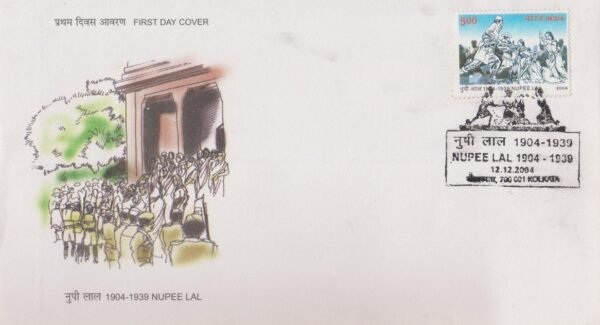
First Day Cover