
World Summit on the Information Society
Technical Data
| Date of Issue | November 17, 2005 |
|---|---|
| Denomination | Rs. 5 |
| Quantity | 600,000 |
| Perforation | comb 13¼ |
| Printer | Security Printing Press, Nashik |
| Watermark | No Watermark |
| Colors | Multicolor |
| Catalog Codes |
Michel IN 2110 Stamp Number IN 2125 Yvert et Tellier IN 1875 Stanley Gibbons IN 2295 WADP Numbering System - WNS IN042.05 |
| Themes | Conferences | Globes |
Introduction
The digital revolution in information and communication technologies has created a global platform for the free flow of information, ideas, and knowledge. This transformation has significantly influenced how societies function, benefiting both developed and developing nations. While it serves as an essential business and social tool in developed countries, it also enables developing nations to participate more equitably in global economic, social, and educational development.
World Summit on the Information Society
The World Summit on the Information Society (WSIS) is a formal summit organized under the auspices of the United Nations at the level of Heads of State and Government. The initiative for the summit was launched by the International Telecommunication Union and was endorsed by the United Nations General Assembly through Resolution 56/183 in 2001.
The main objective of WSIS is to develop a shared vision of a global information society and to prepare a strategic plan of action for achieving that vision. The summit also aims to ensure that the benefits of information and communication technologies (ICTs) are accessible to everyone across the world.
Objectives and Areas of Focus
The summit promotes the use of digital technologies to advance several areas of development. These include:
- E-strategies and digital governance
- E-commerce and economic growth
- E-health and healthcare accessibility
- Education and literacy
- Cultural diversity and gender equality
- Sustainable development and environmental protection
By focusing on these areas, the summit seeks to create an inclusive information society that benefits all sections of humanity.
The Geneva Phase (2003)
The WSIS process was divided into two phases. The first phase was held in Geneva from 10 to 12 December 2003. During this meeting, world leaders agreed upon a Declaration of Principles and a comprehensive Plan of Action.
The Declaration presented a vision for the use of ICTs to build a people-centred, inclusive, and development-oriented information society. It emphasized the goal of enabling individuals, communities, and nations to create, access, share, and utilize information and knowledge to improve their quality of life and support sustainable development, in accordance with the principles of the United Nations Charter and the Universal Declaration of Human Rights.
The Road to Tunis (2005)
The second phase of the summit was scheduled to take place in Tunis from 16 to 18 November 2005. Leading up to this event, international efforts focused on monitoring progress and implementing the Geneva Plan of Action.
Working groups were established to address important issues such as Internet governance and financing mechanisms, ensuring that the goals of the information society could be realized effectively.
Other Major United Nations Summits
Over the years, the United Nations has organized several major global summits addressing key international challenges. These include the World Summit for Children, the Earth Summit, the World Conference on Human Rights, the International Conference on Population and Development, the World Summit for Social Development, the Fourth World Conference on Women, and the International Conference on Financing for Development.
Another landmark gathering was the Millennium Summit held in New York, where world leaders pledged to work collectively toward major development goals by 2015.
Vision of an Inclusive Information Society
The ultimate aim of the World Summit on the Information Society is to support the United Nations in fulfilling the goals of the Millennium Declaration and to create an inclusive and equitable global information society. By harnessing the power of digital technologies, the world can expand the concept of a “global village” and promote the free exchange of knowledge and information for economic and social progress.
Commemorative Postage Stamp
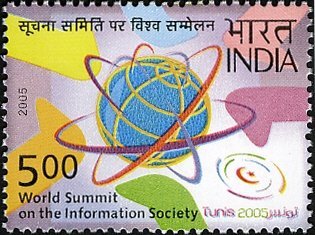
To commemorate this significant global initiative, India Post issued a postage stamp marking the World Summit on the Information Society held in Tunis in 2005. The stamp celebrates the global commitment to building a connected and inclusive information society.
Leave a Comment
You must be logged in to post a comment.