
Rashtrapati Bhavan
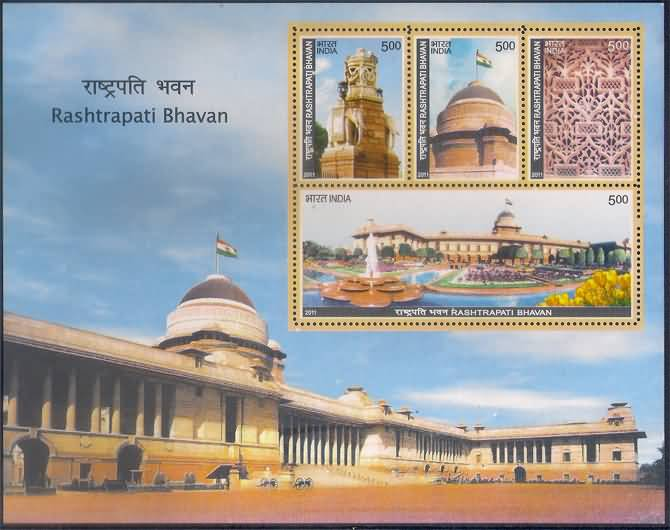
Technical Data
| Date of Issue | August 5, 2011 |
|---|---|
| Denomination | Rs. 20 |
| Quantity | 300,000 |
| Perforation | 13 |
| Printer | India Security Press, Nashik |
| Printing Process | Wet Offset |
| Watermark | No Watermark |
| Colors | Multicolor |
| Credit (Designed By) | Sh. Sankha Samanta |
| Catalog Codes |
Michel IN BL97 Stamp Number IN 2535a Stanley Gibbons IN MS2828 |
| Themes | Architecture | Elephants | Flags | Fountains | Gardens | Government Buildings | Statues | Townscapes/ City Views |
Stamps in this Miniature Sheet
From Imperial Palace to Democratic Symbol
The Rashtrapati Bhavan, formerly known as the Viceregal Lodge or Viceroy’s House, was conceived in 1911, following the Delhi Durbar, under Lord Hardinge, the then Viceroy and Governor General of India. Designed to reflect the power and authority of the British Empire, the building was entrusted to Sir Edwin Landseer Lutyens, an architect of rare originality, with Herbert Baker providing valuable assistance.
Construction began in 1913 and was completed in 1929. The building was formally commissioned in 1931, with Lord Irwin becoming its first occupant. Over time, this grand imperial structure transformed into the office-cum-residence of the President of India, emerging as a living symbol of the Republic of India and the world’s largest democracy.
Grand Entrance and Processional Approach
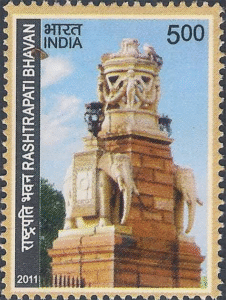
The entrance to Rashtrapati Bhavan is guarded by an exquisitely designed wrought iron grille, flanked by stone piers that support pairs of sandstone elephants and stone lanterns. Stone aedicules provide shade to the guards, enhancing both functionality and aesthetics.
The Processional Way leading to the majestic forecourt features the iconic Jaipur Column, rising 145 feet from base to the tip of its six-pointed glass star. Supported by a steel tube within the shaft, the column was funded by the Maharaja of Jaipur. Inscribed at its base are Lutyens’ words:
“Endow your thoughts with faith, your deeds with courage, your life with sacrifice so all men may know the greatness of India.”
Architectural Grandeur and Central Portico
The Central Portico, forming the main façade, is approached by thirty-one imposing steps and supported by twenty stately columns. At its centre stands the historic Rampurva Bull Capital from the Asokan period, placed prominently before the entrance to the Durbar Hall. The central colonnade is flanked by twelve shorter pillars set at a higher level. The two wings on either side currently house the Cabinet Secretariat and the President’s Secretariat.
Durbar Hall and Historic Moments
Passing through the massive teak doors, visitors are greeted by the magnificently illuminated Durbar Hall, situated beneath a grand dome from which a spectacular chandelier is suspended. The hall houses a statue of Gautam Buddha from the Gupta period. Twin staircases of ash-grey marble lead into the hall, where historic ceremonies such as the swearing-in of Shri C. Rajagopalachari as Governor General and Pandit Jawaharlal Nehru as independent India’s first Prime Minister took place.
Courtyards and Stairways
At the upper ground level lie the North Court and South Court, connected by carriage subways with wooden flooring. The South Court is distinguished by polished bronze cobras spouting water atop octagonal red sandstone pillars, designed with chevron patterns resembling snake skin.
The building contains four inner stairways, including the Grand Open Staircase, described as “one of the triumphs of Lutyens’ imagination.” Approaching the Ashoka Hall and the State Banquet Hall, it creates an illusion of being indoors until one realises the blue ceiling is the open sky. During ceremonial occasions, the President’s Bodyguard lines these staircases.
Ashoka Hall: Ceremonial Heart of Rashtrapati Bhavan
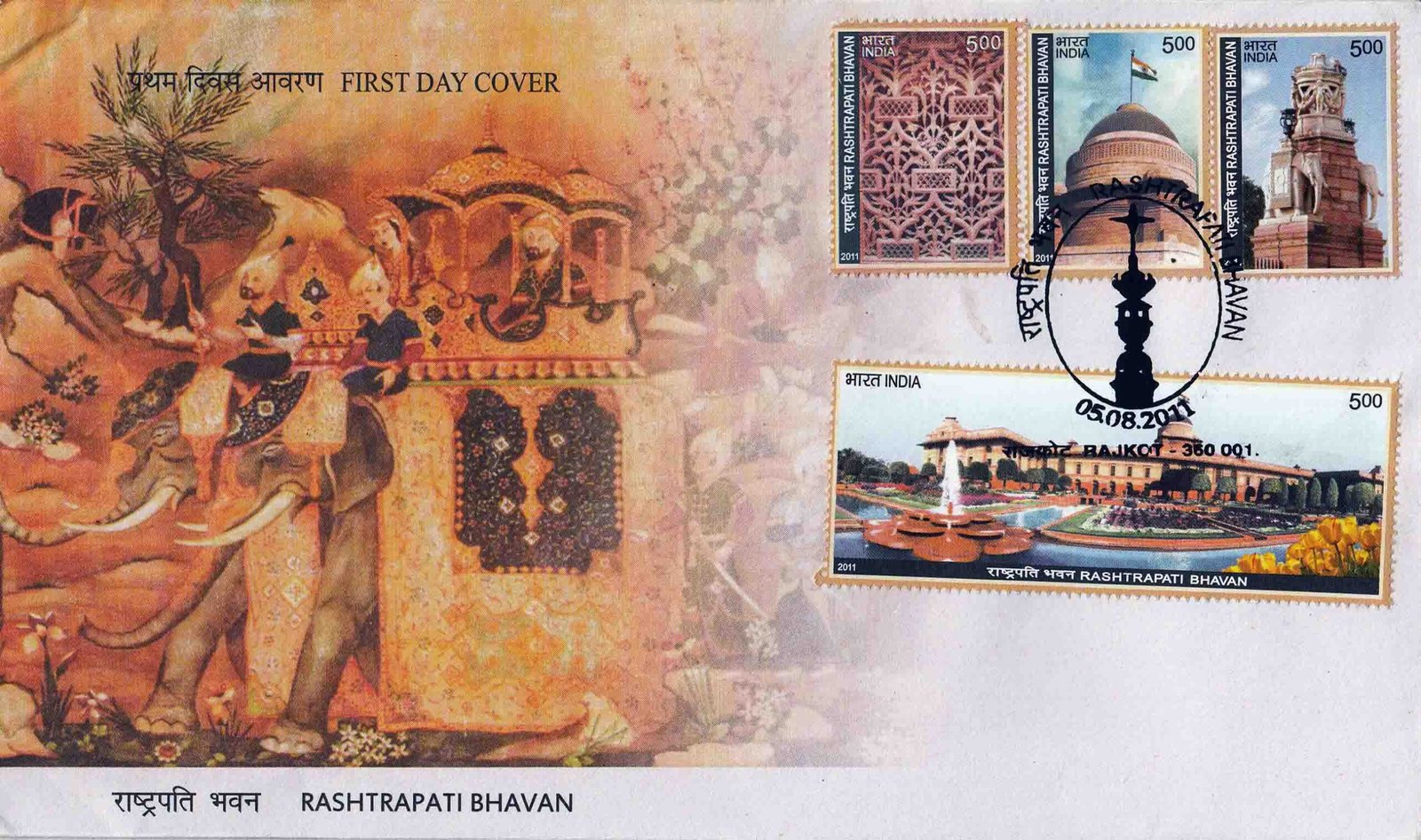
Formerly the State Ballroom, the Ashoka Hall now hosts important ceremonies such as ministerial swearing-ins and civil and defence investitures. The hall features an elaborately painted ceiling by T. Colonello, with a central nine-piece oval canvas surrounding a rectangular Qajar painting. A continuous panel depicting royal processions with lions, camels, horses, bullocks, and carriages adorns the walls, part of which is illustrated on the First Day Cover.
The Dome and Architectural Synthesis
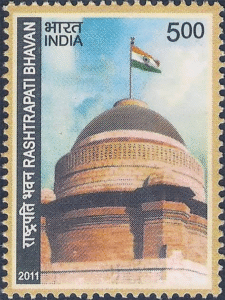
Crowning the structure is the majestic Neo-Buddhist Dome, inspired by the Stupa of Sanchi, over which the National Tricolour proudly flies. Measuring 22.8 metres in diameter, the copper-covered dome has developed a dark patina over time. Encircled by a Buddhist railing and accented by four octagonal kiosks at the corners of its base, the dome exemplifies Lutyens’ mastery of architectural harmony.
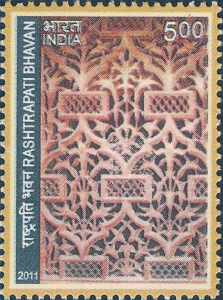
Lutyens skillfully incorporated Mughal jallies, floral reliefs, and motifs inspired by Delhi’s Red Fort, blending them seamlessly with European architectural principles. Indian animal motifs, particularly elephants carved in red sandstone, are prominently featured throughout the complex.
The Mughal Gardens
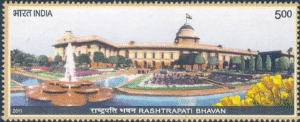
The Mughal Gardens reflect the classical Mughal love for symmetry, water channels, and geometric layouts. Divided into a grid by intersecting water channels, the gardens feature lotus-shaped fountains, rectangular lawns, flowering beds, and shaded trees. The Circular Garden, centred around a round pool surrounded by concentric flower beds, completes the layout. The gardens are at their most spectacular in February and March, when they are opened to the public.
Philatelic Commemoration
As New Delhi celebrates its centenary, Rashtrapati Bhavan marks eighty years of its glorious existence. To commemorate this historic milestone, the Department of Posts has issued a Miniature Sheet consisting of four commemorative postage stamps celebrating 80 years of Rashtrapati Bhavan, the official residence of the President of India, New Delhi.
First Day Cover
Leave a Comment
You must be logged in to post a comment.